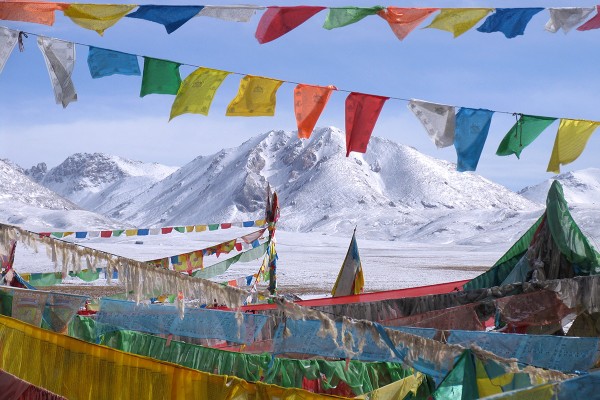
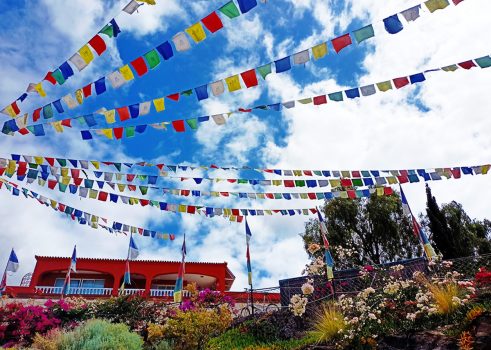
In areas populated by Tibetans, Lungta or prayer flags can be found strung in high places such as the tops of temples, monasteries and houses and along mountain ridges and peaks, and it is believed that the blessings of the prayers and mantras printed on them are blown by the wind to spread benefit to all. Traditionally the lungta are in sets of five colours, green, red, yellow, white, blue, representing the elements, and they can show a ‘wind horse’, various mantras and prayers, and images or names of four powerful animals in each corner.
At the Gars of the Dzogchen Community we prepare strings of coloured lungta before the Tibetan New Year, or Losar, that are then authenticated and hung up around the Gar on the morning of the third day after Losar, according to tradition. The old prayer flags are removed and burnt. If, for example, a person approaches a year that is considered negative for them according to Tibetan elemental astrology, it may be beneficial for them to prepare and put up a string of lungta corresponding in number to their age.
Chögyal Namkhai Norbu gave a brief explanation about the symbols on the Lungta at Merigar West in 1991.
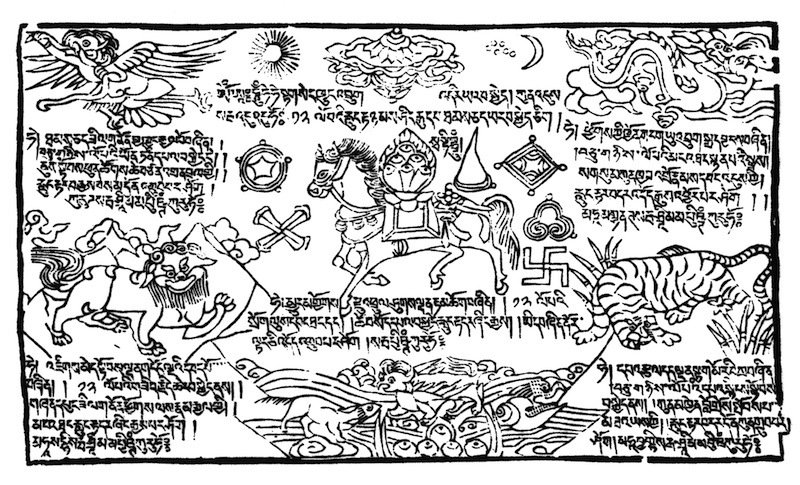
Lungta, which means ‘Wind horse’, refers to the protective force of the individual. There are many types of force linked to the individual but this vital force is the most important. In ancient times in Tibet it was symbolized by a horse surmounted by a wish-fulfilling jewel. This vital force is linked to fulfilling wishes and bringing about good fortune, benefits and prosperity. If the fundamental vital force is perfect, everything will go well.
Why is this force symbolized by a horse adorned with jewels rather than another animal? In ancient times the horse represented impetus, speed. For example, today if we had to have a symbol for speed we would use the image of a missile. But long ago missiles did not exist and on earth speed has always been symbolized by the horse. Moreover, the horse has always been an animal closely linked to man. For these reasons the horse was chosen.
‘Lung’ means air. Some scholars such as Mipham said that lung comes from the Chinese, but this is an interpretation. The truth is that lung is linked to prana because our force is linked to prana. So when we say ‘wind horse’, by wind (or air) we mean our prana, our vital energy. This symbol is represented in the prayer flags which are also called lungta.
At the centre of the flag is the horse, and in the four corners there are the figures of the tiger, the lion, the eagle and the dragon. These four animals, which can be seen on both Buddhist and Bönpo prayer flags, represent the elements according to an ancient system. Nowadays, the Bönpo do not explain these things thoroughly but when we study ancient Bön we can understand that the Bönpo used precisely these animals to represent the elements.
In the Bön tradition, the eagle is the most important figure and represents the fire element. When the Bönpo want to get into contact with the local guardians they do a sang ritual in which they use fire. In Tibetan temples, butter lamps are always used: there are hundreds and thousands of them everywhere. Even if there is electricity, Tibetans still use butter lamps. If it was simply a matter of having light, electricity would be enough, but in this case, we do not only need the light, we also require the presence of fire. When a butter lamp is lit, there is a continual presence of fire.
This is also true in the ancient Bön tradition in which fire and energy, represented by the eagle or Garuda, are very important. In Bön the Garuda is considered to be the source of all divine manifestations and of the local guardians and even today the most important practice in Tibetan medicine to heal illness is that of Garuda. In Tibetan medicine there are hundreds of healing mantra, a large number of which are linked to the mantra of Garuda. Therefore the eagle or Garuda is a very important figure for protection in general.
The dragon is considered to be an aquatic animal. Sometimes it is said that the dragon flies in the sky but his origin, however, is considered to be water and therefore he represents the water element.

The lion is the symbol of the earth element. Why? In Tibet people always talk about the snow lion. We
don’t know if the snow lion actually existed, but on the Tibetan national flag there is a snow lion that is completely white. Where is the snow found? On the highest mountains which are the symbol or the most concentrated essence of the earth element.
The tiger is an animal that lives in the jungle and the forests. A forest is made up of trees and in astrology the air element is represented by wood which in this case is not dry wood but that of living trees. Since trees never stop growing and spreading out, in astrology they represent the air element.
The ancient Bön tradition used animals as symbols of the elements rather than portray them directly. Why? Because animals are alive and live in a particular dimension which is the dimension of the respective element. So to explain that the elements have energy and are alive the Bönpo used the symbols of animals. This was their typical way of representing the elements.
On the prayer flags there are many mantra to reinforce and help energy and to develop the lungta. One can use all sorts of mantra – of Kalachakra, of Tara, of Padmasambhava etc. – but the principle mantra is always accompanied by particular words in order to develop the lungta…
What is important is to receive transmission of them because then, when they are applied, they can have an effect. Therefore when one does the rite of the lungta, authenticates with these mantra and then hangs up the flags somewhere, this can strengthen the person’s vital force.
Excerpted from Chögyal Namkhai Norbu’s ‘The Practice of Lungta’ published by Shang Shung Publications 1995
Read about the history of preparing lungta prayer flags at Merigar