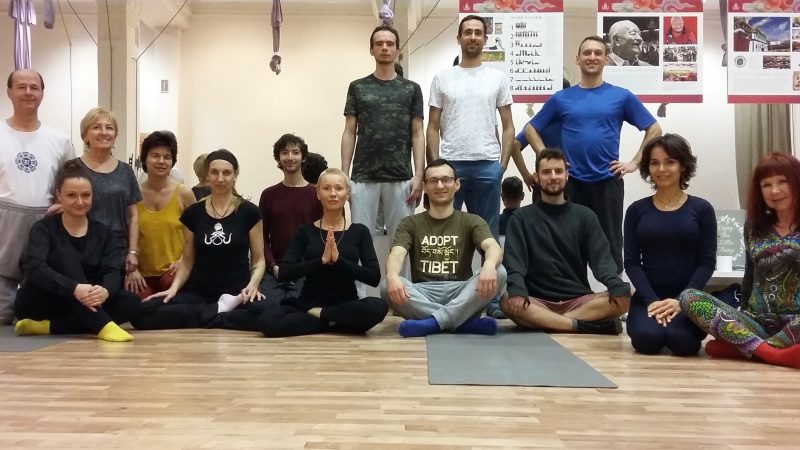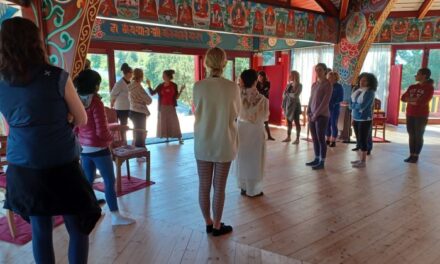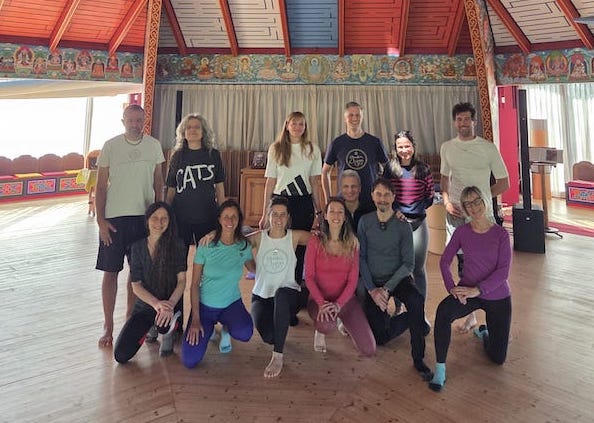
On the morning of Saturday, April 25, the spring sun shyly illuminated Merigar, while a cold but gentle wind blew from the north. Not a single cloud marred the deep blue sky, while, warmed by the lukewarm wooden steps of the Gönpa, teachers and aspiring teachers awaited the start of the course “Didactic Principles and Teaching Methodology for the Practice of Yantra Yoga,” led by Fulvio Grosso, a Yantra Yoga teacher with extensive experience. Fulvio was, in fact, a teacher of Artistic Gymnastics and Biomechanics at ISEF in Rome, and in the 1990s, was appointed as an instructor by the Italian Gymnastics Federation, by other sports federations as well as the CONI School of Sport for teacher training. This experience, gained across artistic and Eastern disciplines, was precisely the key to designing and implementing this course, which focused only to a minor extent on Yantra Yoga itself, concentrating instead on other aspects: from the preparatory phase to relaxation, right through to how to position oneself within a space.
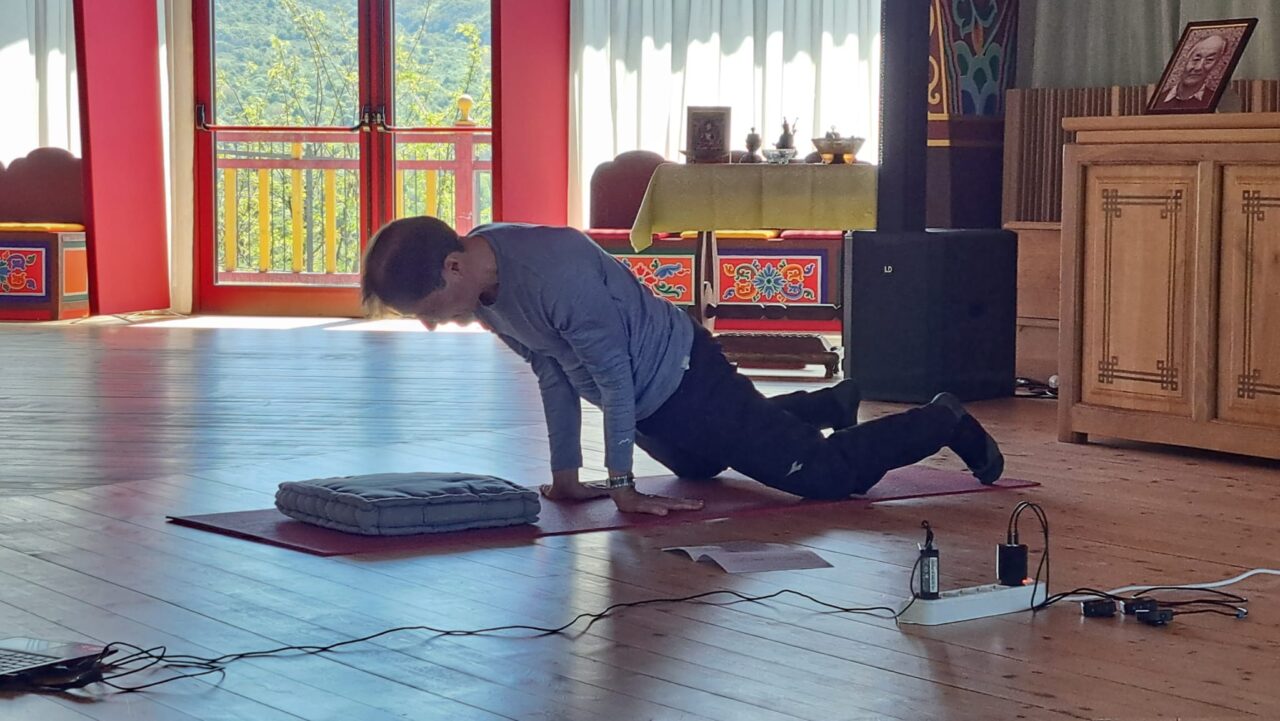
In fact, once we left the warmth of the Gönpa steps, following Fulvio’s instructions, we arranged ourselves in a radial formation. Fulvio then immediately clarified that the course would not focus on breathing – a topic already recently covered by Fabio Andrico and other teachers – but, first and foremost, on the preparatory phase, namely warm-ups, strength development, and stretching. To prepare for the actual practice of Yantra, it is important to first warm up the body in order to reduce the stiffness of tissues and ligaments and lubricate them properly. Raising body temperature brings these benefits, also putting us in a more active state and ready for movement.
Regarding strength development, Fulvio explained the types of muscle contraction before moving on to introduce the correct terminology for the main types of movements our body performs during the preparatory phase and during Yantra. One aspect that emerged during the first session was that strength, although Yantra does not require intense or excessive physical training, must be developed in relation to the types of movements we want to be able to perform; it is important to note, however, that Fulvio also emphasized the importance of cultivating the correct experience of breathing and holding the breath, rather than focusing solely on executing the movement with aesthetic perfection.
The explanation of the different types of stretching was also very useful and interesting: dynamic, active, passive, static, isometric, PNF (Proprioceptive Neuromuscular Facilitation), and so on.
After a break in the cozy dining hall of the Yellow House, with a delicious lunch cooked by Sangeeta, the afternoon continued with the practical session. We went through a series of warm-up exercises, strength-building exercises, and different types of stretching, focusing on when it is best to perform a certain type of exercise (whether before the session or at a separate time).
The following morning, we explored various types of relaxation both theoretically and practically, ranging from the widely used Schultz Autogenic Training to guided visualization, and then in the afternoon we worked together on exercises that can help best prepare for the different Yantras of the five series.
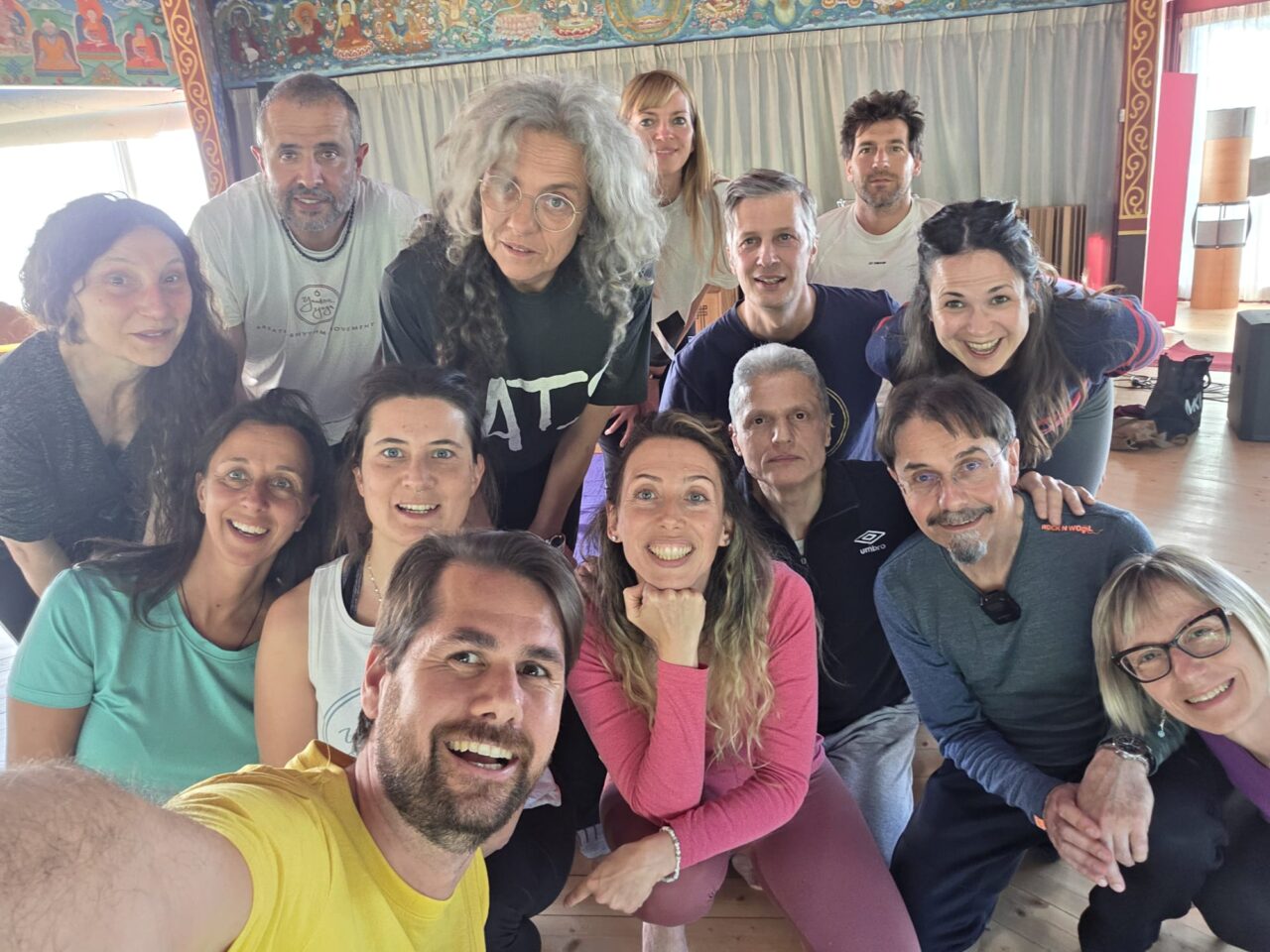
The course, held in a harmonious and friendly atmosphere and guided by Fulvio Grosso’s expert and welcoming leadership, undoubtedly achieved its goal, providing many useful tools for teachers and aspiring teachers alike. In addition to the course itself, written and video teaching materials were provided, which were essential for reinforcing and cultivating the knowledge gained.
We hope that courses of this kind can be held regularly at Merigar and elsewhere, ideally on a systematic basis, and that they can range from topics already covered to others not yet explored, drawing on the knowledge of the many teachers and practitioners in the Dzogchen Community who, in addition to being experts in the practice of Yantra Yoga, bring with them valuable professional expertise that can only enrich the teaching methods of our instructors.
Matteo Maglietti