Dynamic Space of the Elements is a network without borders open to everyone where people can bring their ideas, interests, talents and energy to a myriad of projects linked to culture, tourism, diversity and environmental care. With its base in Bagnore, close to Merigar West, Dynamic Space was founded and is guided by Migmar Tsering and has been involved in artistic and cultural projects in the Dzogchen Community around the world. The Mirror recently interviewed Migmar about the initiatives that Dynamic Space of the Elements are currently working on.
The Mirror: Migmar, we understand that you have been working on a new book. Could you give us a little information about it?
Migmar: I’ve just finished working on a book on the first level of sached or Tibetan geomancy. There is a great deal of material as well as many illustrations on sached but to put it all in a single volume would have made an enormous book. For this reason, the current book is on the first level. In the future we will be publishing books on the second and third level.
The second level book will describe how to make objects to overcome obstacles with rituals and various objects while the third level will contain more practices.
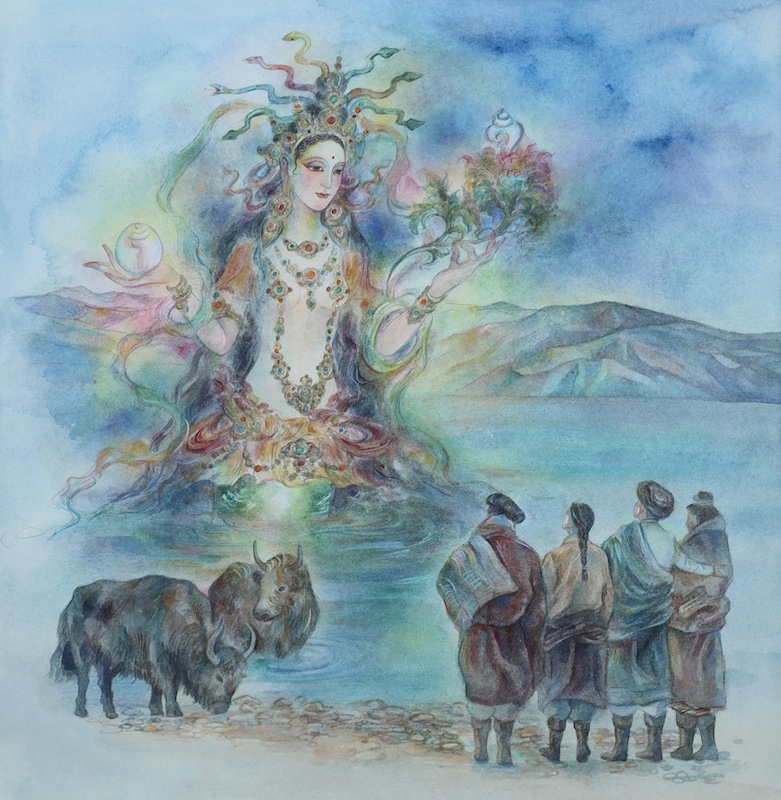
Painting of the Nagini, the origin of Tibetan geomancy, by Dynamic Space. Description at the end of the interview.
The Mirror: Looking through the first level book I see that there are many beautiful illustrations with houses so this book deals mainly with aspects of sached that are related to the house.
Migmar: Yes, this first volume describes the three ways we can make an analysis of the general situation: the first is related to the form, the second is personal astrological elements while the third is related to the shape of objects surrounding the house, such as mountains, hills, trees, and how their shape may be similar to an object, such as a vajra or a bell or similar to a living being such as a dog or a mouse and so on. The book describes 360 ways to make this analysis (of the sached of the house).
For instance, if a person is considering building a new house, he or she should check the land. If one already has a house, one should check the objects surrounding the house. If an element is found that may be negative for the house, one needs to find a solution for overcoming this. On the other hand if one finds positive elements in the sached, it is important to take advantage of them and receive some benefit.
For example, if the shape of the land or the objects surrounding the house are considered negative, when a person’s energy is low this may have a harmful effect and for this reason, in ancient times, people gave a lot of importance to sached.
Sached is not only useful for the living but also for those who have passed away. When a person passes away calculations have to be made to discover where the ashes should be laid or where the person should be buried. This, however, is taken into consideration in the second level book which we plan to publish in about a year. The first level book we plan to have in print by May of this year.
In fact we are putting together a course on sached, Tibetan geomancy, so that whoever is interested can follow the course, take the exam and become a geomancer (sa khyen). We plan to start these courses next year and to become a professional geomancer a person will need to pass three levels.
The Mirror: Another project of the Dynamic Space of the Elements that we have been following is the creation and placement of the 108 Stupas from the terma of Changchub Dorje. Could you update us on this important project?
Migmar: Up to now we have been able to create, fill with relics and precious substances, authenticate and set up 16 of these stupas in different places. In June 2026, another 16 stupas will arrive at our headquarters, four of which already have homes waiting for them in Australia, Argentina and so on. We hope to be able to place one in Russia and another in Crimea.
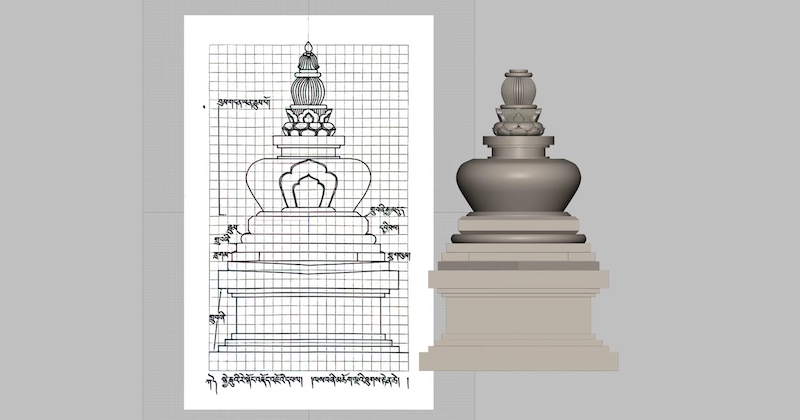
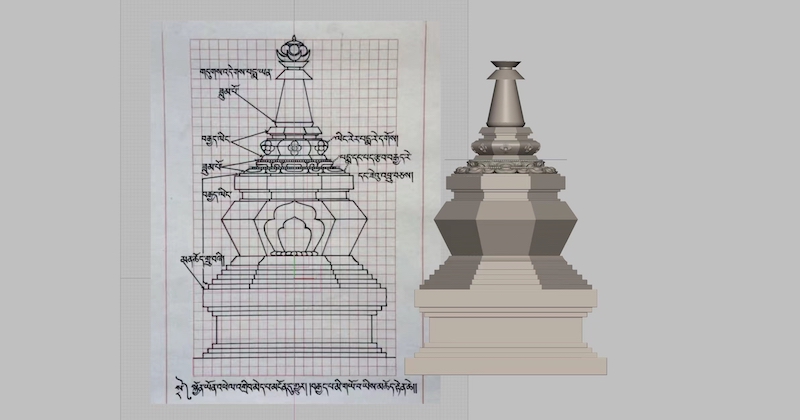
In Changchub Dorje’s terma, each stupa is different and many of the forms that he envisioned exist in no place on earth. When we started this project, we sent designs of the most simple stupas to the workshop in Chengdu so that they could study and learn how to make them. Now that the workshop has become more skilled in the work, the designs that we send are those of more intricate and detailed stupas, such as the Garuda Stupa, the Vajrakilaya Stupa and the Dorje Drolo Stupa.
The most difficult and time-consuming work for us is filling them. Although the stupas are small, inside there are a great number of mantra rolls which take us a lot of time to do. Then we have to prepare an enormous quantity of pills containing relics including cypress or earth that Rinpoche collected from many sacred places when he visited them. We are also preparing many sogshin (tree of life) or central axis for the stupas as well as lotuses to place at their base and all of this takes us time.
I will be visiting Maratika in Nepal shortly and taking a stupa with me to possibly place in a monastery close to the sacred caves. It will be filled and authenticated here in Italy before we travel.
The Mirror: The Dynamic Space team is always very busy. Are there any other projects that you are working on at the moment?
Migmar: This year I started working on a new book related to the course on the five elements in which there are a lot of practices related to the five elements, the significance of the elements, the relationship between them and also all the various systems around the world that deal with the elements. It’s something that I’ve already been working on for three or four years. Some of the material is based on the Drathalgyur and Nyida Khajor tantras, and then the comments according to Tibetan medicine and Chinese medicine.
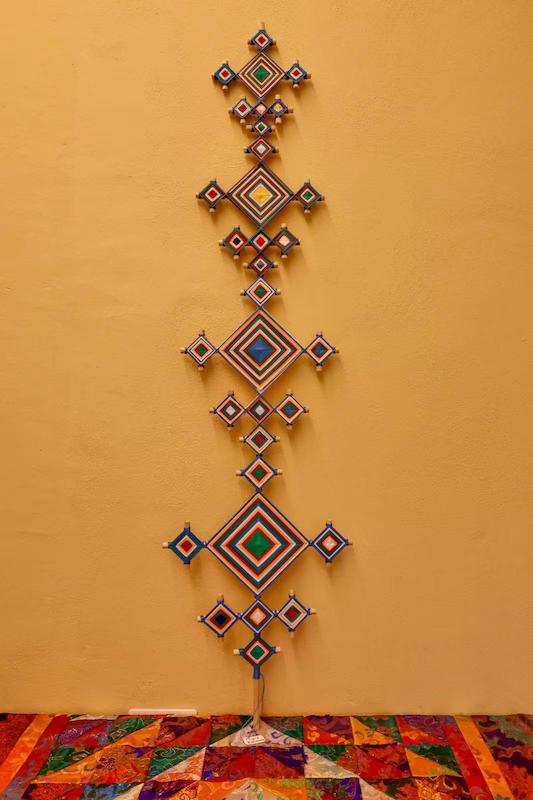
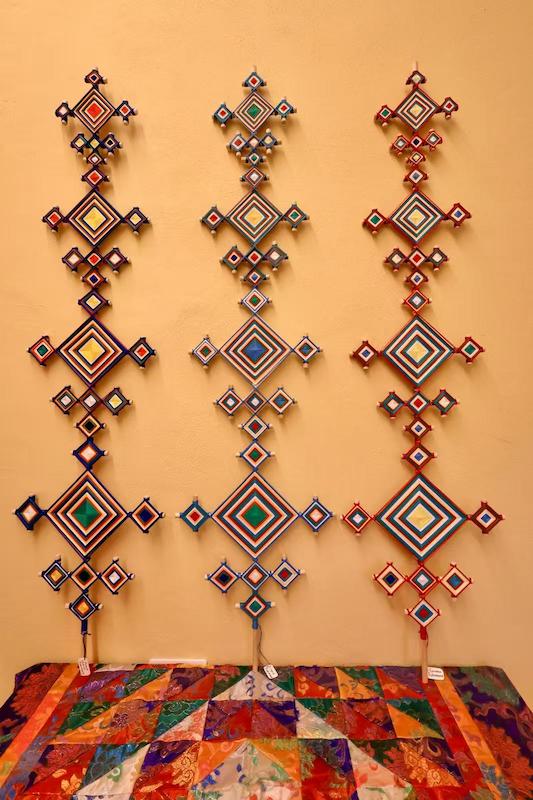
Then fairly recently we did an online course to show how to calculate and make a larger and longer namkha consisting of four namkhas in decreasing size, one above the other – the lower larger one representing the year, the slightly smaller one directly above it representing the month, then the namkha of the day and finally, at the top, the hour. The one we have here is particularly big but a more manageable size would be a total height of 108 cm. In the Master’s book of the namkha all the elements are listed for the month, day and hour so we took our calculations from there. Some people have already asked us to prepare these larger namkhas and we have sent out several.
In the future we would like to make namkhas for couples, uniting in a particular way the two sogshin connecting the capacity and fortune elements.
The Mirror: This namkha is quite amazing! Thank you, Migmar, for sharing all the latest activities with our readers. We wish you and your team all the best in the new year!
Description of the image of the Nagini: “According to Tibetan tradition, the origins of geomancy (sa pyad) are traced to the Four Great Geomancers of Tibet: Khyung Göd Namkha Ling, Ma Chig Palgyi Dorje, Sidpa Trulgyi Mi’u Thung, and Chongro Mi Zhar. It is said that these masters received their knowledge from a nāginī, Ma Pham Yutso, at the shores of a sacred lake.
Following her instructions, the geomancers brought sand according to their capacity. The nāginī gathered and arranged it into symbolic formations, revealing the principles for reading the land. From this transmission came the system of 360 geomantic formations, which form the foundation of Tibetan geomantic knowledge, later preserved in texts such as the Precious Garland of Geomancy.
These teachings describe how to observe the landscape through three aspects: the physical substance and qualities of the earth, the symbolic forms that land shapes may resemble—such as ritual objects, animals, or divine figures—and the energetic and elemental relationships between land formations and living beings. Together, they express the Tibetan understanding of landscape as a living field of form, symbol, and energy.”
You can also read this article in:
 Italian