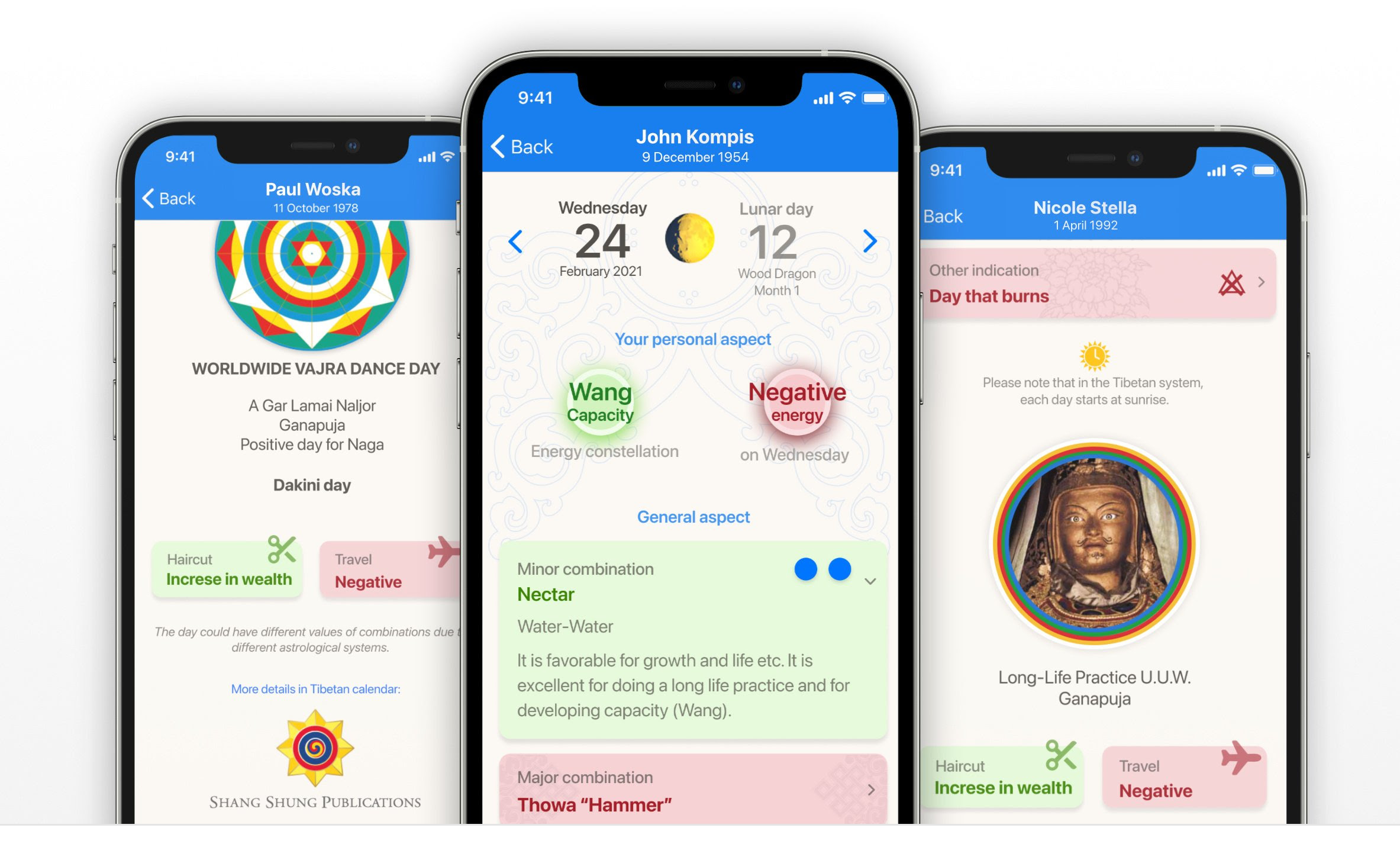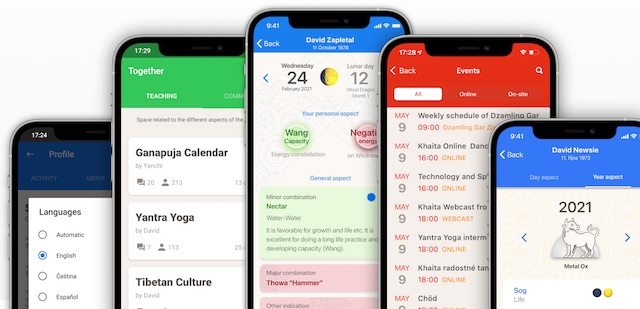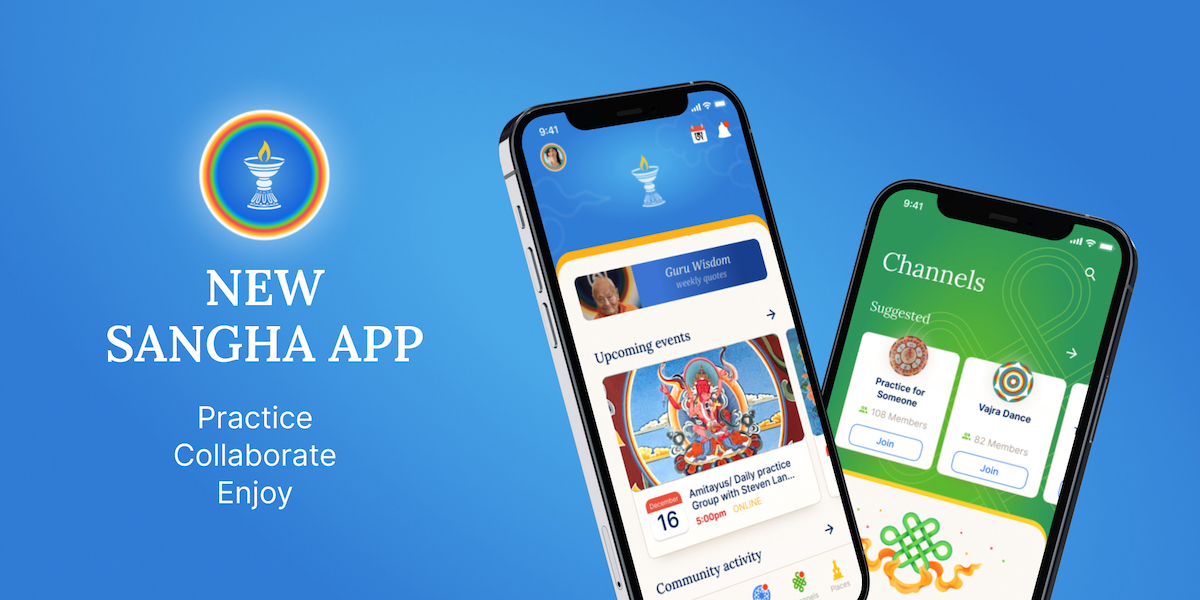
This year, Losar celebrations fall on February 18, 2026. The dates in the Sangha App Calendar are based on the printed version of the “Merigar” calendar, which is prepared and published annually by Shang Shung Publications.
There are several systems of calculating Losar, for example: the Phugpa system (the official standard in Tibet), the Jungtsi system (the astrology of the elements), or the Tsurphu system (used in the Karma Kagyu lineage).
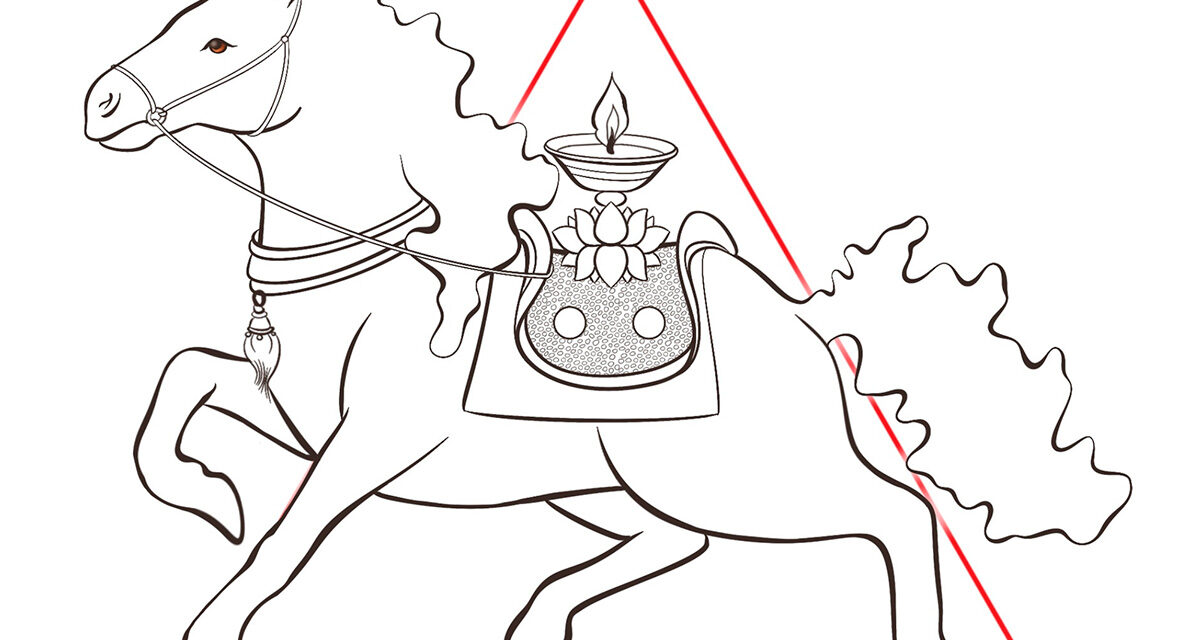
According to the Phugpa system, the year begins on the 1st day of the month of the DRAGON, marked as the FIRST month in the calendar, so the Year of the Fire Horse begins on February 18, 2026. But according to the Jungtsi system, the year begins on the 1st day of the month of the TIGER, so the Year of the Fire Horse began last year on December 20, 2025. According to the Tsurphu system, which often coincides with the Chinese New Year, the celebration of the Year of the Fire Horse falls on February 17, 2026.
Since the overlap between these systems’ calculations of the beginning of the year covers the months of December-January-February, people born during this period may have two different signs, and sometimes even different elements. This can be confusing.
The “Merigar“ calendar is compiled based on information from the Men-Tsee-Khang Almanac of Dharamsala, where the calculation of the beginning of Losar is primarily governed by the Phugpa system. It is calculated based on the Kalachakra tantra. The beginnings of Losar according to the Phugpa system are listed in the table at the end of the printed version of the calendar. The information in the “Merigar” calendar is additionally coordinated and integrated according to the instructions of Master Chögyal Namkhai Norbu.
According to the Jungtsi system, the year begins on the 1st day of the month of the Tiger, marked in the calendar as the ELEVENTH month. This beginning of the year is considered the astrological start of the year (the winter solstice, the month of the tiger, the beginning of spring).
According to the Tsurphu system, the beginning of the year is also considered to be the first day of the month of the Tiger, but it is referred to as the FIRST month. The table of the beginnings of the year according to Tsurphu can be found in Key for Consulting Tibetan Calendar (pages 44-47).
Let’s take the example of people born in 1973.
Losar according to the Phugpa system was March 5, 1973, when the Year of the Water Ox began. Losar according to the Jungtsi system was December 22, 1973, when the Year of the Wood Tiger began. According to the Tsurphu system, Losar began the Year of the Water Ox on February 3, 1973.
| Date | Phugpa | Jungtsi | Tsurphu |
| Jan. 1 – Feb. 2, 1973 | Water Mouse | Water Ox | Water Mouse |
| Feb. 3 – Mar. 4, 1973 | Water Mouse | Water Ox | Water Ox |
| Mar. 5 – Dec. 21, 1973 | Water Ox | Water Ox | Water Ox |
| Dec. 22 – Dec. 31, 1973 | Water Ox | Wooden Tiger | Water Ox |
One Western year, three astrological systems, and three signs.
Am I a Water Mouse or a Water Ox?
Am I a Water Ox or a Wooden Tiger?
These people may have doubts about which system to use to make their namkha. Or which protective mantras from the book “The Four Methods of Development” they should wear.
In a personal communication from 2011, Rinpoche indicated that we should wind namkha and wear protective mantras in accordance with the Tsurphu system, from the book Key for Consulting Tibetan Calendar (pages 44-47).
In the new Namkha book (2021, page 39-41), Rinpoche changed this indication to the Phugpa system, thus reducing the variations due to the different calendars.
In conclusion, we should follow Rinpoche’s most recent recommendations and use the Phugpa system for winding namkha, the same that is featured in Sangha App Alendar.
Happy Losar and Tashi Deleg!
Note
A previous version of this article indicated the Tsurphu system as a source for namkha weaving, citing private communication and publications up to 2021. However, upon consulting with Adriano Clemente and Migmar Tsering, we updated the information according to the more recent source, published in 2021. The latter indicates that namkha should be prepared following the Phugpa system. We apologize for any inconvenience that might have stemmed from the earlier version of this article.
Support Sangha App
Sangha App is a project run by a non-profit organisation, at the service of the Teachings and the Community. Our main current activities include the app maintenance and fixing bugs, developing new features according to practitioners’ needs and circulating information and knowledge within the community.
If you find it useful, you can support us! We accept donations here.
You can also get involved by:
- Helping us compile the monthly schedule of courses
- Keeping a discussion channel alive by stimulating conversation or sharing materials
- Volunteering with your local Gakyil – inserting local activities in Sangha App
Get in touch with us by writing us an email.
The aim is to keep the app free of charge and continue its development as a reliable tool which we all can benefit from and contribute to.
Sources:
Compiled by M. Rita Leti on the basis of the teachings by Chögyal Namkhai Norbu (2014) Key to Consulting the Tibetan Calendar. Shang Shung Publications.
Tibetan Calendar 2026-2027 2153 Year of the Fire Horse. Shang Shung Publications.
Chögyal Namkhai Norbu (2011) The Four Methods of Development. Shang Shung Publications.