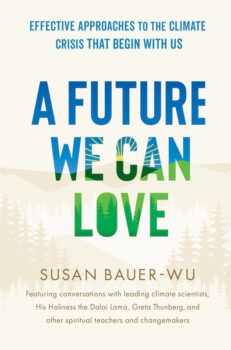
How We Can Reverse the Climate Crisis with the Power of Our Hearts and Minds
Shambala 2023
by Susan Bauer-Wu
Review by Andy Lukianowicz
‘The environment does not need fixing. It is our behavior in relation to it that needs fixing.’ Dalai Lama
‘We are failing, but we have not yet failed.’ Greta Thunberg
This timely book, inspired by the conversation between the Dalai Lama and Greta Thunberg in January 2021, is a wonderful compendium of information from climate scientists, activists and spiritual leaders from all corners of the world to urge readers to embark on a four-part journey, starting from making available knowledge of climate science, to engendering the energy and capacity for change in the direction mankind has been following in the Anthropocene, to recognizing the urgency and will needed for change to avert the extinction of mankind, and the concrete actions we can take.
Susan Bauer-Wu [ably assisted by co-author and editor Stephanie Higgs], who apart from being president of the Mind and Life Institute [an organization co founded with the Dalai Lama in 1987] is an organizational leader, climate scientist and mindfulness teacher, presents this book as a skilful interweaving of conversations with climate scientists, climate activists, and community and some [but not enough?] religious leaders which never descend into resignation, despair or anger at the vicious, cynical, mendacious, hypocritical and corrupt world ‘leaders’ who act gleefully against our future, but instead always seek and find ways to proactively work to defend ‘our home’, as Greta calls it, ‘our only home’, the Dalai Lama chimes in. One extract by the Dalai Lama is pithily titled, ‘when pessimism is not an option’. Systematically and methodically the lies peddled by the fossil-fuel lobbies and their government and media disinformation lackeys are unmasked and deconstructed regarding the extent, depth and catastrophic impact of the business-as-usual model of the Industrial Growth [!sic] Society; we are warned that even idyllic nature films and documentaries are lies co-opted into the great pretence, ‘making us think that nature is fine’.
Joanna Macy calls the life-sustaining society alternative to our collective extinction the Great Turning; others call for an Ecological Revolution; Susan instead opines a less provocative, ‘smaller-scaled’ title, that suggests something within the reach of everybody, and recommends naming it the birth of a new Age of Enough, where everybody can contribute first of all by curtailing and rejecting the seduction of the constant drive for more to satisfy the manufactured ego’s false wants, not needs; but as David Loy succinctly puts it, ‘Why is more better when it is never enough?’ We need instead to find fulfillment in what we have – as taught in the Buddha’s teaching as promulgated by the Dalai Lama. His is perhaps the most powerful voice in the conversation, both with regard to the authority of his statements of the Buddhist teachings and also his grasp of the facts and gravity of the climate situation [regrettably a grasp not shared with a large number of Tibetan dharma teachers, as I found out when doing research for my friend John Stanley’s book on the Buddhist Response to the Climate Emergency; the Zen teachers John contacted, including Joanna Macy, an important voice in this book too, were more up to speed on the climate situation] and his almost telepathic congruence with the message of Greta, two generations his junior.
More specifically, to achieve this we then need to come out of our social and spiritual shell and reach out to inform others of the need to generate the will and knowledge necessary to renounce the false promises of consumerism and commodification spewed by neoliberal ‘capitalism on steroids’. Please note that these words are not mine but are the precise words of Zen Buddhist Roshi and anthropologist Joan Halifax, author of the seminal Shamanic Voices 1979; she describes the effects then goes on to identify the causes of our dilemma; she also breaks down into four stages our moral suffering when confronting the climate crisis: distress, injury, outrage and apathy. It is the outrage we feel that can generate the energy that must be harnessed into moral action. Her interventions are amongst the most no-nonsense and direct in the book, always cutting to the chase.
The book takes the reader step by step through an adroitly devised program that deploys the Buddhist teaching on interdependence to better understand the nature of the climate crisis and the need to take immediate action for its solution; then explains why the scientifically proven feedback loops unleashed by our disastrous and heedless actions leave us no time to wait to take action on an individual and collective level. Individual? Chögyal Namkhai Norbu tirelessly taught that practice and action starts with each one of us, ‘the first number is number one’. Rebecca Solnit helpfully states, reflecting on lines written by Virginia Woolf at the time of the first world war, ‘the unofficial history of the world shows that dedicated individuals and popular movements can shape history’; or Matthieu Ricard: ‘Let’s not underestimate the banality of goodness’. Despair is not an option! Collective? First, strength accumulates by acting, working, and practicing together; second, it is worth reiterating that, contrary to the lies propagated by its lackey spokesmen the fossil-fuel industry is the biggest driver of emissions, it is not individual behavior – remember their gaslighting message ‘things would be ok if people used less water when brushing their teeth’; nor, though I hate to contradict them, is it the fault of cows farting!
Nor is social compliance any longer an option, and the fact that Greta Thunberg is now regularly arrested – at least twice, in the Hague and, I am ashamed to say, in London – shows there are no depths to which our western ‘leaders’ will not stoop to appease the fossil fuel industry and silence its opponents. Moreover a couple of years after the publication of this book the USA, bastion of polluters, promoters of the perversion and perishing of our planet, held an election and chose as their next president… Donald Trump, loud bombastic climate crisis denier, who canvassed proclaiming a platform promise to ‘Drill, baby, drill’!
To reiterate, the book is structured in four parts: knowledge, capacity, will and action, gently but firmly guiding us from considering the disastrous consequences of persisting in the business as usual model of the Industrial Growth Society [translation, wallowing in greed, hatred and ignorance] to preparing the groundwork for the Age of Enough, the only path to survival of human society and civilization [not forgetting the important survival of our closest relatives, the animal realm], helping and encouraging nature to return to what it does best and naturally: greening.
Part One of the book, in two chapters, Science and Spirit, concentrates specifically on recognizing the harm we are doing to ourselves and the planet, acknowledging our responsibility, exacerbated by our unhealthy social mind exacerbated by a socio-economic system dedicated primarily [or exclusively?] to the exploitation of nature and of our fellow humans in less ‘advanced’ [!sic] societies. We are encouraged to look within and discover what, beneath the flim-flam of consumerism, we are doing it for…? The contributors encourage and lead us to take cognizance of the gravity of our self-inflicted situation and as this sinks in, to deal with the arising anger, fear and anxiety and transform these into the energy necessary to struggle for change; some suggest how to develop rituals and practices [some in line with the zer-gna practices taught in the past by Chögyal Namkhai Norbu] to reconnect with our inner nature and with our ‘outer nature’ our home, not a rock hurtling through space as reductively proposed by some ‘scientists’ but the earth as a living being, Gaia [although James Lovelock, author of The Revenge of Gaia 2006 is one loud voice somehow overlooked in this book: his warning, that the earth is acting to rid herself of an unwelcome guest, homo shopiens, to return the planet to the fauna and flora who do her less harm and love her more, is a warning we should heed] and with the gods and goddesses and spirits of nature [that people also know how to contact and invoke as we do through the practices of Tibetan Buddhism and Bon]; and generally rise up to defend our, and more importantly our children’s, and animals’ [the ones we haven’t yet exterminated into extinction] future survival on this planet that our ‘leaders’ are hell-bent [here the word choice is certainly my own] on destroying. Take to heart what the young are saying to the older generation, we who have wreaked this havoc: ‘You will die of old age, we will die of climate changed’ [updated to; ‘if we don’t all die first in the nuclear war you so desperately want to unleash first’]; and how to proactively help, by speaking and acting on behalf of the human and natural communities and environments most immediately in danger of extinction by the actions of ‘civilization’. We have to change our whole education model; the Dalai Lama emphasizes the importance of education, imperative so as not to simply replicate a next generation of homo shopiens, to teach them to become more mindful and conscious and strive to overturn our patriarchal, misogynist, racist [it is Michael Moore’s ‘stupid white men’ who are mainly responsible for this mess] model of society whose wealth is largely based on plunder, pollution, waste and slavery. This fact, in Al Gore’s felicitous phrase, is an ‘uncomfortable truth’, and Joan Halifax’s strong statements confirm that woke is true, real and a fact. We must become stronger morally and through our acuity and discernment take responsibility for our activities to help ourselves and others come to understand, courageously face and together overcome the spiritual crisis challenging modern humanity in order to recover knowledge of the sacredness of humanity and of nature, as detailed in Seyyed Hossein Nasr’s exemplary book Man and Nature 1968.
Susan has woven a remarkable tapestry of quotes from her contributors, one can imagine them sitting around a table each putting in a suggestion or observation adding to and furthering the conversation as needed. Those of Macy, Halifax, Ricard and Loy I have already mentioned, among others there are also Jennifer Odell, and Nobel peace prize winner Wangari Maathai, founder of the Green Belt Movement in Kenya. She recounts a touching story of how ‘a tree of God’, a fig tree by a stream near her home annually replenished life; when she returned home after years at college, the tree was no longer there, replaced by a church. ‘Now I discovered the place of God was in a church.’ And sure enough, the stream had also disappeared.’ Nature mind displaced by concept mind. Literally, this story reminded me of something Chögyal Namkhai Norbu once said, that centers are set up to serve the spread of the teachings, subsequently the teachings serve the spread of centers. Each reader will find their own favorite themes.
The book closes with a plethora of practical, helpful and accessible to-do lists drawn up by several seasoned active contributors. Just as tantric Buddhism offers a multitude of ways and practices as ways to enlightenment, maybe as many in number as there are practitioners, so also one can find in these lists some congruent mode that resonates with your own deepest feelings.
In conclusion, I was struck by a quoted statement by Greta, that in a sense we are all climate crisis deniers unless and until we take cognizance of the impending and accelerating disaster that, unless and until we start to act to avert it, we are all precipitating. So read this book, then get out there and join the fight for the survival of our planet – our home, that we inherited as a palace and are bequeathing to our children having turned it into a toilet; of animals, our neighbors and close friends on this planet, not some inferior species in a perhaps superseded six loka model; and to overcome the beguiling but malignant disease of our degraded and self-destructive Trump-nature [to borrow and update Jeff Wilson’s quip/meme from his marvellous book Buddhism of the Heart] and discover and recover our natural rigpa-Buddhahood, gently giving up and easing out [trekchod] of the rampant, obsessive and destructive individualism of our modern me first culture and relaxing into [thogal] our primordial essence, radiant nature and effulgent compassionate energy resurging as homo SAPIENS, knowers and tasters of our true nature, so that Gaia will welcome us back to our home.

Andy Lukianowicz was born in London, and after receiving teachings and transmissions on nondro and transmissions and initiations on inner practices from the Nyingmapa master Dudjom Rinpoche, moved to Italy to study and practise Dzogchen further with Chögyal Namkhai Norbu Rinpoche, living first in Naples then later in Rome. Fluent in Italian and English, he translated written books but, more importantly and more fruitfully for his practice, aural/oral teachings, principally for Norbu Rinpoche for thirty years, and also for Lopon Tenzin Namdak Rinpoche, Tenzin Wangyal Rinpoche, Khandro Rinpoche, Sakya Trizin, Tai Situpa, Tsoknyi Rinpoche and others, and not least had the privilege to translate for Dalai Lama XIV on his inauguration of the Merigar Gönpa.