Costantino Albini
This talk, on August 17, 2025, was the first in a monthly series of cultural gatherings entitled DZG Talks in which music, culture, and philosophy meet. The talk was broadcast live on the DZG Talks YouTube channel. It has been edited for brevity.
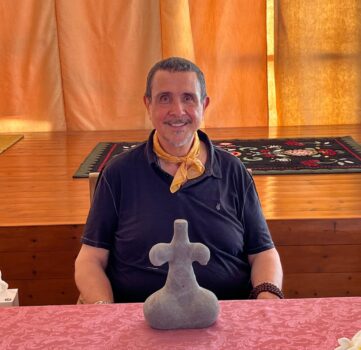
Good morning everybody. I am very happy to be here. A long time ago, in a distant country, a baby boy was born – that was me. I was born exactly nine years after the end of the Second World War in Milano, in Italy, and spent many years of my childhood there.
The world around me was very different from the world that we have now. In Italy there was a strong feeling of coming back to life after the war and reconstruction and industrialization was going on and people were working very hard. A neighborhood in my city had been bombed and they were already reconstructing the whole city after these terrible years of the war.
When I was a child, I was accompanied to school and picked up by somebody in my family but when I was a bit bigger, I just went by myself, by tram or bus. It was quite safe. Back then there were no cell phones and the only media was television and radio. When people wanted to know the news, they would gather in cafes where there was a television, and they would get all the news.
In those days technology was very simple. If I had an emergency and couldn’t come back early from school, I had to look for a token to use the public telephone to call my mom and let her know otherwise she would get worried and be very angry with me when I came home.
When I was born, the population of the planet was 2,685 billion. Now, in 2025, the population is 8 billion, 231 million, almost quadrupling. In the lifespan of a man, the population of the planet is four times more which is quite dramatic.
Now when we look around us at what is happening there are so many wars, so much aggression, so much dissatisfaction. People are very strongly turning against each other. And then at the social level there is more and more difference between the very poor and the extremely rich. From the point of view of nature scientists say that there are thousands of species of animals and plants that have become extinct in this century for many different reasons. Also for us at this moment, there is a kind of veil of mystery about what we are eating, what we are drinking, what we are breathing. We don’t know how much microplastic is in our tissues, in our brains, how much poison from pesticides in our food and how many chemicals are coming into our system through all the objects that we use every day.
Life is not so easy at the moment. We receive information but we don’t know if it’s true or fake. We don’t know how many falsehoods, fabrications and deceit are given to our minds through the media. How can we know from the news that something happening in another country is true or not? It’s very difficult for us because we are bombarded with information all the time. So on the mental level, there is a strong pollution.
And we ourselves have been changing through all the decades that we’ve been exposed to this. For instance, the rate of infertility has been growing especially in more developed countries, scientists say in a large part caused by the different types of pollution that we inhale, eat and drink through the years.
We are also changing because our body is trying to adapt in order to survive in the poisonous environment in which we are living, that we have built around ourselves. We are sometimes at a loss to find the meaning of all this which can bring some mental problems and disturbances to us.
Since the pandemic, I have been studying Western astrology and learned some amazing things. For example, we are presently living in a phase that, from an astrological viewpoint, there is a monumental change going on. Some planets, particularly the so-called transpersonal planets, are now in relationship to one another in the sky in ways that have never happened before in the memory of humans. It’s something unique.
Until 1781, the planets were considered to be seven. Astrology also considers the sun and the moon to be planets and there are also Mercury, Venus, Mars, Jupiter, and Saturn. Saturn was considered to be the final planet in our solar system. Many meanings were given to these planets over the years, through experience, analysis, and events, and energies were attributed to them. The transpersonal planets were discovered more recently, the first one, Uranus, in 1781, and then after 100 years, Neptune. Pluto was discovered in 1930 and, in 1977, another planet, Chiron, was discovered.
Because they are farther away from the sun, they [appear to] move more slowly so when they are aligned to each other or to the other planets, their effect is felt much more strongly because it lasts a long time. Uranus, for example, was discovered around the time of the American civil war, and a little after the discovery, there was the French revolution. Because of that, many astrologers found that the energy of Uranus has to do with rebellion, revolution and also strong sudden changes. That is just an example. So these transpersonal planets generally have an effect more on the historical level, on the social level, on the totality of humankind, more than on personal lives because they seem to move so slowly.
For instance, when I was born I had Uranus in a certain position in my birth chart because of the date and the hour I was born. But Uranus remained there for such a long time that many other people on the planet have Uranus in that position. It’s called a generational effect.
The point is that the transpersonal planets for around the last decade have been creating aspects or geometrical angles to each other which are unusual, that haven’t happened very often in history. And lately, they are beginning to have aspects that are even more unusual, so unusual that in human history they have never been recorded. In this moment, they are all connected to each other, they are all interacting with each other and the energy felt by humans is a strong energy of change.
Many astrologers say that this is a pivotal moment, a critical moment, a right of passage for humanity. Some of them say that humanity is now in the birth canal; it’s the end of humanity’s childhood and the beginning of humanity’s adulthood, meaning that there is a very strong critical consciousness shift. Humanity, as a total, has to grow up in this period. And this period has been going on already for a few years and it will go on until the end of 2027 or the first half of 2028. Some astrologers call this the end of Kali Yuga, an Indian system of counting time in which every Kalpa is divided into four ages. The first is like a golden era, but the last one in which we are, is the heaviest one in which there is no clarity, few blessings in the world, and everything is more difficult and heavy.
If you think about it, if it’s true, this is also a sense that we are in a big turmoil because it’s the end of a long period but a new period is going to begin in the years to come so it is important that we understand that we have to work with ourselves to grow up, because the world will never be the same.
Things are changing at a very accelerated pace in all aspects – politically, socially, naturally – so it’s important that we understand this, be aware of what’s going on, open our eyes and ears to be more responsive and ready to not only adapt, but even, so to speak, to surf on the waves that are changing. It is like a tsunami is coming and if you’re just standing in front of it, it will destroy you. But if you can surf, then you can plunge into the water, surf on top of the tsunami and give direction to your life. The idea is to survive.
So in order to make a change in our life, we have to make a change in our inner life. Since we were born, we have been constructing our worldview. As newborn babies we were just taking everything in and trying to make a sense of it. We had a few important things, which were surviving, eating, being loved, feeling protected. But when we grew up a bit, we started learning from our families, from life, from the world that our need to be protected, to be loved, to be surrounded by certainty is continuously changing and we had to adapt to the change and change ourselves in order to survive. We always looked for stability, for reliability, dependability. We needed a world that we could trust, in which we felt like, “I live in this world, I do this, and I will survive, and I will be well”.
On the other hand we are continuously seeing that things are changing and in a way that we cannot predict, and it is not easy for us to adapt or to find a way. We have done a particular job with our mind since we were children – we have been looking around and through our five senses we have selected a few things that were more important for our survival, for our well-being – but doing so, our mind has learned to cut away many other things.
Our eyes see many things, but we don’t see them. We see only what we want to see because we are looking for something. But we don’t even know what we are looking for. We are looking for survival, to be well, to eat, to drink, to sleep, to have a roof over our head, to be loved, to find a good situation in which we can thrive but we find confusion and so we cut away many things. Because of this, some parts of the world around us become totally invisible and also some parts of our mind that we don’t like. We just put them in a dark room because they are not socially acceptable.
Anger, for example, is considered to be bad, even though at times it is justified. We grow up with this conditioning and try to hide our anger and, in the end, after some time, we are not even aware of getting angry because our anger is being put away in a dark room in our head, or in our mind, in our heart, somewhere in our consciousness because it is not socially acceptable. But it’s not that it disappears. All this accumulates in us.
So something that starts to be important is to take care of ourselves, to look into ourselves and to accept what is going on. Psychotherapy can help, but there is also a very interesting thing that we can do alone, which is entering into a state of meditation. Practicing a state of meditation gives us the clarity to see because if we just look normally, there are many things we don’t see. However, if we meditate without focusing on anything in particular, we just look into the inner space of our mind, then we start seeing things that are there, that have been there all the time. This is just an example, but it also works with our emotions, with our states of being, with our feelings, with our body. The moment in which we learn how to relax and be open, then we begin to have more understanding. We begin to see what is there. So we need to observe ourselves, to be present to ourselves as much as we can.
We are generally anxious because we want to live in a predictable, reliable environment. If the environment becomes unreliable, unpredictable, we immediately get scared. Everything that is changing scares, menaces, threatens us because we want to be in a world that doesn’t change. This, however, is impossible because change is continuous.
And then in this world, we may feel disconnected. For example, using social media, we completely give away our privacy in order to get as many connections as possible and have many friends, even though they’re not really friends because we have never met them. In the social media world, we just look at a screen, get a lot of likes, and we measure our life on that. We have given away our privacy, all that is precious to us and find ourselves alone in a room in front of a computer or with a phone.
What we need to do is look at each other’s faces, look into each other’s eyes and connect with people. We can do that better if we first reconnect with ourselves, with the part of ourselves that we don’t usually deal with, the part that is considered the “bad boy”. The important moment in psychotherapy is when you discover that all the terrible things that you don’t want to admit that you think or that you would like to do, are all coming from you and are part of you. And as long as it is part of you and it is not acted into some evil actions, that is acceptable and you have to make friends with it. The point is to make friends with yourself again because one of the reasons why we sometimes feel disconnected is because we are not connecting with ourselves, with our core.
But if we connect with ourselves, observe ourselves and we are present and compassionate with ourselves, then we are also able to be present with others, to be compassionate with others, and to connect heart to heart, eye to eye, soul to soul. So reconnecting is the first point and acting in everyday life through this and also recognizing others as humans that are worthy of compassion, of love, of respect.
These times are leading to a global transformation and we should get ready. The direction we want to give to our life depends on us. In the moment in which we see who we are, what we want from life, how we want to live, the changes should not overwhelm us. They should just wake us up. The best way to deal with unpredictability is by becoming unpredictable ourselves.
Václav Havel, the former president of the Czech Republic, wrote a beautiful book in which he said, the heart of freedom is unpredictability. Unpredictability doesn’t mean to be the “bad boy” and do things that nobody expects. Follow instead what your heart tells you and be sincere with yourself.
Another quality is to be authentic. Before we speak, do I really mean what I’m about to say? Are my words powerful because they come from my heart or are they just empty sounds? And then we should gain some sovereignty over our lives, become masters of our lives. This is the way to be free inside.
The great American poet, Maya Angelou, wrote, “Aging is biological, but growth is by choice.” We can go on the rest of our lives without choosing anything, being swept around like dry leaves in the wind, or we can choose, and that means to stop being like little children, limiting our brain, our knowledge and capacity.
Now is the time to open up our knowledge, our capacity, to gain more freedom in the world. To do that, we have to meet uncertainty. We are afraid of what is going to happen, what is behind the next corner. But instead we have to understand that uncertainty is also part of us, that our so-called subconscious and unconscious are parts of us that we don’t know. We don’t really know what is in our mind, in the depth of our mind. So unless we go in and learn how to work with our inner feelings, the deepest ways of manifestation of ourselves, then we don’t know.
Henry David Thoreau, the writer, said, “Not until we are lost, do we begin to understand ourselves”, so lose yourself, and open up to everything that you never knew, because truth is there for everybody. If we construct our own truth, then we are in that box. Instead, we should lose the self that we have constructed then we will start to know something.
There is another verse from Peter Gabriel, the singer: “It’s only in uncertainty that we are naked and alive”. That means that uncertainty is actually a saving moment in which we stop being afraid, we stop being rigid and grasping at something and we flow. We go with the flow and we open up to whatever may be; I am the master of my life and I decide what direction to go. This means to be naked of the old self, to go through this birth canal and leave behind who we were and become who we are meant to be, to be complete human beings. To do this, we have to do as Frank Zappa, a great musician, said: “The mind is like a parachute. It doesn’t work if it isn’t open”.
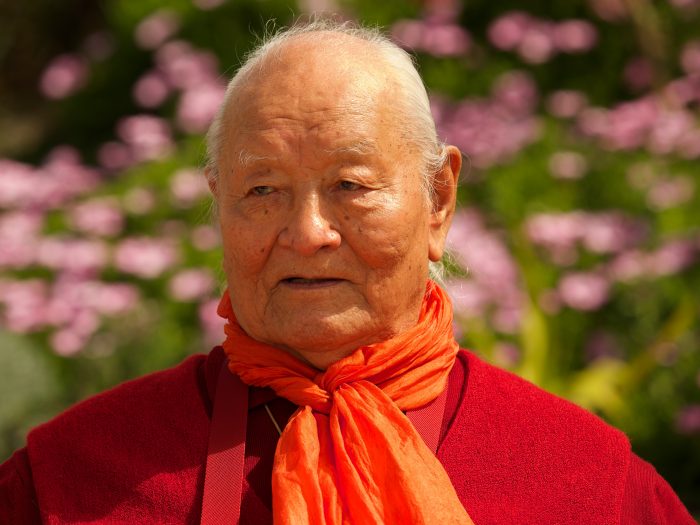
Costantino Albini is one of the first students of Chögyal Namkhai Norbu, a master of Dzogchen, an ancient knowledge aimed at recognizing our naturally perfected state.
From a young age, Costantino embarked on mystical and musical studies, exploring the connection between spiritual practice and musical creativity. Over the years, he developed expertise in Indian rāgas, music, astrology, and esotericism. He is now dedicated to the study of Western astrology, continuing to build bridges between his research on sound and Dzogchen.