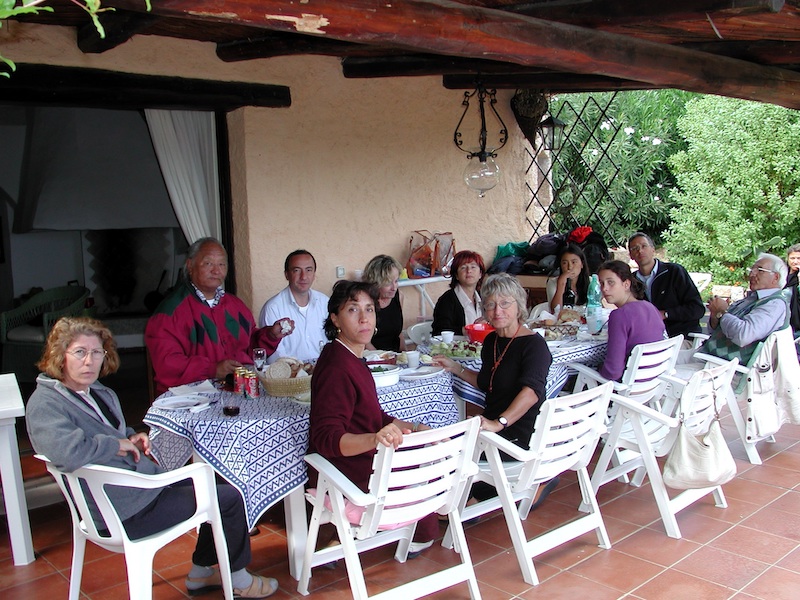
In September 1995, Rinpoche, together with his wife Rosa and his niece Phuntsog Wangmo, honored us with a visit to Sardinia to spend ten days on vacation by the sea, after recovering from a long serious illness.
We found them a villa in a place called “Cala Corallina” (the name comes from the fact that there are numerous small pieces of coral on the beach). A 200-meter walk through a beautiful garden led from the house to the beach, so Rinpoche could easily reach the beach and enjoy long swims.
One afternoon, Rinpoche was resting on the sofa when he suddenly woke up and asked us if we could find him some sheets of white cardboard, a pair of scissors, and some colored markers: blue, yellow, and red.
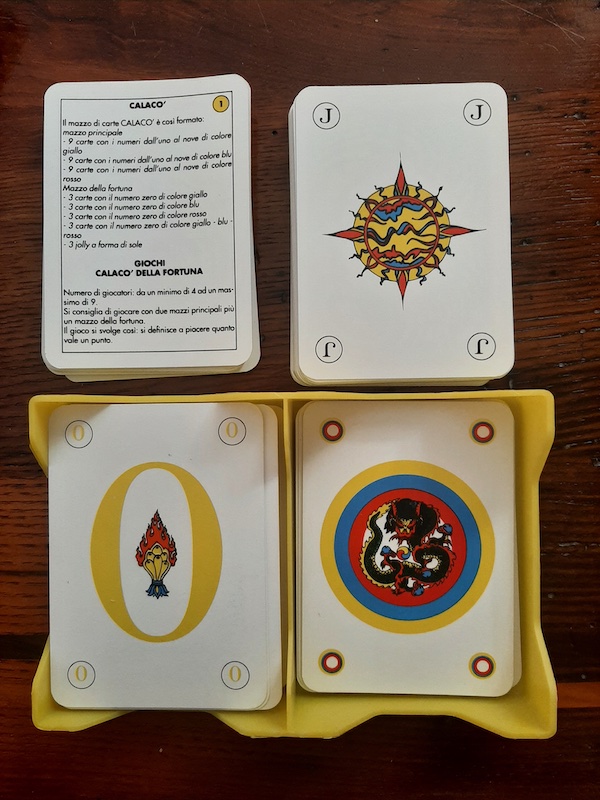
We immediately went to get everything, and ten minutes later Rinpoche was sitting on the sofa and began cutting out the cardboard. We watched silently and curiously as he worked. With great patience and precision, Rinpoche cut out 42 pieces of cardboard, all the same size, about the size of a playing card. Then, using the markers, he began to write on the pieces of cardboard: on nine pieces he wrote the numbers 1 to 9 in blue, on another nine in yellow, and on the last nine in red. There were still 15 pieces of cardboard left.
On the first three, he wrote three blue zeros, then three yellow zeros, three red zeros, and finally three zeros of three colors: blue, yellow, and red. On the last three, he drew three jokers.
After checking everything meticulously, he asked us what we thought. Our answer, even though we clearly didn’t understand anything, could only be: “Very interesting, what is it?”
And so Rinpoche began to explain what he had done and how it worked. He told us that he really liked games and that while he was resting, this new game had come to mind. The three colors corresponded to three levels: yellow is the highest level and wins over blue and red, blue is the middle level and wins over red, which is the lowest level of all.
He told us that the Zeros were used to free you, and the Jokers freed you from negative situations and doubled the positive ones. It was all becoming very appealing!!!
Rinpoche stood up and asked us all to sit around the table and try to play, and here are the rules he explained to us.
There are two types of cards: the “Main” cards, which are all the numbered cards of the three colors, and the zero and joker cards, which are called “Luck” cards.
Each player is given a number from 1 to 9, as are the numbers on the cards. If there are fewer than nine players, someone will have two numbers. One player acts as the dealer and deals the cards until the deck is exhausted, then passes to the next player in a clockwise direction, and the numbers given to the players also rotate, with number one being the player to the left of the dealer.
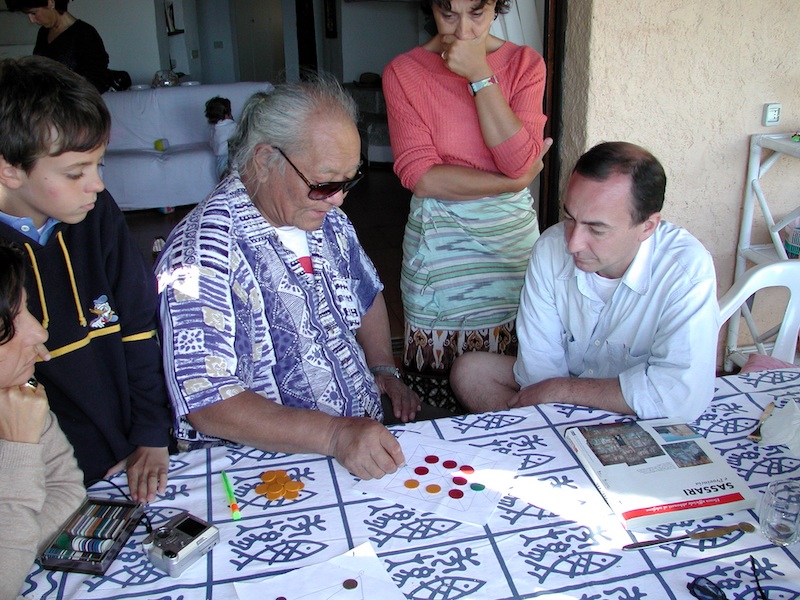
After arranging us around the table in this way, he told us that we now had to decide what a “point” was worth and how to choose the player who would start as the dealer.
A point is given the value we want and must be decided with everyone’s consent. Everyone chooses a card from the “main” deck, and the highest point acts as dealer, but we must always keep in mind the value of the colors: any “yellow” point beats all “blue” and “red” points, and any “blue” point beats all “red” points. If the colors are the same, the highest number wins.
So he got us to start playing, even though we still didn’t know how!
Rinpoche held the deck and began to deal one card to each of us, starting with the person on his left (clockwise). Once the cards had been dealt, he told us to turn them over on the table. So we found ourselves with yellow, blue, red, or zero cards. Now how does it work?
Then he told us that the yellow cards win: if the dealer has a yellow card, all players must pay him the points on the card (which can range from one to nine); if the dealer has a red card, he loses and must pay all players the points on the card; if the dealer has a blue card, he pays the points on the card to the player with the same number.
But be careful, because now the zeros and jokers come into play. The zero cancels any winnings or payments, so if, for example, the dealer has a yellow card, everyone pays except those who have a yellow zero or a three-color zero or the joker. The same applies to payments: the dealer with a red card pays everyone except those who have a red zero or a three-color zero or the joker. The same applies to the blue color.
After adjusting the dealer’s position, we move on to see what each player has and how it relates to the others.
If a player has, for example, a yellow four, they win four points from the player in position number four, but always with the rule of zeros and jokers. Similarly, if the cards are red or blue (if the player has a blue card, they pay the value to the dealer, always keeping in mind zero and jokers).
Now there was a problem: what if the player in position number four has a yellow four? He cannot win from himself, so Rinpoche decided that in these cases (winnings and payments) you are paid by the player on your left and you pay the player on your right, not forgetting the zeros and jokers.
If a player or the dealer has a joker, they never pay, and if they are to receive, they receive double.
We were all caught up in the game, which Rinpoche made go very quickly, but we made a lot of mistakes and he laughed with pleasure.
After a couple of days of practice, the game was refined: a player could play the gamble, double or triple, and so the winnings or losses also became double or triple, but only for those who had accepted the same gamble. Those who do not want to gamble cannot be influenced by those who do.
We also realized that to play well, you need two main decks and one lucky deck.
You can imagine that at night when we went to sleep, our vision was full of yellow, red, blue numbers and colored zeros. Rinpoche was very happy that the game worked and that it was very enjoyable. It was very entertaining to see how the zeros could reverse wins and losses; you were never sure.
What to call it?
Rinpoche decided that since we were in Cala Corallina, the game would be called CALACO’.
Before leaving, he asked us to write down the rules, and we asked him if it would be useful to have the decks of cards printed so that everyone could buy them and play. He said yes, and so it was done.
This is the brief story of the birth of a game that sprang entirely from Rinpoche’s mind.
With these cards, you can play many other games, from solitaire to a game similar to poker.
Those interested in ‘reading the cards’ with these will have plenty to fuel their imagination. Just think about the meaning of the three colors, the function of the zero, and the luck of the joker, and then… you need some clarity.
We hope that these few lines will encourage many of you to try this fantastic game.
Thank you, Rinpoche.
This story was written by the group of practitioners from Sardinia (Riccardo, Giampiero, Bianca, and many others) who, with great affection and devotion, have always supported the Master, his family, and the Dzogchen Community from the beginning, inviting him and organizing the short vacations in Sardinia that the Master enjoyed in those years.
The CALACO’ cards, created thanks to their commitment and the support of Merigar, can be found in the Shang Shung Publications webshop.
The package includes game instructions in English, Italian, German, Spanish, and French. The translation of the instructions will also be available in Chinese.
https://www.shangshungpublications.com/en/products/product/calaco-cards-game
Shang Shung Publications Team