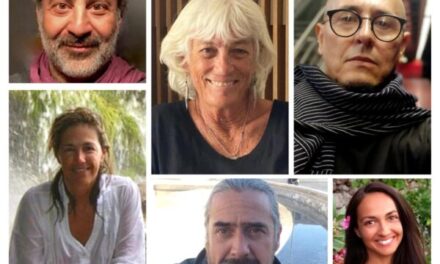
The Life of Knowledge is a lecture series organized by Shang Shung UK and the Ka-Ter Project of Shang Shung Institute Austria dedicated to the vast legacy that Professor Namkhai Norbu left, including many literary works, as well as associations and organizations.
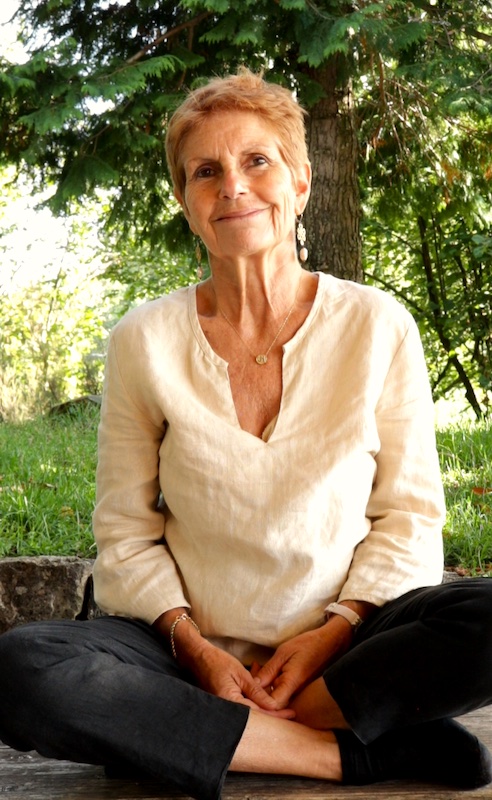
On Sunday, 21 February 2026, Adriana Dal Borgo, a longtime student of Professor Namkhai Norbu who has been working with dance and movement for many decades and Eva Leick, dancer, professional choreographer and academic spoke about some of their experiences of Khaita Joyful Dances, a project that was very dear to Rinpoche in the last years of his life.
Jamyang Oliphant from SSUK: Dzamling Gar was one of the last major projects of Chögyal Namkhai Norbu. He composed the Dzamling Gar song and also created a dance for it. Could you talk a little bit about that? And also, would you consider the Song to be part of Khaita?
Adriana: Yes and no. The Song is part of Khaita because he manifested it at that moment and because it deals with dancing, with singing, in this sense it’s part of Khaita. However, it’s different because it is a complete teaching. Rinpoche wrote the text and created the music and also part of the dance. For the dance he suggested that the movements represent the meaning of the Song. ‘’It’s a complete teaching”, Rinpoche said, “I could write three volumes on this, because it has a very deep meaning’’. There is a booklet from Shang Shung Publications with the transcription of Rinpoche’s teachings.
ITA: https://www.shangshungpublications.com/en/products/product/product_734
EN: https://www.shangshungpublications.com/en/products/product/product_733
An example of this is the importance Rinpoche gave to collaboration in the words of the Song. In the relative sense collaboration is doing something together which is one of the main aspects of Khaita. In the second part of the Dzamling Gar song it says, “Come to Dzamling Gar, unifying our strength and capacity’’. This means we do things together but, in the inner sense, collaboration is integration. And this is the main point for us as practitioners. This is also the message of Khaita, collaboration and, innerly, integration.
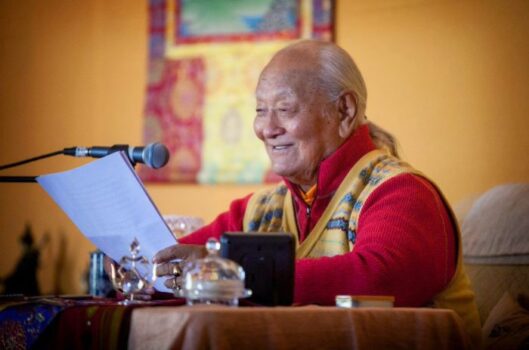
And I would like to add something else regarding Rinpoche. He always had a really broad vision and often we don’t understand that. More than once he said, ‘’In the Dzogchen Community we have three methods related to movement: Yantra Yoga, the Vajra Dance and the Joyful Dances. All these three are Khaita’’. This sentence is something I continue to reflect on and try to understand.
Of course these three methods are very different in some aspects, but they all work with movement and they all work with rhythm and with sound – external sound in the case of the Vajra Dance and the Joyful Dances, with the breathing in Yantra Yoga. This phrase of Rinpoche’s is very important for me personally. It gives direction to my practice and when I’m teaching I try to convey the meaning of it.
Then we cannot say that one practice is better than another. Each practice, each method is perfect and can be used when we need it, according to the moment. What is important is that we try to have a broader view.
For me, Khaita is the bridge from formal practice to applying practice in our daily lives because the rhythm, the sound and the music are very different in each song. Some songs are slow, some are faster, some are extremely fast and in a single song the rhythm may change. This is the perfect training in being present and dealing with circumstances that change continuously in our lives. And in particular, Rinpoche said when we work with time, with rhythm, we understand how to deal with circumstances.
This is why for me, Khaita is the bridge for understanding how to apply presence in our daily lives.
Jamyang: Eva, you did your PhD about Khaita with a very nice thesis which was published fairly recently, sponsored by Ka-ter. Were there any challenges to your study of Khaita? Is it considered to be Tibetan studies and were there any challenges for you in the academic world? Was it hard to be accepted by the Tibetologist crowd?
Eva: Well, yes, it was and this remains a challenge until this day, because I don’t consider myself a Tibetologist. So, I’m dealing with something that is connected to Tibetan culture, of course, because the songs come from there, and also some of the movement is based on it and inspired by it, but then it really goes beyond that.
So let me start first with something that works, and then I’ll go back to the challenges.
Two years ago, one of the milestones in this academic path so far has been the conference for young Tibetologists at Oxford University, where thanks to you, I also got the opportunity to present Khaita and explain a little bit about my research. This was really something nice because it arrived in this world of Tibetology, which I think is something that Rinpoche definitely would have supported and would have wanted because he was working as a Tibetologist himself at university.
[Khaita demonstration at Oxford University: https://melong.online/shang-shung-uk-khaita-oxford-university/ ]
But then again, because Khaita is so many things and there’s no limitations it also works in disciplines of ethnomusicology, for example. It works in dance studies, it works in the context of spirituality. And this is a challenge academically because you have to be very fluid, very flexible somehow, but also it’s a benefit because you’re not limited in any way. Just like Khaita can be many things and many perspectives, it’s very rich in that aspect.
But for sure, one of the challenges to this day is to translate something that is based on experience into mostly words, because the academic world is built on written words and also spoken words, so how do you translate a movement experience into words? For instance, I sometimes have to think of this sentence by choreographer and dancer Isadora Duncan who said, “If I could tell you what it meant, there would be no need in dancing it.” And so, very often I’m reminded that dance is a complete language in itself, and it is nonverbal.
And this aspect of collaboration that Adriana also emphasized, I think partly works because we don’t have to speak. We are speaking with our bodies, but we are not restricted by language in that sense. Even if we are very international groups of dancers usually, we all speak the language of dance that is beyond words.
And so of course the challenge for me was and is to translate something into words that then can be read without having that experience. And I tried to find as precise terms as possible and also transcribe the movement in words, but of course it’s not the same. It always remains something on the paper in the end.
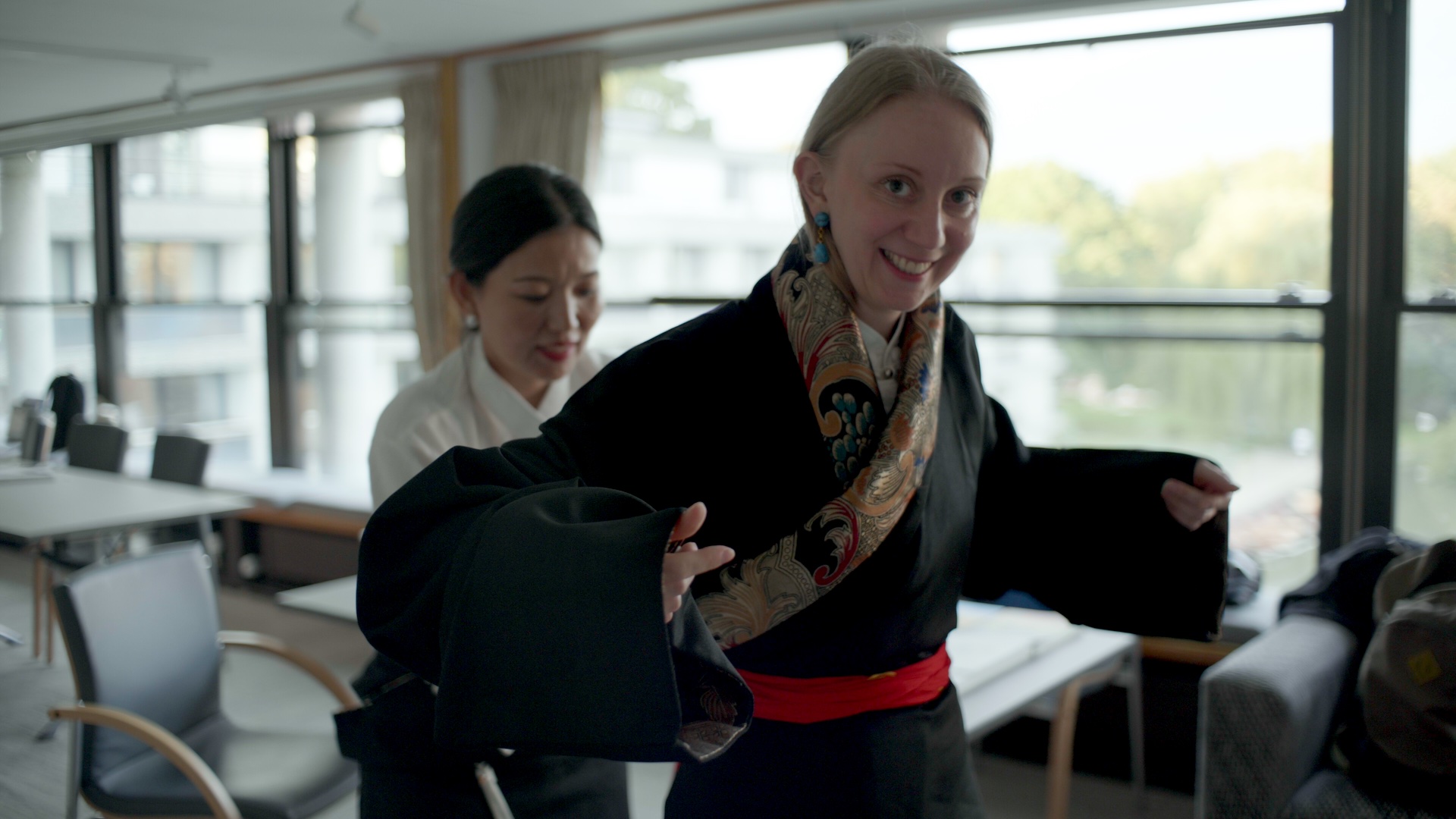
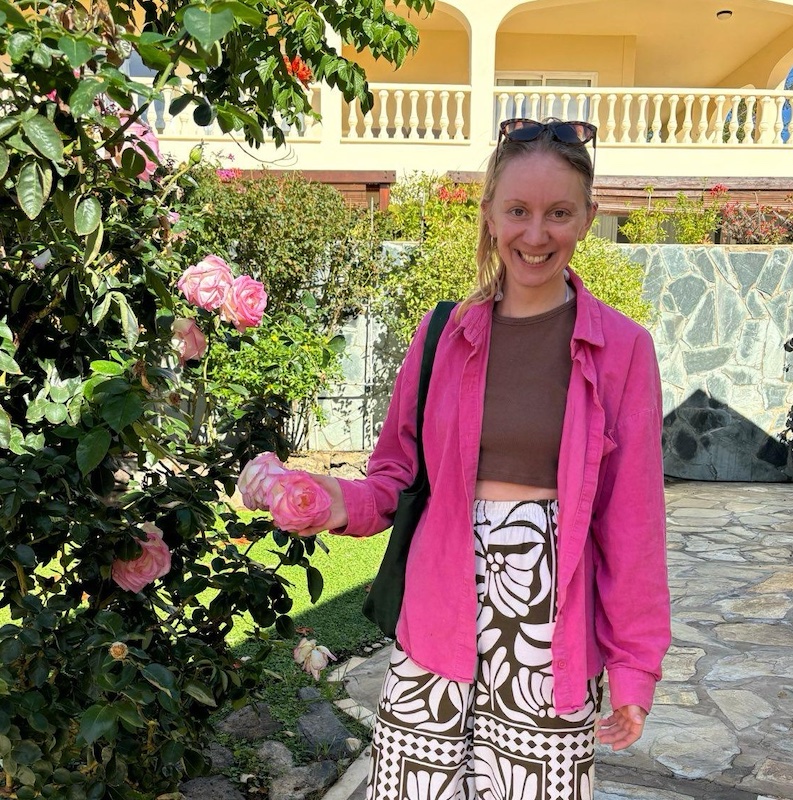
Eva Leick preparing for the Khaita performance at Oxford University
Jamyang: To round up, I would like to ask you both: In which ways would you say that Khaita is a Dzogchen practice for you personally?
Eva: I think one of the reasons is that it makes life easier. It has many different forms, but actually no form at all so it’s something that you take with you in your daily life. For example, one of the things that I learned from working with a lot of different bodies in space is to find an aspect of harmony. Of course, if you have music and a kind of choreography to follow, this sense of harmony is established more easily. But you can also take this to your daily life experiences, for example, at the airport or at the train station where there are a lot of people. I really notice that I manage to relax more because I can somehow tune into the rhythm of people and understand it like a song. The rhythm always changes but maybe there are some patterns, so I can understand them and relax.
Then there is this aspect of collectivity, collaboration and working in groups, which is also key to the Dzogchen Teachings of Rinpoche. I think this is very concrete in Khaita. There’s no way around working together if you have to form a circle or do certain couple choreographies. You have to work together. There’s no way around it.
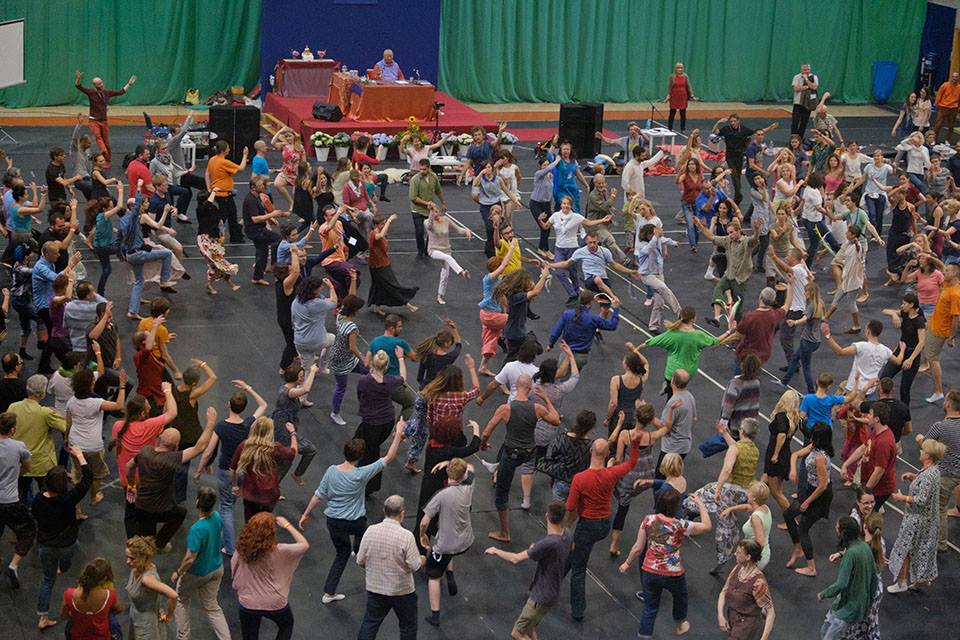
Khaita in Warsaw Poland. Photo by Małgorzata Lewińska
Adriana: I would like to add one thing here. If we have a circle, we all need to be responsible. If even one person is not aware, then we are not a circle anymore. In a circle, we are all equal and we also learn to respect each other’s space.
There’s another aspect: because Khaita is such an unconventional method that Rinpoche created, we also face our own limitations. It works fantastically for this. I remember at the beginning, especially older practitioners would say: ‘‘But why is the Master doing this instead of working on his dreams or on some of his texts? Why is He dedicating so much of his time to these songs?’’ A musician told me: ‘’For me, at the beginning, it was really a challenge, as a musician I didn’t like this music. Then I realized that this was a judgement, I like – I don’t like. And I overcame it’’. So Khaita as a method manifested in this unconventional way and gives us the possibility to discover our own limitations and to overcome them.
In addition, we may be afraid to show ourselves dancing because when we dance, we are naked. But it doesn’t matter in Khaita whether we are good or not. Only if we have to do a performance, then we try to check the movement but otherwise this is absolutely not the point. So it doesn’t matter. But in general we are afraid to show ourselves, how we dance, or if we are good or not, so Khaita is a mirror. It’s really a perfect mirror.
At the end of 2025, Eva Leick’s recent scholarly article, “Dzamling Gar Song and Dance: A Khaita Manifesto,” was published in the Tibetan studies journal Yeshe. In this article, she examines and analyzes the song’s three sections, with particular attention to their meaning and corresponding movements. She also emphasizes the song’s significance as a key example of the whole Khaita method. It is available in open access: https://yeshe.org/regular-issue-vol-5-no-2/
Direct link to article: https://yeshe.org/wp-content/uploads/regular_issue_5_2_2025/Dzamling_Gar.pdf