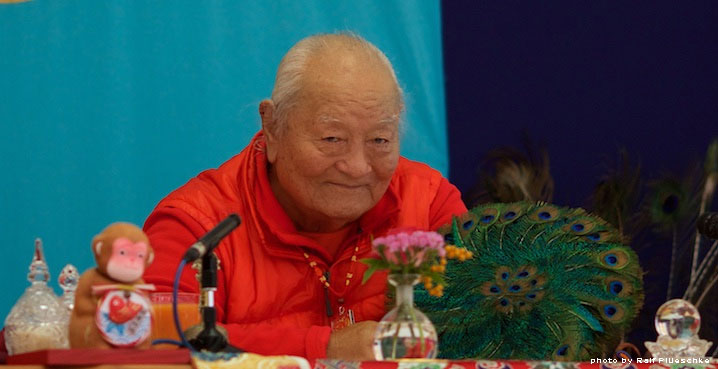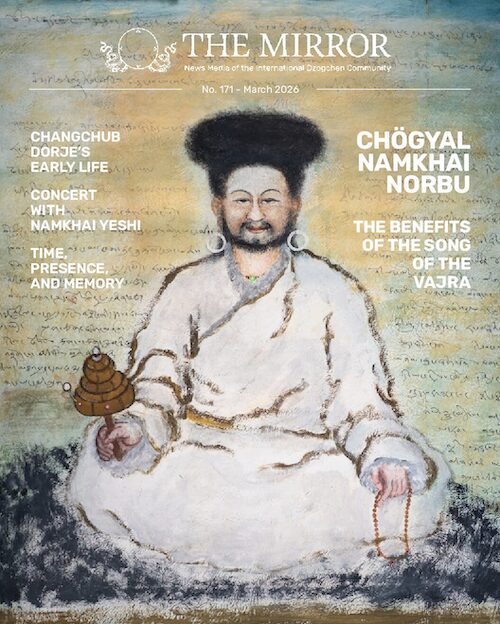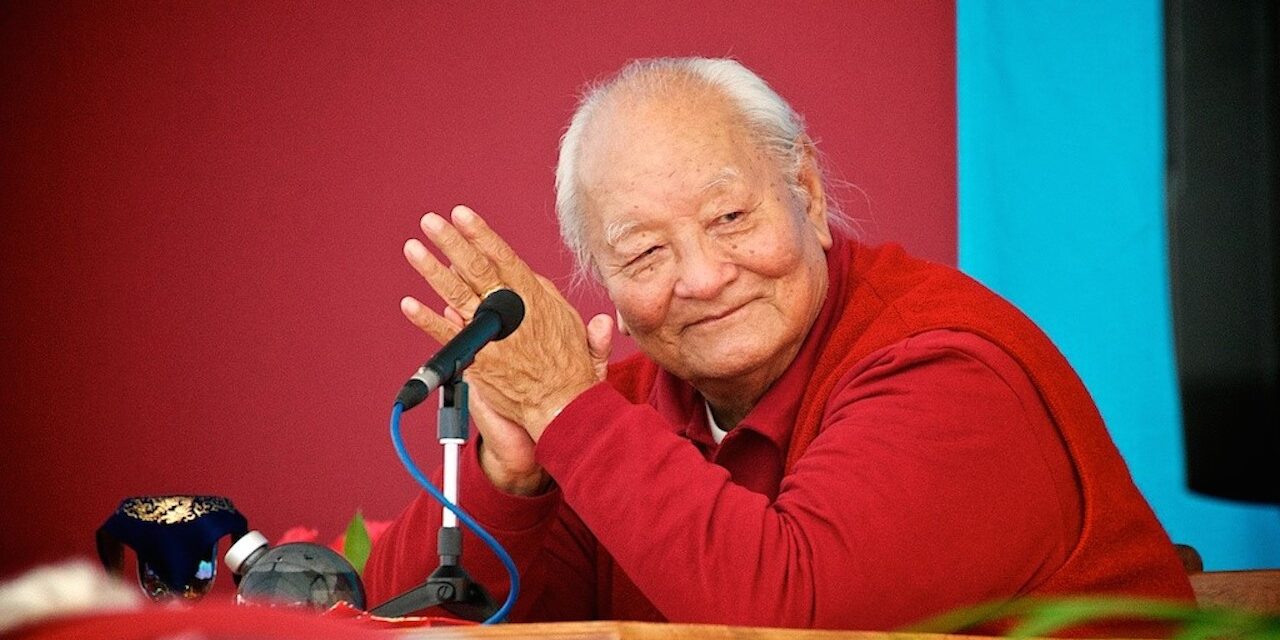
An excerpt from the Song of the Vajra Retreat, Hong Kong, 2012. May 19, day 4. Continued from issue 170 of The Mirror.
The Song of the Vajra is the most important practice in the Dzogchen teaching, and not only have I explained it but we have also practiced it together. Now I’d like to talk about how the benefits of the Song of the Vajra are explained in the Nyida Khajor tantra so that you can understand a little more because this is the origin of the Upadesha tantra, the Song of the Vajra. This tantra explains how, through singing and dancing the Song of the Vajra, we integrate our existence in the state of contemplation.
The tantra gives some specific explanations.
དེ་ཡང་རྣལ་འབྱོར་ཐབས་ཀྱི་གཙོ།
གྲགས་པ་མེད་པ་རྡོ་རྗེའི་གླུ།
སངས་རྒྱས་ཀུན་གྱི་ཡིད་ཀྱང་ཚིམ།
རྣལ་འབྱོར་པ་ཡི་ཉམས་ཀྱི་གྲོགས།
That means that for people who are doing practice, who have knowledge of the Dzogchen teaching, the method for having realization becomes most important.
གྲགས་པ་མེད་པ་རྡོ་རྗེའི་གླུ།
When we sing the Song of the Vajra we produce it with our breathing, which means that we connect our breathing with our vital energy. This is how we do it. But at the same time we are connecting with its real nature. Nature is how sambhogakaya manifests from the real condition of the dharmakaya, from the primordial Buddha. That is called natural sound and we do not produce it with our breathing. But we are living in our dualistic vision and, in this case, in order to integrate in that state, it is important that we connect with our breathing and our prana energy. That is the reason why we sing the Song of the Vajra.
སངས་རྒྱས་ཀུན་གྱི་ཡིད་ཀྱང་ཚིམ།
The real nature of all enlightened beings is manifesting in this state.
རྣལ་འབྱོར་པ་ཡི་ཉམས་ཀྱི་གྲོགས།
That means this is how practitioners’ experiences of the practice manifest.
མཁའ་འགྲོ་མ་ཡི་ཡིད་རྣམས་འཕྲོགས།
རིགས་དྲུག་འཁོར་བའི་ཞེན་པ་བཟློག
སྐལ་དང་ལྡན་པ་དང་འདུའི་གནས།
སེམས་ཀྱི་རྒྱུད་ཀུན་རང་དབང་ཐོབ།
As I already explained, the Nyida Khajor tantra contains many details. When we are producing the sounds of the Song of the Vajra, at that moment millions of dakas and dakinis are always present in our condition. That is the potentiality of the Song of the Vajra.
རིགས་དྲུག་འཁོར་བའི་ཞེན་པ་བཟློག
The root of our Six Lokas is our attachment to different kinds of emotions which produce a particular samsaric situation. How can we liberate ourselves from that condition? Singing the Song of the Vajra is supremely powerful and beneficial. As a means of liberation from samsara, it is a supreme method.
སྐལ་དང་ལྡན་པ་དང་འདུའི་གནས།
This means that we who have a connection with the Dzogchen teaching and transmission are fortunate because we are able to follow teachings, receive transmissions and use the method of the Dzogchen teaching. When the teacher gives introduction we can use many different methods. Even though we may not immediately discover our primordial state, or we remain in doubt, when the teacher introduces us using different experiences we remember and repeat them until we reach something concrete and discover our real nature.
Even though we may exert a lot of effort, sometimes we are not satisfied and do not discover it. In this case what should we do? We can do Guruyoga and sing the Song of the Vajra just as we did today. The tantra explains that if we do that, the potentiality of the Song of the Vajra increases our clarity and it becomes easier for us to discover our real nature.
སེམས་ཀྱི་རྒྱུད་ཀུན་རང་དབང་ཐོབ།
We are conditioned by our mind even though we know that we should be beyond mind. For instance, we practice Guruyoga, and for a few seconds, a few minutes, we succeed in remaining in that state, but after a little while we have to face our dualistic vision. When we deal with our mental condition it is very easy for us to get distracted. This verse means that when we have discovered and integrated the sound of the Song of the Vajra, even though we are not always in the state of Guruyoga it makes it easy for us to be aware of this kind of knowledge. This is the reason why we say to practitioners: if we are not always in instant presence at least we should be in ordinary presence. Instant presence means beyond time and space, completely beyond mind. But when we are not distracted with our attention, we are still in our mind. There is a big difference between instant presence and ordinary presence.
When we become Dzogchen practitioners, the most important thing is to be in the state of Guruyoga and to govern everything with the state of Guruyoga as much as possible. The second most important thing is being present, in ordinary presence. How can we learn to be in ordinary presence? Although a lot of people ask about how to be in ordinary presence there is no particular technique. What is important is knowing what it means to be present. Being present means that if we are doing something, at that moment we know that we are doing it. In general when we think about something, we are totally distracted with that thought, then another thought comes and another. This is not presence and for this reason we should learn [about it].
If you have some free time you may feel like dedicating yourself to learning how to be present for some hours. Even though you may have twelve hours or so of free time it is not easy to train for all that time, however you can make a commitment to apply yourself to being present for, say, three hours.
You decide that from this moment you want to be present for three hours. If you have decided that you are present at that moment another thought may arise, such as: “I should go to the shop to buy something because I am free today.” But you recognize that you have that thought and you are not distracted by it. You already know that you were thinking of going to the shop but it doesn’t mean you need to renounce that idea. You can apply everything. “Now I’m going to the shop.” You walk a little and you are aware that you are walking to go to the shop. After a little while you remember that you didn’t take enough money and should go back to take more money. But you shouldn’t get distracted by that. You think, “I am thinking that and I am going to get more money.” So you do everything while continually being present.
It is not very easy at the beginning when you are learning. Not only learning how to be present but anything we learn is not so easy at the beginning. However, when we become a little familiar with it then it becomes easier. You may remember how it was when we started to learn how to drive. We took driving lessons, first of all learning the theory, but when we started to drive it wasn’t easy at all. Day after day we learned and then finally we could manage the car. I remember when I began to drive the car was always lurching. But after a little while we became familiar with driving and we could drive everywhere.
When we are driving a car we are present. Sometimes it seems we are not present when we’re talking with our friends or looking outside but this is because we have become familiar with driving and for that reason we have space for looking and talking. But in the real sense we are present because if we are not we could have an accident. So this is a good example of presence.
But this is only the presence of driving a car. Our life is not only driving a car. There are many things related to our body, speech and mind. We can learn [how to be present] doing physical activities, talking with people, thinking and judging, everything that is related with our body, speech and mind. We can learn one thing at a time and in the end we don’t need any effort. When we become more familiar with being present we can talk with people and think and so on for hours and hours without being distracted.
Even when we are walking, doing some activities that are more samsaric if we are present and not distracted everything becomes so much easier. First of all we discover that tensions develop because we are distracted with things and think that things are important or should be in a certain way. When things are not the way we want them to be then we get angry and struggle with that and tensions develop. But if we are really present, we do not have these kinds of tensions, and even if there are tensions, immediately we discover that. If we discover there are tensions, why should we hold on to them? It is much better if we free ourselves. So you see in that case being present everything becomes concrete.
When we follow Sutra and Tantra teachings in general, at the beginning teachers talk about the four mindfulnesses that are considered to be very important. Then we have the eighteen qualifications for a perfect human life: eight freedoms from negative states and and ten favorable conditions, divided into two categories, one related to the individual, the other related to our dimension. We study all of this day after day in an intellectual way and give a lot of importance to these topics.
Although it is very beneficial to do something like that, it is not the main point. We concentrate on these topics but we really need to have a presence of ourselves as human beings. The perfect human condition is precious because it allows us to learn teaching, to apply it and to have total realization in our lifetime. Our condition and our capacity is much better than that of dogs and cats, for instance. But there is no need to particularly learn about the eighteen qualifications in an intellectual way. We can simply understand how the qualities of a human being are. If we are present about that we know at this moment we have this precious condition, although nobody knows how long we will have it.
Then we have the second mindfulness, impermanence, of which there are many examples and many things we can learn. However, concretely we know that we are living in time, that time is going ahead. We just need to look at a watch for example – tick tock, tick tock – going ahead and never going backwards. Our lives are related to time and going ahead day after day we get nearer and nearer to the end of them.
Sometimes young people think that they have all their lives [ahead of them], but they should consider what “all their lives” means. A life can simply be one day or one week, nobody knows. Some people think that old people will pass away soon but, since they themselves are younger, they will remain in this world. However, many young people pass away before the old. Of course we understand that old people cannot live much longer in time. For instance, when a person is seventy years old they know how life is and that it cannot last much longer. People say that living to be eighty and ninety is a very long life. If someone lives to be one hundred, oh, fantastic! But in an ordinary way it is not so easy. We may live a little longer but our body does not collaborate with us. Our function of the senses does not collaborate with us. So this is our real condition – we all have only a short life. We know that we have a precious condition but we exist in time and nobody knows when our precious time will finish.
But while we are living in this moment, what are we doing? Most of the time we are distracted, we are going after emotions, we are producing a lot of negative karma instead of overcoming problems. This is the third mindfulness. Time is related to our activities and when we create negativities we should be present and do our best in the circumstances, that way we do not produce negativities. It is very important that we also understand that if we produce negativities we have infinite samsara. Knowing that we should try to do our best. This is the fourth mindfulness.
All four mindfulnesses need presence because even though we may learn about them one by one in great detail, if we do not have presence they do not work. So you see, presence is very important.
Many people who are dedicated to the teachings think it is better to chant mantras, like Tibetans who go around holding a prayer wheel in one hand and a mala in the other always chanting OM MANI PADME HUM, OM MANI PADME HUM, OM MANI PADME HUM, thinking that it is a very important practice. Of course it is also a good practice, particularly if they have a good intention, but that does not become the path of total realization.
We may accumulate good merits with that and gradually diminish some obstacles and increase our clarity just a little. It also helps us slowly discover which is the main path for realization. But when we have the possibility it is much better to work more concretely so when we compare chanting mantras or something similar with being present, being present is much more important.
In most traditions and teachings, they do not give much importance to being present and do not consider it to be a kind of practice whereas in Dzogchen teaching it is a very important practice. This verse makes us understand that.
རང་རིག་བདེ་བའི་གསལ་རྣམས་འདེགས།
ཤེས་པ་གཅིག་པའི་ཡུལ་ཡང་བྱེད།
We discover our real nature and how to have that kind of knowledge which is always connected to different kinds of experiences. One of the most important experiences is the sensation of bliss while another is the experience of clarity. When we use the Song of the Vajra it gives us a concrete experience of clarity and bliss combined in our real nature. This is the function of the Vajra Dance, for example. With the Vajra Dance we have a mandala. You can find out more about the mandala when you learn the [Dance] of the Vajra.
When we sing the Song of the Vajra we are always in instant presence, integrating with the sounds we are singing, one by one, of the Song of the Vajra. Then we are moving to specific places on the mandala which means we are integrating with our energy of movement which is related with all our experiences of bliss, sensation and clarity. We maintain that kind of experience and through it we increase being in the state of instant presence.
In a simple way we can say that the Song of the Vajra and the Dance of the Vajra are very important methods for integrating our body, speech and mind in the state of contemplation. Of course when we are learning at the beginning we have to use our minds thinking about which direction we should go and where we should put our feet when we are singing. All of this is related to our minds. But when we become a little familiar we don’t always need to think about where we should go. That means we are becoming familiar with the Dance of the Vajra and we can integrate totally being in instant presence and combining it with the sound of the Song of the Vajra. Then we can understand how important it is to integrate.
Edited by L.Granger
Final editing Susan Schwarz
Tibetan by Prof. Fabian Sanders
Photo of Chögyal Namkhai Norbu by Lesya Cherenkova