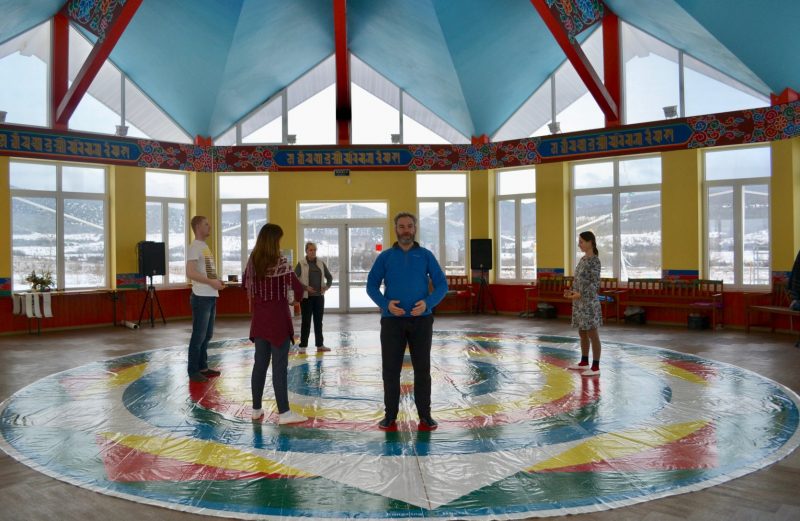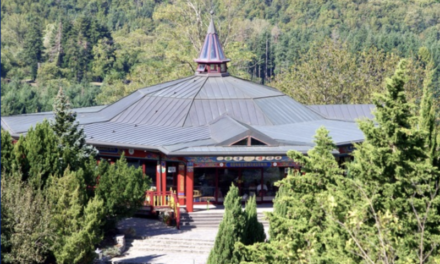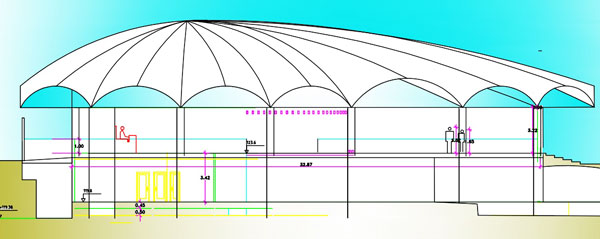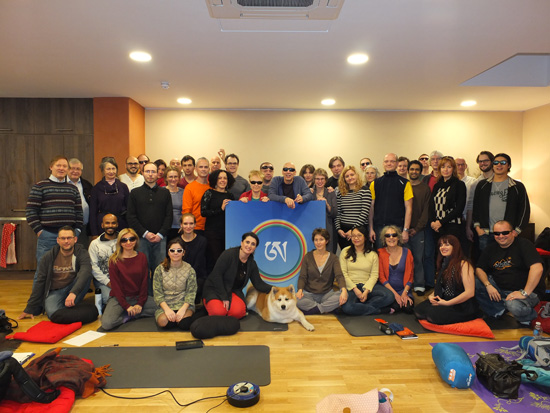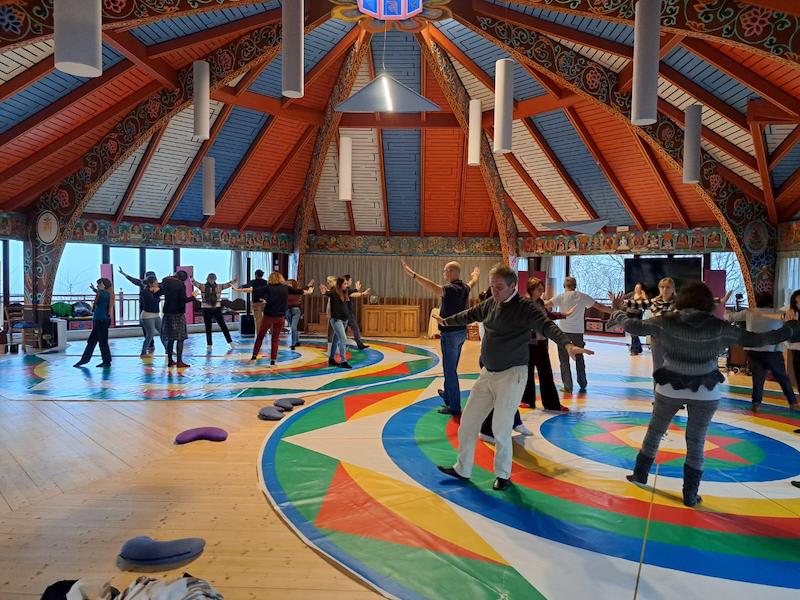
From January 4 to 6, 2026, Merigar hosted a Vajra Dance retreat at the Gönpa, focusing on the first part of the Dance. The occasion was to bring together participants, beginners from three courses, which have been taking place in recent months in different locations in Italy (Rome – Venice – Merigar), and experienced practitioners for three days of intense sessions.
We asked two participants to write about their experience during these days. They are two different points of view, one from an experienced practitioner who lives in the Merigar area and one from a practitioner from Rome who discovered the dance a few months ago.
Vajra Dance Practice retreat for the first part of the Song
by Lucia Della Libera
From January 4 to 6, 2026, Merigar offered a wonderful opportunity to review and practice the Vajra Dance up to the verse “kelanam.” About thirty practitioners enthusiastically immersed themselves in the two mandalas set up in the Gönpa.
This refresher course was specifically organized to give participants in the courses running in parallel in Merigar, where the course is led by Cosimo di Maggio, and in Rome, where the course is led by Rita Renzi and Christiane Rhein, the opportunity to gain greater confidence in their practice. More experienced dancers also took part in the retreat, enjoying this time to refine some details and practice intensively.
Rita Renzi guided and supported us with delicacy and precision, dispelling our doubts and correcting our inaccuracies. She invited us to practice without music as support but simply using our voices to sing. The purpose of this method is to better identify the timing and coincidence between syllable and corresponding movement on the mandala, making it a vivid experience. Giovanna Natalini, as a musician, helped us with the correct intonation of the singing.
As the hours passed, we were able to immerse ourselves more and more deeply into the practice, find greater harmony with our companions, and relax. The atmosphere in the group was collaborative and very participatory, and we took turns so that everyone had a place on the mandala.
We ended the retreat with a sense of satisfaction and gratitude and with the desire to always have new opportunities like this!
Thank you Rita, thank you Gakyil, thank you Geko!
The Color of Snow
by Lidia Riviello
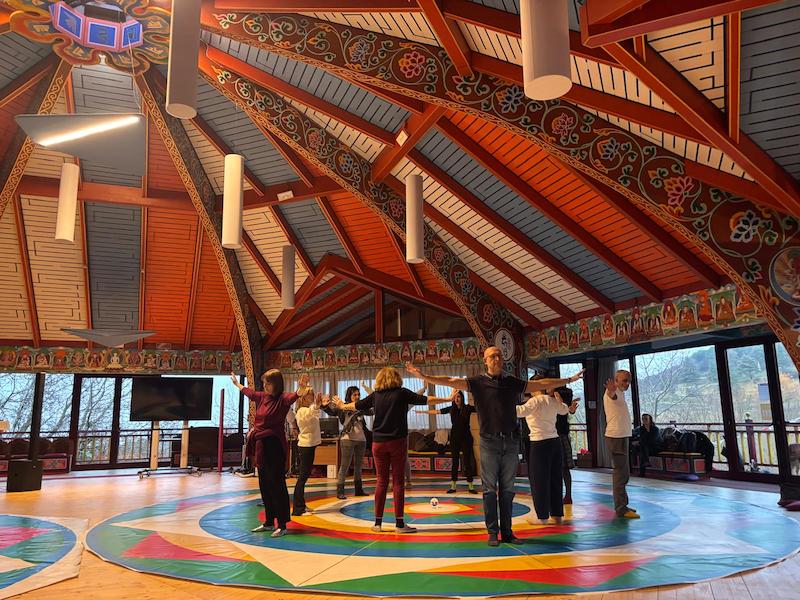
You’re lucky, it’s right near your house! This was the message that a friend with whom I shared the splendid habitat and life experience at Dzamling Gar in the summer of 2025 sent me while I was in Santa Cruz trying to track down some apparently lost luggage. That open, enthusiastic message referred to the great opportunity to enroll in the Vajra Dance course in Rome shortly after my return from Dzamling Gar, which was to begin in October for five months with Rita Renzi, Christiane Rhein, and Giovanna Natalini at Zhenphenling in Rome.
This opportunity perfectly coincided with a certain sense of disorientation I felt upon returning to Rome after a long, intense period of transmission, practice, retreats, and not yet knowing Zhenpenling. However, confident in the state I was in—at home—I slipped into September, heading towards Via dei Marrucini, and after a month, in October, there was the magnificent mandala of Zhenphenling, happily filled with presences, voices, sounds, breaths, movements, and glances. That was the course, the lucky one, because it manifested itself at home and not only in the sense of the neighborhood, San Lorenzo, in Rome, where my mother lives. Grateful to the Master, I began the first steps.
The first steps
There was no first step taken on the Zhenphenling mandala on October 4, but like footprints in the snow, the steps are everywhere, evoking a subtle, infinite sensitivity and recalling the presence of uncontaminated white. Upside down, a bodily dimension, beyond. I had observed the Thun of the Vajra Dance the entire summer at Dzamling Gar. I had moved on the mandala while the natural light of the Gar radiated every movement and turn of the practitioners, and during the courses and daily practices, the natural space merged with the visualization of every sound and movement of the song and dance.
And when I found myself on the mandala during October, somehow the movement on the mandala became an additional experience, and the natural continuity of finding myself now and there (here) did not surprise me but absorbed me like an acoustic sense of the body. It was as if my disjointed experience in life of moving so hyperactively and tirelessly rediscovered every point still active but waiting for, even before childhood memories, one step before.
Not exactly a feeling, more an active experience within me. Every review, every learning of sound, every syllable corresponding to a movement, all the possible moments toned the fragility, and the fragility toned the mobility, making me recognize what presence, gravity, and balance were. Recognizing my condition during this course took on the practical connotation of not having to be in the performance but of finding myself, showing myself, and not having to prove myself. For me, it was an evolution and a return to the same time and space with others. The others, the community, that I recognized, that I have always searched for and proposed in my practices of life in all its forms.
Thanks to the help of the teachers, friends, and Rita Renzi’s encouragement, “you’ve just begun,” it was as if, associated with her ever-present smile, it moved me towards “you’ve always begun,” giving me another chance, with Giovanna Natalini’s voice exercises so essential and profound and Christiane Rhein who moved continuously, reviving a dynamic of presence.
I continued, aware of my many mistakes, of my distraction at times, going out and observing, but always remaining inside, ‘using’ my desire for the mandala in a visualization of the clarity of my being, of my state. Keep going, said a friend at Dzamling Gar when he saw me not giving in to the fear, albeit natural, of the judgment of my fellow practitioners in front of my inexperienced and awkward movements, and I did not feel like continuing the course. But it was precisely because of this fear that I continued, learning and trying to correct the underlying imperfections, following the teachers, observing the practitioners, observing myself. In this course, I was learning the state of presence and awareness. Grateful for the teaching, I returned to Merigar.
Merigar, a return and a retreat
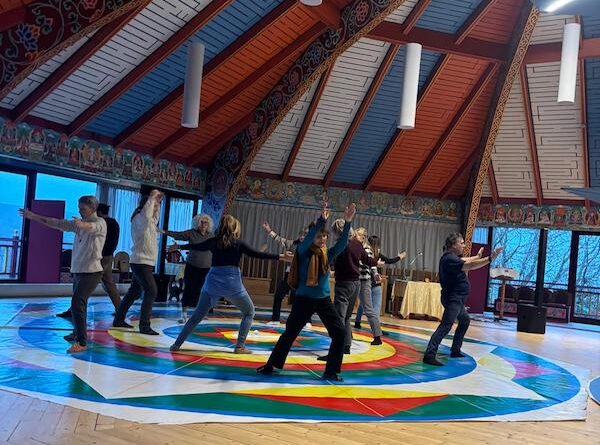
And then, in January 2026, I returned to Merigar, where one always returns and from where one never feels one has left. The announcement of the retreat dates, finding the warm welcome of Tiziana Gottardi, traveling to Merigar with a friend with whom I will share this special retreat.
The announcement of a possible snowfall, laughing together about the ice and admiring the thermal energy inside the ice that leads to warmth.
This retreat at Merigar began with the repetitions and new teachings of other movements, sounds, and syllables. Each session was experienced and absorbed during those three intense and meaningful days.
From the moment of doubt to that of letting go, the seemingly contrasting moments became increasingly integrated until they became a single moment in constant change.
One episode that remains and transformed me was on the morning before leaving, when in the same period of time I felt at least five different frequencies coming from the movements. This feeling in me and in the other practitioners of a coexistence of many conditions was truly very energetic and beneficial for many days to follow, so that I practically and naturally changed my state, voice, choices, and external actions for a long time. The constant help between practitioners is a very important aspect of this experience. Every attention, care, and dedication was experienced by me as a further presence on the path we were sharing together, from cities, languages, cultures, and personalities, each one unique and fruitful. Meditation in movement, corroborated by this ongoing course, and grateful to the Master, I discover the color of snow.
The color of snow
Back in Rome, grateful to friends and teachers, in the snow, the color of the mandala was the first rays of the rising sun on the day of reviewing, awaited with even more excitement, if possible, as an effective emotional continuation of the course, always in progress…
Grateful and under a blissful and beneficial influence, the course was so rythmically structured, marked by temperatures, the rhythm of the seasons, the frequency of experiences, the movement of breaks, the observation of daily variations, and the discovery of the color of snow as not only symbolic but very concrete, a connection to everything. Without ever leaving the step, grateful and always recognizing every ray of experience with that: ‘You are lucky! And it is (always) near your house!’