At Work & Play with Norbu Rinpoche
At His Family Home in Formia, Back in the Day
Celebrating the 40th Anniversary of ‘The Crystal and the Way of Light: Sutra, Tantra, and Dzogchen’
John Shane
Time is fascinating.
Where is the past? It’s gone. The past is just an interpretation happening now.
The present moment has zero duration.
And I can’t really say that there is a future.
I have never encountered anything other than the actual immediacy of the present moment
I can’t even pin down what ‘now’ actually is.
From that point of view, what we call ‘time’ is actually just the intrinsic dynamism of reality morphing and evolving as a spontaneously appearing spectrum of energy.
What are you going through right now..? I hope everything is going well for you.
I am in my 80th year, and despite being fortunate enough to be in generally good health compared to many of my friends who were born in the same year as me, my doctors have decided that I need to have a series of surgical procedures in the coming weeks that will each require a full anaesthetic.
When one is facing adverse circumstances, it can be helpful to remind oneself of positive factors in one’s life, so to keep myself busy as I wait for the first operation next Tuesday, I have been reorganising my archive of photos and videos of my life and travels with Norbu Rinpoche.
And despite my not initially intending that it should do so, going through the photos in my archive has taken on some aspects of the kind of ‘life review’ that elderly people are advised to undertake as they enter the later stages of their lives.
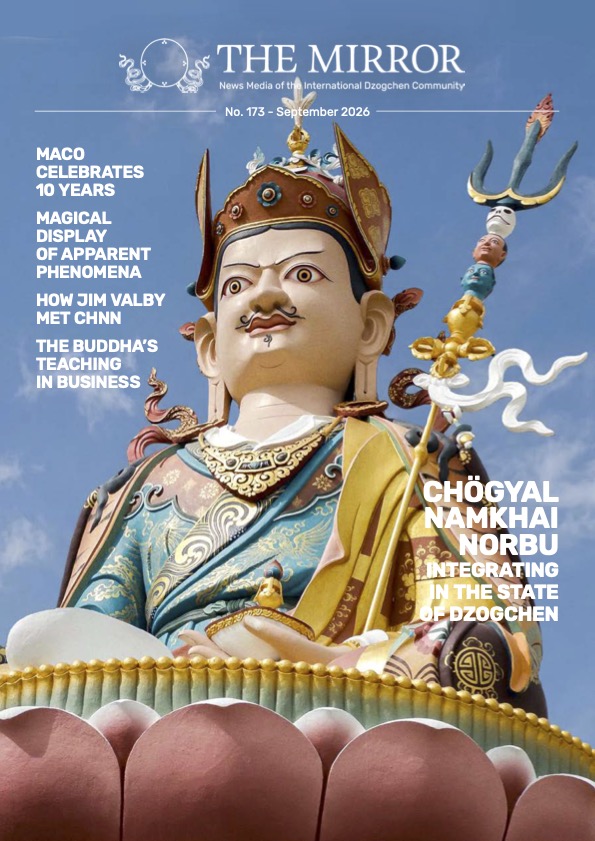
When I was asked by the editors of ‘The Mirror’ if I would like to contribute an article to the next edition of the magazine, I decided that I would share a few of the photos in my archive with the magazine’s readers, explaining very briefly what they mean to me in the hope that my sharing the photos in this way might be of interest to others who have their own history of a relationship with Norbu Rinpoche and his teachings. We are, after all, each of us, embedded in the same mystery of connection not only through our common humanity, but also – more particularly – through Norbu Rinpoche’s transmission.
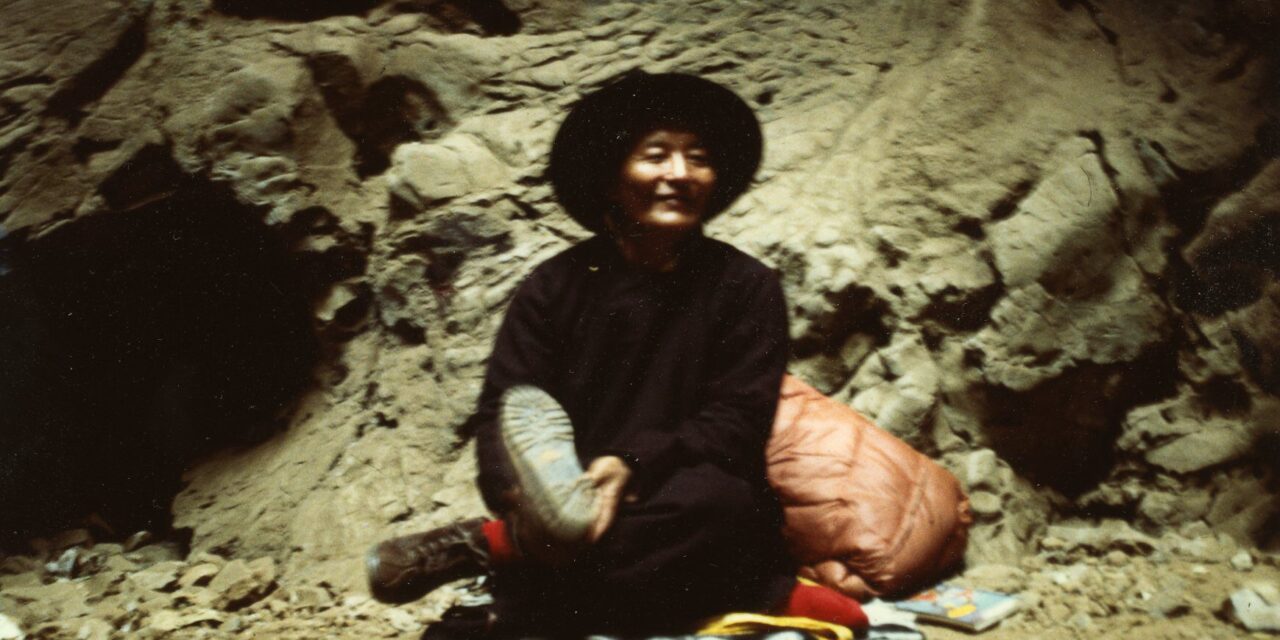
The first photo that I would like to share is one that I took of Norbu Rinpoche inside the huge cave at Maratika in the mountains of Nepal when a group of his students went on a long trek with him so that we could do a retreat there. It was during the time of this visit to Maratika that Rinpoche had a vision of the terma text of the Long Life sadhana of Mandarava that the Dzogchen Community now practices.
In the photo you can see Rinpoche putting on his boots after he had given a teaching in the cave at Maratika.
This is particularly significant to me, because, when I reviewed the photo after I had taken it, I was reminded of the famous story of the Hasidic rabbi who – when he was asked why he had traveled so far to see his teacher – replied that he had made the journey of a thousand miles just because he wanted to watch his teacher tie his boot laces – which, he said, was much more important to him than reading or receiving from the teacher explanations of the doctrines of the Torah.
His teacher, the rabbi went on to say, embodied his teachings to such an extent that whatever action the Rebbe carried out – no matter how trivial and worldly that action might seem to be – was an example of the deepest meaning of the teachings.
And that is exactly what I felt then and still feel about my relationship with Norbu Rinpoche, a relationship that led me – over so many years – to make so many thousand mile journeys around the world to work with him closely, firstly as his translator and then, later, as his editor – but always as his student.
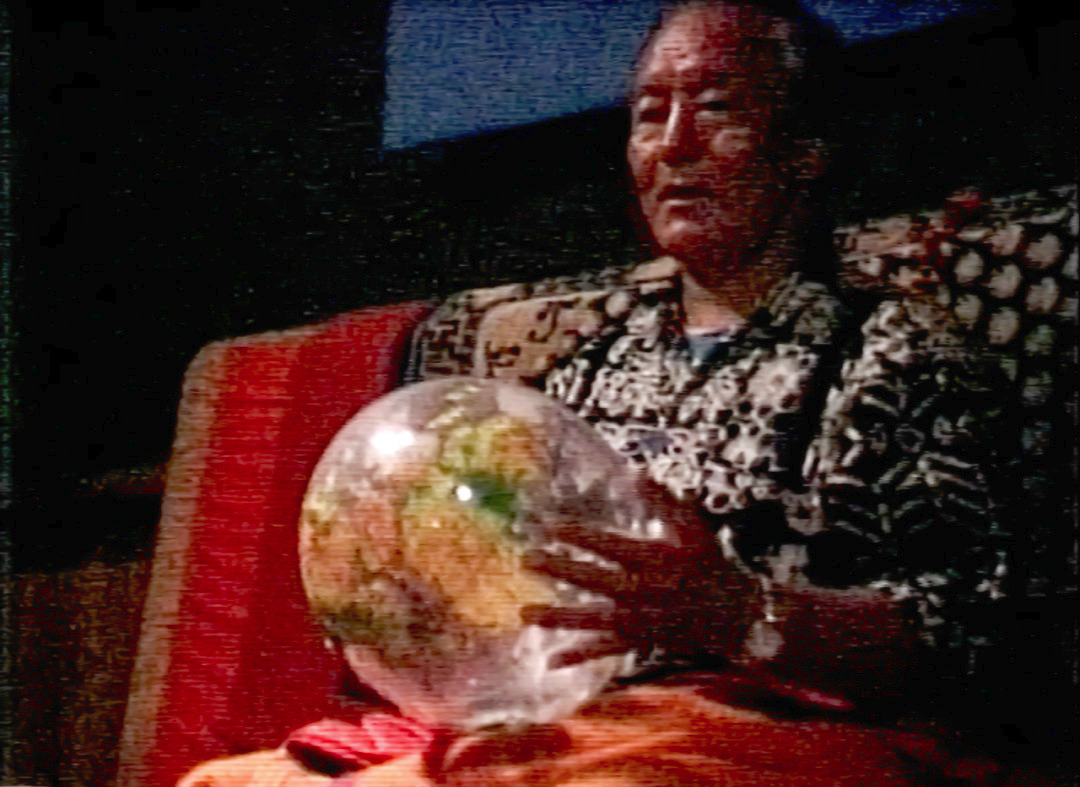
In this second photo, which is a screen shot made from video footage I took in Hawaii, you can see Rinpoche holding in his hands an inflatable globe that he was given as a gift at a retreat there. I feel that the photo captures Rinpoche’s care for the whole world, that I have sought to emulate.
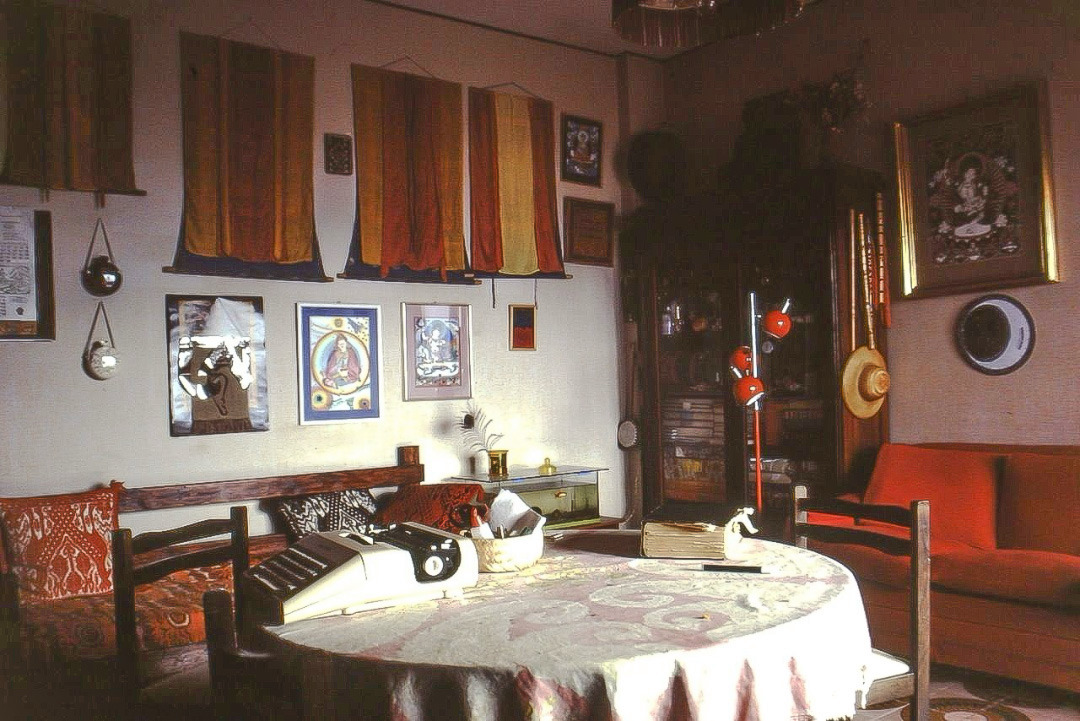
When I was invited by Norbu Rinpoche – after a retreat he gave at Monte Faito, in the mountains near Naples – to visit for the weekend, the Namkhai family’s private apartment in Formia, halfway between Naples and Rome, I had no idea that I would end up staying there for six months and that, during that time, Rinpoche and I would begin work on the book that would become ‘The Crystal And The Way Of Light: Sutra, Tantra, And Dzogchen’, that has now been translated into more than 30 languages.
In the photo above, you can see the living room of the Namkhai family apartment, the dining table at which Rinpoche and I worked, and the sofa on which I slept during all those months.
This photo was taken, of course, long before Merigar, the first centre of the Dzogchen Community, was founded.
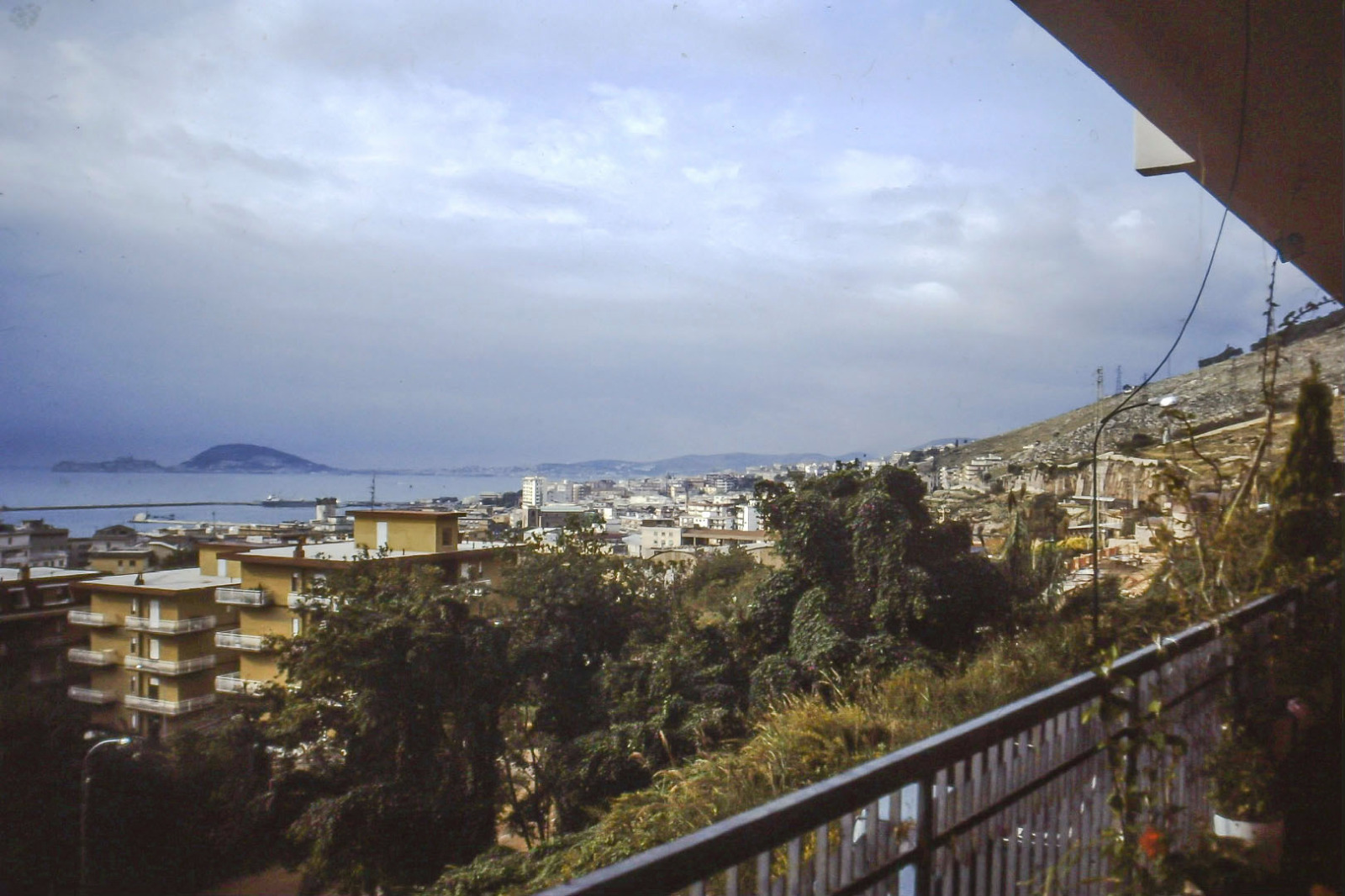
The next photo is the view from the balcony of the Namkhai family apartment in Formia, that looked out, over the Mediterranean Sea towards the town of Gaeta. Rinpoche, at the time, was still working as Professor of Tibetan and Mongolian culture, language, and literature at the Oriental Institute of the University of Naples, and Formia was conveniently located more or less half way between Naples and Rome, with the result that Rinpoche could easily travel by train or car to each of those two major cities when necessary, which often later did to take flights to other countries.
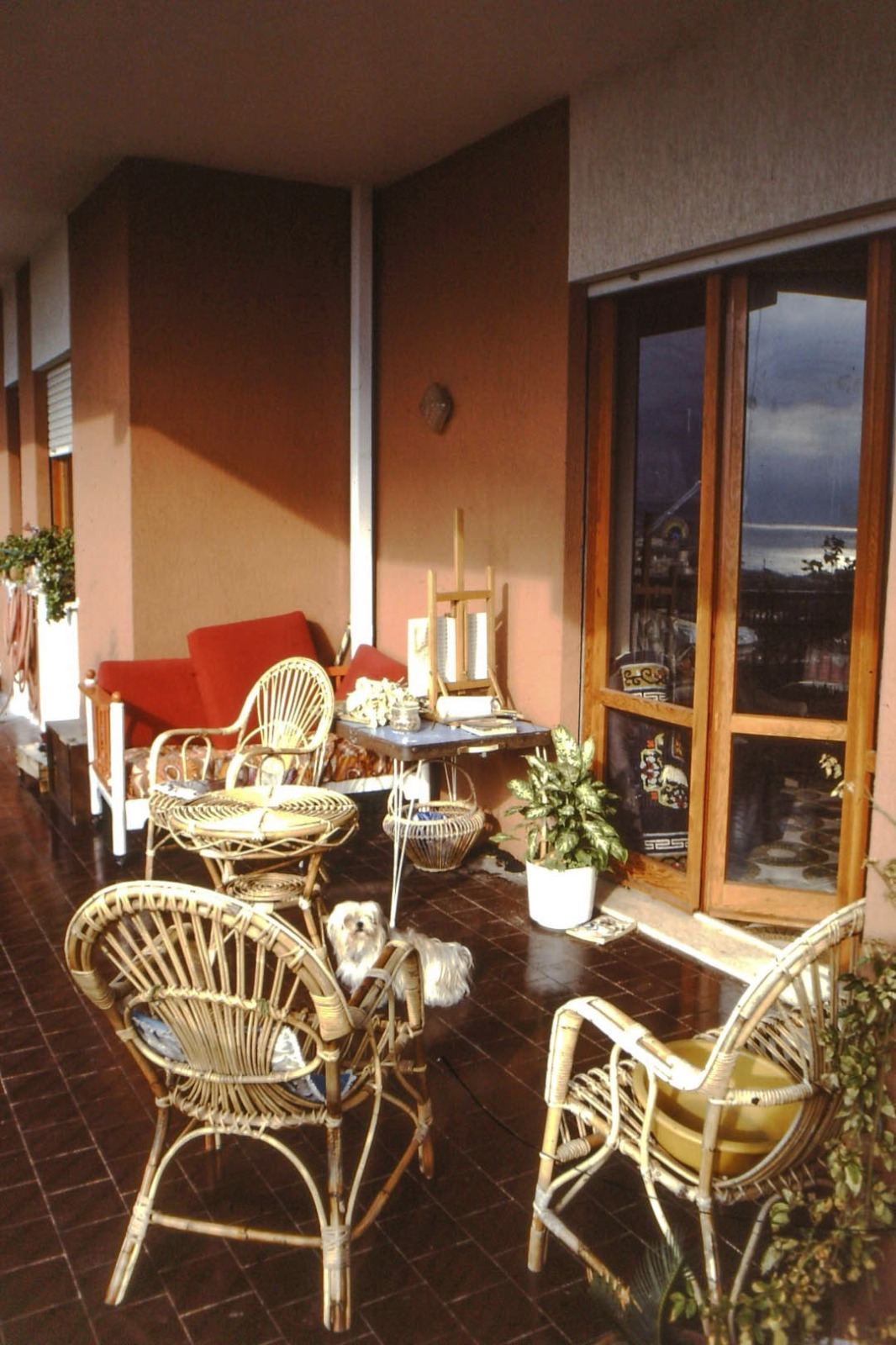
Above you can see a photo of the balcony outside the windows of the living room of the Namkhai family apartment, where I often used to sit with Rinpoche to practice, to write, or just to talk, during the months I stayed with the family.
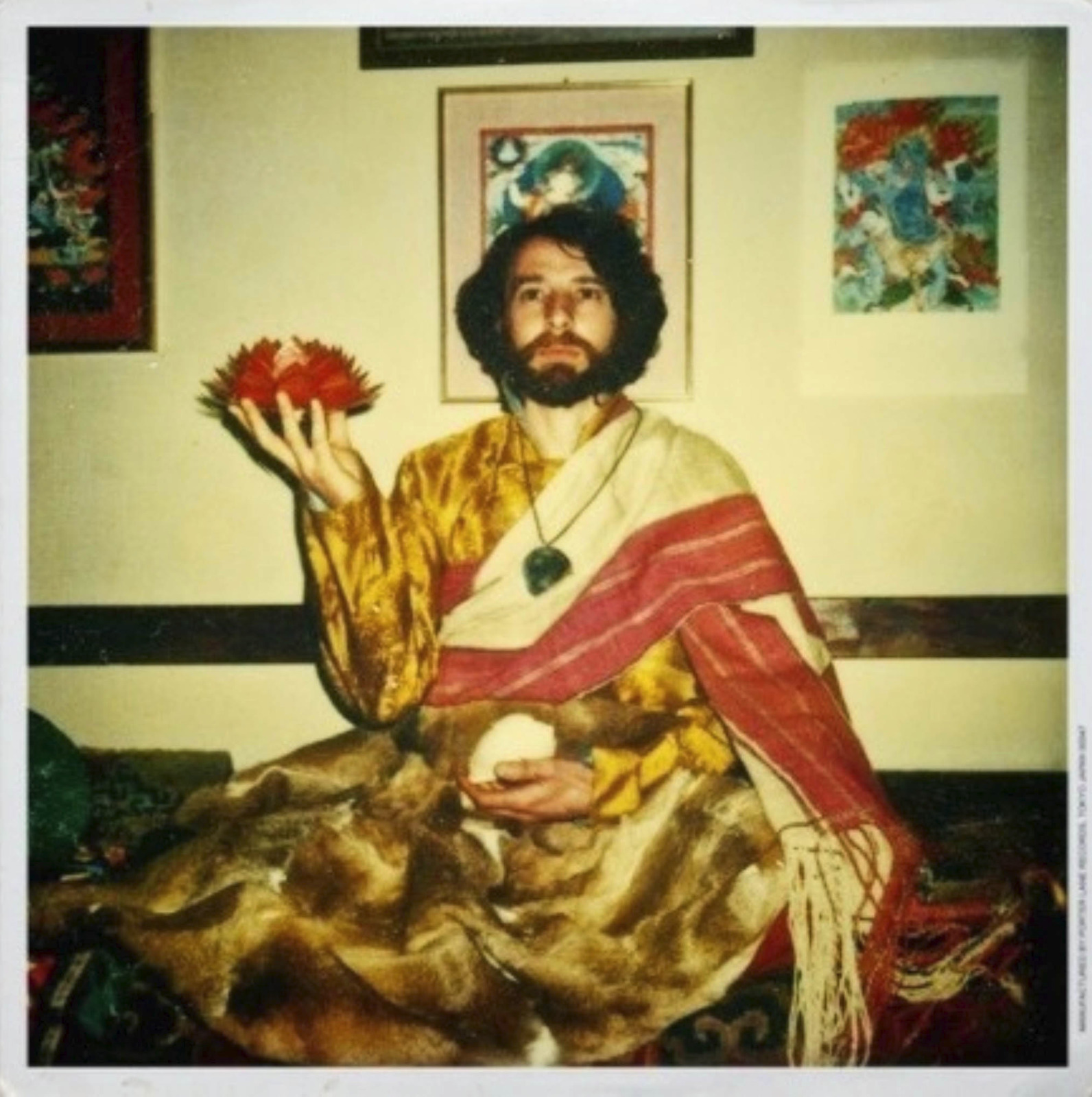
Finally, here I am – sitting on the sofa in the living room on which I slept during those months, in a photo that Norbu Rinpoche himself took with my camera after he had personally – with much laughter – dressed me up in his Nagpa robes and posed me for the shot.
I am holding items Rinpoche had chosen for the photo: a lotus in my right hand, and a conch shell in my left hand. He also arranged the Tibetan necklace that you can see hanging around my neck.
Given how much Rinpoche and his family were laughing while Rinpoche dressed and posed me, it took a lot of effort to follow Rinpoche’s instructions as he called out, while he focused the camera on me, ‘Stop laughing, John..!! Look serious…!! Don’t you dare even smile..!! That’s right, John…gaze into space…!! There you are, it’s all done…!! Now, you can relax…!!’
Norbu Rinpoche had an extraordinarily strong work ethic: he always worked very hard.
While I was sleeping on that sofa in the living room of his family apartment, I would often wake up very early in the morning to find that – while I still slept – he had for several hours already been sitting writing at the dining table.
On such days, when I finally woke up, Rinpoche would often read me what he had written down about the lucid dreams that he had had the night before.
But, although he always worked very hard, he also liked to play.
And those who worked with him, as well as working hard, always had a lot of fun.
His sense of humour was as strong as his work ethic, and he loved to joke around with his students.
By the time of the Monte Faito retreat, which was by no means my first retreat with Rinpoche, I’d already experienced at first hand how much fun he would have – as a lama born and raised in what Westerners often back then thought of as a fabled ‘Tibet of magic and mystery’ – playing with the tendency of his students to indulge in spiritual fantasies, not only in relation to the Buddhism of Tibet, but also in relation to him.
In this spirit of fun, he was very good at keeping an absolute ‘poker face’ while getting people to agree to wildly improbable propositions he would make, after which he would then pull the rug out from under them by telling them he’d been testing them all along to see how gullible they were, or that he had wanted to find out how much nonsense they were prepared to agree with just because it was him – a Tibetan lama born in Tibet – saying it.
When Rinpoche first took me to his family’s apartment in Formia, for example, I found that – just inside the front door – there was a large and very heavy stone pestle and mortar standing on the floor of the lobby.
I couldn’t help noticing this pestle and mortar, because the first time I entered the apartment, I banged my foot hard against the mortar as I walked in, and Rinpoche immediately asked me why I thought it was there.
Rinpoche’s face was so expectant of an answer that I didn’t have much time to reply, so I said that I thought he probably kept the pestle and mortar there as an ‘awareness trap’ to see if – as they were coming into his family home – people were distracted or of if they were resting in present awareness, as he had taught them.
Rinpoche nodded enthusiastically, encouraging me to go on and expand on the idea of the ‘awareness trap’, which I did.
Every time I stopped talking, Rinpoche asked me to go on and say more, as he nodded in seeming agreement with me, reacting as if I’d grasped the reason that the pestle and mortar was in the hallway – a secret that no one else had ever grasped.
Rinpoche’s whole family, who were gathered to greet me as I arrived at their home, watched this exchange, and they also nodded and smiled so encouragingly that I felt proud that I must have hit the nail on the head with my exotic explanation.
It wasn’t until about a month later that Rinpoche’s wife, Rosa, finally let me in on the joke that the reason the pestle and mortar were really there was that the patterned ceramic floor tiles in lobby had come unstuck, and the pestle and mortar were the only things the family had found to hand that were heavy enough to keep the tiles in place while the glue that they had used to fix them down had time to harden and set.
So much for my intuitive mystical insight…!!
Everything I have written above is, of course, no more than an approximation: I’ve done my best to describe these places and past events in words and images, but the reality of what happened is something else again.
The mind has an incredibly powerful interpretive faculty that connects flashes of thought occurring instantaneously into a vortex of virtual interpretation, constructing an elaborate, heroic and tragic story about a person (in this case, a certain ‘John’) who supposedly exists through time.
But the entire ‘world’ is, in fact, already ‘gone’ every instant.
What we call ‘memory’ is actually just thought energy, a specific patterning that is popping up in consciousness right here and right now.
Just as in a dream in which the dreamer might dream a detailed backstory that never actually happened, this ‘history’ of ‘John’ that I am sharing with you here is, in reality, actually just a current flavor of katag and lhundrub – voidness and self-arising manifestation – dancing co-emergently with each other in the present moment.
I hope that you have enjoyed the play of the energy of these words and images as they appeared in your awareness as you read them and looked at the photos, which I have offered here in the spirit of playfulness with which Norbu Rinpoche – the first time I set foot in his family apartment in Formia – engaged with me, using the riddle of the purpose of the strange placement of the heavy pestle and mortar in the hallway of his home, to tease me out of my habitual thought processes and towards resting in the reality of ‘what is – however ‘good’ or ‘bad’, ‘positive’ or negative’, ‘what is’ might seem to be.
In the same way, in every moment that I spent with him, Rinpoche encouraged me to go beyond the deluded mind that – entering into conceptual judgement – divides the seamless web of ‘what is’ into ‘this’ and ‘that’, ‘good’ and ‘bad’ and ‘self’ and ‘other’ – falling into the habitual misperception through which the experience of the natural state of the display of spontaneously self-liberating awareness comes to be mistakenly experienced as the dualism of samsara, with all the suffering that implies.
Be well, and live long…
. . . . . . . . . . . . . . . . .
Over the last month, I have begun to experiment at my recording studio here in London with AI-assisted music generation.
One of the first experiments I did with music AI was to try to set to music a lyric I spontaneously made up in one of those moments back in the old days when Rinpoche used to ask, in turn, those who were ‘hanging out’ in a circle around him after the teachings to sing something or other – any old thing that came to their mind in the moment.
Me being ‘Shanespeare’, when my turn to sing came, instead of singing a pop song or folk song, or something else from memory, like a lot of people did, I made up in the moment a simple, repetitive mantric circular lyric in English and sang it to Rinpoche and the crowd gathered around him.
I could see, as I sang, that Rinpoche really liked the lyric and he quickly began to sing it back to me.
These are the words that I sang to Rinpoche that evening, over and over again, with subtle variations, which he, and then everyone else there joined in with:
“In the time….
In the timeless time….
In the time before time….
In the time before time began”
The ‘timeless time’ is obviously the ‘now’ when we are fully present and beyond time….which Rinpoche understood immediately and began to sing the words back to me…so that we were both together in ‘the timeless time’ and then, when the other people around him also began to join in singing along with him and me, we were all present in the same moment together…..and it was a very beautiful.
I obviously couldn’t aim to match that moment with the music I programmed the AI to make, so I tried to make a choral version of the lyric, and below you’ll find one of the several versions I made of the track….
If you feel you would like to read and listen to more of my work, or if you would like to write to me, please do so by going to my Substack publication, which you can find by clicking on the following link: