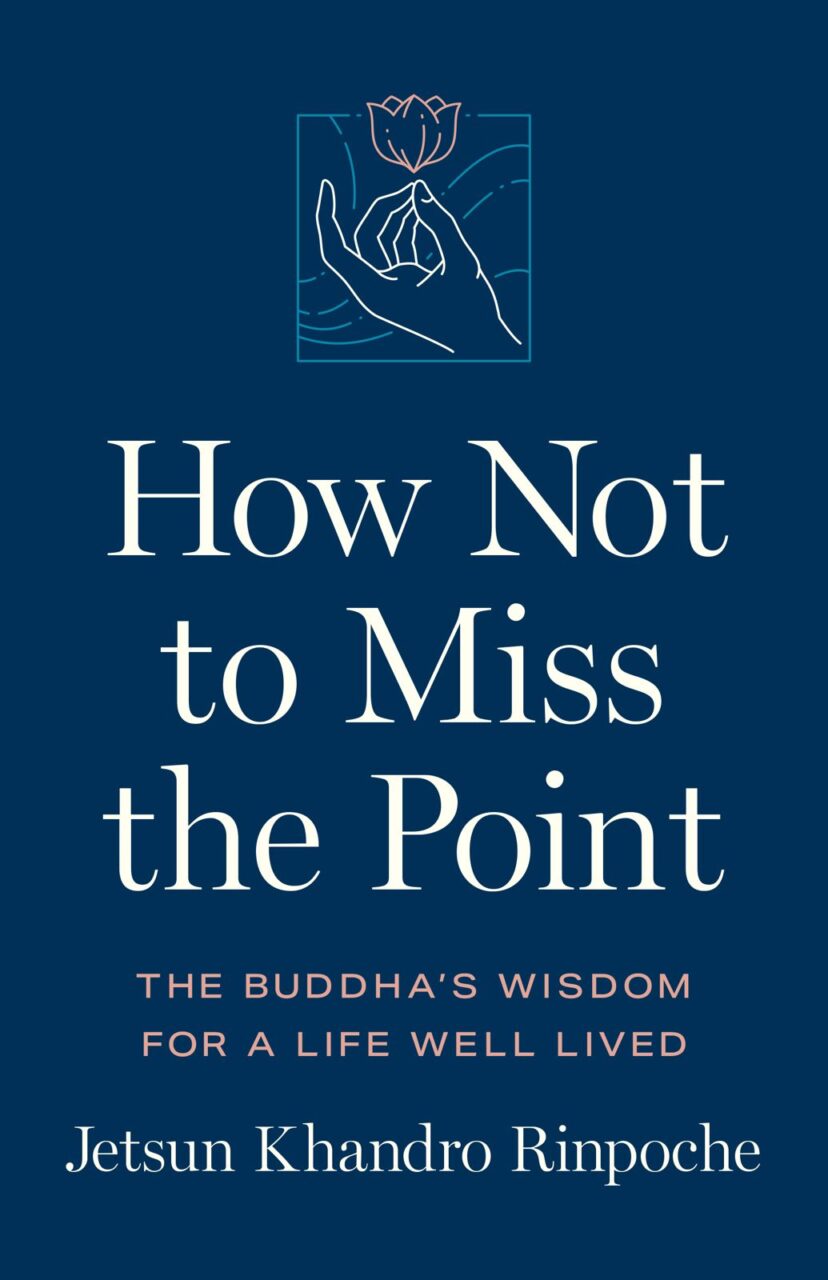
The Buddha’s Wisdom for a Life Well Lived
Jetsun Khandro Rinpoche
Shambhala, 2025.
Review by Andy Lukianowicz
This is the long-awaited second book [following This Precious Life, 2003] by Jetsun Khandro Rinpoche, who has been teaching to centres under her spiritual direction and to interested audiences in general in Asia and the West since 1987. Edited from transcripts of oral teachings, and peppered with [usually self-deprecatory] autobiographical musings, it comprises two parts: one, the Buddha’s advice for a meaningful life, and two, getting to the heart of practice.
This marvellous book, as well as original statements relies on Khandro Rinpoche’s gift of restating familiar thoughts [and this book is based on the thoughts of Buddha 2,5000 years ago] recast in a fresh way. Anyone who has attended a teaching by Rinpoche will confirm this, and seen her teaching manner evolve, congruent to the changing needs of changing times, especially taking on the urgency needed to address our highly troubled times as evinced by this collation and collection of timely teachings.
The book comprises two parts: The Buddha’s Advice for Leading a Meaningful Life, and Getting to the Heart of Practice, thus adhering to the classic format of presenting the view: Buddha’s teachings on mind and being in this environment, followed by advice on practice, what to do in order to resolve the human predicament or samsaric existence and accomplish the fruit of nirvana.
Let’s start with some striking phrases, to introduce newcomers to Khandro’s teaching style, to see the way she adroitly and masterfully coins, adapts and moulds seemingly straightforward turns of phrase and quips to get readers thinking afresh. From the first part, treating fundamental issues, such as the essence of Buddhism: “The Buddha’s actual awakening was probably very simple: just a question, an answer, and a change of perspective.” Another striking statement: “To become a non-Buddhist is the ultimate goal.” On the three Basic Laws of Nature: “The logic of Buddhist ethics does not have to do with any religious belief;” and on compassion: “Compassion releases others from your struggle to make them conform to your wishes.”
Interestingly, Khandro Rinpoche gives a fresh insight on Shariputra’s four-line definition of Buddha’s essential teaching given to Mahakashyapa, which Padmasambhava in Garland of Views quoted to define the essence of the Hearer’s Vehicle, interpreting as a condensed summary of teachings from Theravada (line 1) on non-virtue to eschew, Mahayana (line 2) on virtues to adopt, and Vajrayana (line 3) on mind-training, summed up thus: This is Buddhadharma (line 4). Rinpoche warns “Extreme reliance on something outside of oneself creates corruption: corruption of the individual, corruption of society, and therefore corruption of spirituality itself;” and, on ego, suggests “When joined with awareness and discernment, this self-cherishing ego can become the reference for cherishing others.” Talking on Mind Training: “Mind is the artist….. This is what was taught by the Buddha – but this teaching is beyond any religious discourse. It simply illuminates the basic responsibility of being human: that we are human beings with beautiful powerful minds. This is what the Buddha discovered.”
On practice, she discusses the three aspects of the guru: the outer teacher guru who imparts to us the view: teachings, transmissions, pith instructions and practices; the inner guru, who guides our practising and digesting what we have been taught; leading to meeting the secret guru: recognising our true wisdom fundamental nature of mind. This concurs with a brief teaching on guruyoga and the role/need of a guru, by Chögyal Rinpoche during a retreat at Merigar in 1990: ‘When we receive direct transmission we discover our real condition, then we learn various methods for our realisation and finally, using these methods, slowly slowly we realise something concretely.’ Again, on the guru Khandro Rinpoche offers cautionary advice: “In particular, look out for the tendency to befriend the teacher….[who should be] a person who can provide you with the guidance you need, and not simply the guidance you want.” Further: “While you style yourself as a serious Dharma practitioner, inner transformation will be neglected.” And, perhaps the most striking: “The greatest kindness a teacher can actually show to a student is to die.” And finally: “It is not that you have to continually think about liberating all sentient beings, although that would be good. You could just be a sane human being.”
This book of teachings is true to the fundamental teachings of Buddha, constantly probing, undermining ready-made learnt answers, dogmatism and self-righteousness instead finding ways to integrate self-acceptance, to unmask self-deception, self-aggrandisement and futile striving for a mentally created goal and to break free of ingrained neuroticism in order to enable us [by letting ego get out of the way] to experience the basic simplicity of self-awareness and so naturally self-liberate in the moment, moment by moment. [This was also the key to Korean Seon/Chan master Daehaeng Kun Sunim’s teaching when she succinctly said: ‘To discover your true self, “I” must die’; in ‘Wake Up and Laugh’, Wisdom, 2014].
The teachings coalesce around the early teachings of Buddha himself and to a lesser degree of the early Indian teachers who succeeded him. She points out that “Buddha… never claimed to be anything special, and he never claimed to be an intermediary to some higher being or higher self.” In this regard, Rinpoche’s observations on the problems entailed in the rampant Tibetan tulku system are food for thought. Discussed in depth are teachings on the three marks of existence, and the cause of duhkha – ignorance, Tibetan marigpa, “not knowing the true nature of things” further defined as “the subtle layer of assumptions upon which we base our confused view of the world”…”stupefied by the mind’s response to the previous moment, consciousness becomes a biased sort of energy,” untangling which there “comes the cessation of suffering and struggle”.
Perhaps this is a useful place to point up two recurring, major themes in the book: the reiterated suggested contemplations to ponder at different stages of the discussions; the constant reminders that it is training the mind, meditation, “the actual practice of the Buddha’s teachings” that anchors our practice in reality; meditation is the way to unmask the monkey mind, and helps practitioners “avoid spiritual dramas” [mainly concerning relating to the guru]; and moreover graduated meditations leading to formless meditation enabling relaxing in the primordial state.
Another recurring theme is that of kindness and compassion, with detailed analyses of what these are, and are not, and how they are essential for spiritual growth and also “from a simple humanitarian point of view”. The remedy Rinpoche proposes to “living in a bubble of selfishness… with only three inhabitants, me, myself and I” entails “four simple steps to cultivating sympathetic understanding: First, let sympathetic understanding knock. Second, open the door and let it enter. Third, welcome it and allow it to rest. Fourth, aspire to hold sympathy for others in your heart.”
“Walking the path of Dharma is important because we cannot underestimate the power of habit.” Interestingly, Rinpoche identifies, alongside the drives of “illusory, temporary passions”, as equally important, “the challenges of incompleteness” [lack, is Karen Horney’s term]; yet “to practise the Dharma correctly, you must take everything in your life” and precisely “all emotions, experiences, and stumbling blocks, into the practice of meditation.” Elsewhere she markedly affirms that there is “nothing wrong with emotions”.
There follows a marvellous teaching: “Enlightenment or any realisation does not happen because we will it or demand it. Nor does it happen because we belong to a profound lineage, or sit on a throne, or intellectualise philosophy.” There follow explanations of why we need a teacher and definitions of guru and lama, of devotion, of the necessary qualities of the teacher [with twelve poetic and apposite analogies for the guru spoken by Buddha in The Pattern of the Stem Discourse], how one can have many teachers, how the notion of loyalty is misleading in this context, not least because the guru-disciple “has more to do with confidence than loyalty.” Now, some useful thoughts on the ways Western culture will affect Buddhist teachings, how western Buddhists must not misconstrue cultural trappings, institutionalised practices and dogmatic rules and statements as being the essence of Dharma, and how having “a balanced and genuine approach to study and practice is imperative,” concluding that a true teacher will help the student to realise experientially the teachings directly thus “becoming absolutely and totally independent of the teacher,” thus also obviating “spiritual melodramas” in relating to the guru that merely “display ego’s need for attention.”
Rinpoche also treats the importance of direct experience and its consideration, that is peculiar to Buddhism, in light of the ‘four seals’ of Buddhism: the first, impermanence, entails recognising change in every moment, the second concerns suffering, and Rinpoche observes, concerning relating to others, that one needs “to watch your emotions and constantly examine your inability to free others from yourself”.
She also warns about the nature of doubt, deeming it the sixth afflictive emotion, as “the greatest hindrance”, rooted as it is on “lack of faith, or trust, in the extraordinary power of the human mind.” Congruently, in a dream twenty-five years ago Norbu Rinpoche showed me a picture of a face and said ‘Questo e’ scetticismo’ – scepticism, the modern version of intellectual doubt relying on the purely rational conceptual mind that misconstrues reasonable self-inquiry thus favouring disbelief over confidence in our own inner capacity.. In fact further Khandro Rinpoche adds “Through relying on direct experience and your own wisdom mind, you can put your confidence into action.”
Returning to the four seals, the third concerns the emptiness nature of all phenomena, which contradicts the beliefs about reality that, “conditioned from childhood, in this and many lifetimes”, shape our lives. As pithily put by Buddha in the first turning of the wheel of Dharma, “What is not mind? What is mind?” Rinpoche tersely points out, contemplating and understanding this “is the core essence of what it means to be a Buddhist.”
The fourth seal states: Nirvana is Peace. Simply put: “Nothing changes, yet everything changes because your perspective changes.” Here at this point Rinpoche returns to a triadic simile of Buddhist types regarding treadmill Buddhists [diligent and “really holy”], candyfloss Buddhists [caught up in cute cultural trappings] and “the rest of us” who by changing perspective through direct experience understand the fourth seal “which is about being able to relax… because one sees that beyond impermanence, suffering and [trying to grasp] the [ungraspable] emptiness nature of all things, there is peace”; and this is what instead “makes one a good Buddhist…. I leave the choice up to you.” There follows a warning: “Do not try to escape from this world. Simply be”, and a plea: “With trust in your innate goodness, you could choose to simply be a good human being.”
Rinpoche also reminds us that Buddha foresaw how difficult practising the Dharma would be for future generations: “like a cup flowing upstream,” that going against the flow of samsaric neurosis requires practice which inspires confidence that direct experience of the innate wisdom then spurs us into action. Rinpoche then comments on how our craving for a Dharma of convenience requires courage to overcome so that we do not merely pose as Dharma practitioners, thereby ‘missing the point’ making inner transformation impossible. All this she sees as signs of our degenerate times, adducing especially social media as typical examples of our times of “unkindness and confusion”; further information can be found in Shannon Vallor’s book The AI Mirror.
A beam of light shines through when Khandro identifies “a shift in perspective” as the key: “Since the only thing you have any control over is your own mind, it is your choice how degenerate to make this mind” and later asserts “Essentially, whenever one awakens to innate goodness, it is the dawning of a new aeon, a good time. The times are about what each one of us makes of today – which is actually not that bad. You and I are alive in today’s times and it is we who will make this a good or a degenerate time.”
There follows some heart advice from Trichen Mindrolling to his daughters [Khandro Rinpoche and her younger sister Jetsunma] that is key to this book so I will quote it verbatim: “You can choose to walk on a path made by others. This will be easy, but the path will be the one to decide where you want to go. Or, you can make a new path. This will be difficult, but you will be the one to decide where you wish to go. When you make your own path with wisdom, conditions will never rule you.”
Practising this pithy teaching, in Rinpoche’s words, will “not destroy degenerate times at least it will delay them.” Further, Rinpoche sees degenerate times as samaya and that going “beyond the hurdles of times and conditions, there is a time before degeneration actually happens”; “This is what it means to train the mind…. to work with your perspective”.
There then follow some remarks on recent “not easy” situations faced by spiritual communities and, without whitewashing [or, more appositely, om-washing] a plea to focus not on the criminal behaviour of teachers or groups but on the “many words of wisdom” heard in teachings in western centres, then offering useful advice on “releasing tension” in these troubled communities through silence and mind training.
There follow considerations on the “challenges facing our civilisation… the essential aspects of our civilisation – economics, politics, spirituality, and the environment are in trouble” where the solution is “to watch your mind”. Moreover, “for the sake of the future generations who will inherit this planet” we should “offer prayers and good aspirations”. For a more robust and proactive engagement, I recommend reading Susan Bauer Wu’s A Future We Can Love, for the Dalai Lama’s views on what we can, and should, do.
This is where Rinpoche makes the above-mentioned startling assertion that “the greatest kindness a teacher can actually show a student is to die”, so the student must loosen their attachment to [or dependence on] being a student.
Then Rinpoche recounts how her Italian friend [and student?] Stefania was brought into Buddhism when a book fell on her head – twice! This leads to the subject of self-empowerment: “Ultimately, the Dharma belongs to you.” And, then, musing on “the karma of the world going through a transition” followed by the thought that the future of Dharma is in the West and discussion of the westernisation of Buddhism not being turning it into a commodity, Rinpoche bewails the “thought that has dropped into today’s psyche” leading to a “business deal approach” to Dharma, and bemoans “the tendency [of students] to pick and choose which teachings they like” which usually means those that are most “convenient” warning that this will be a test of our commitment in the West to practising truly, avoiding the many pitfalls spoken of in the book.
There follows a wisdom teaching of the 18th century yogini Jetsun Mingyur Paldron and an exhortation to practise training the mind and to realise and help others realise and understand impermanence, interconnectedness and the open emptiness nature of reality.
Going back to the very roots of Buddhist teachings: as Khandro points out, when Buddha spoke these teachings there was no such thing as Buddh-ism, they were simply words of advice on living a life more intra-personally and inter-personally sympathetic, fulfilling and rewarding. “Buddha’s Wisdom for a Life Well-Lived” indeed!