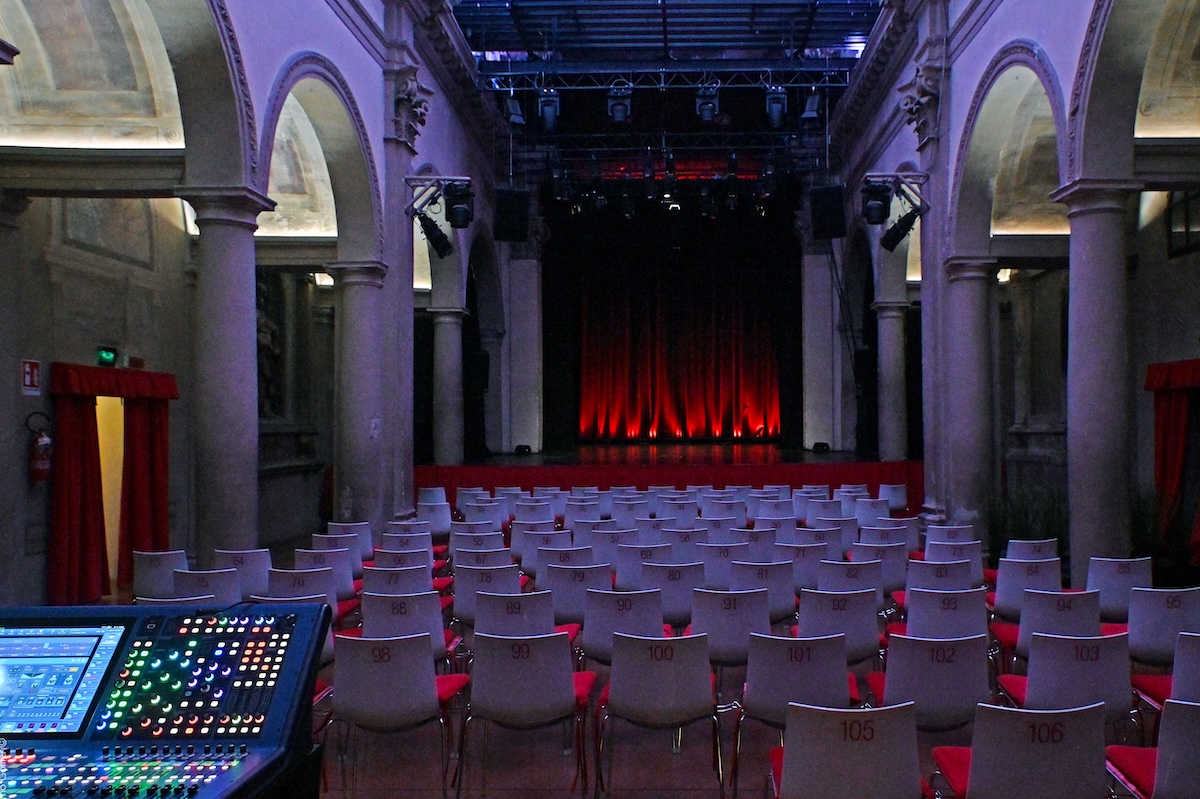
AngelicA – Music Research Center / San Leonardo Theater
Wednesday, November 26, 2025
Namkhai Yeshi MUSIC OF THE PRESENT TIME
EMDS6 (2024, 8’42”); various synthesis techniques, quadraphonic
Assonaggio (2023, 8’11”); synthesized and real-world sounds, extended stereo
Union of Sun and Moon (2025, 30’39“); synthesized and real-world sounds, live electronics, quadraphonic Turing Complete (2021, 6’09”); orchestral sounds arranged in imaginary space, stereo
Namkhai Yeshi computer Alessandro Di Maio live electronics
music by Namkhai Yeshi
curated by Massimo Golfieri
Music of the present time
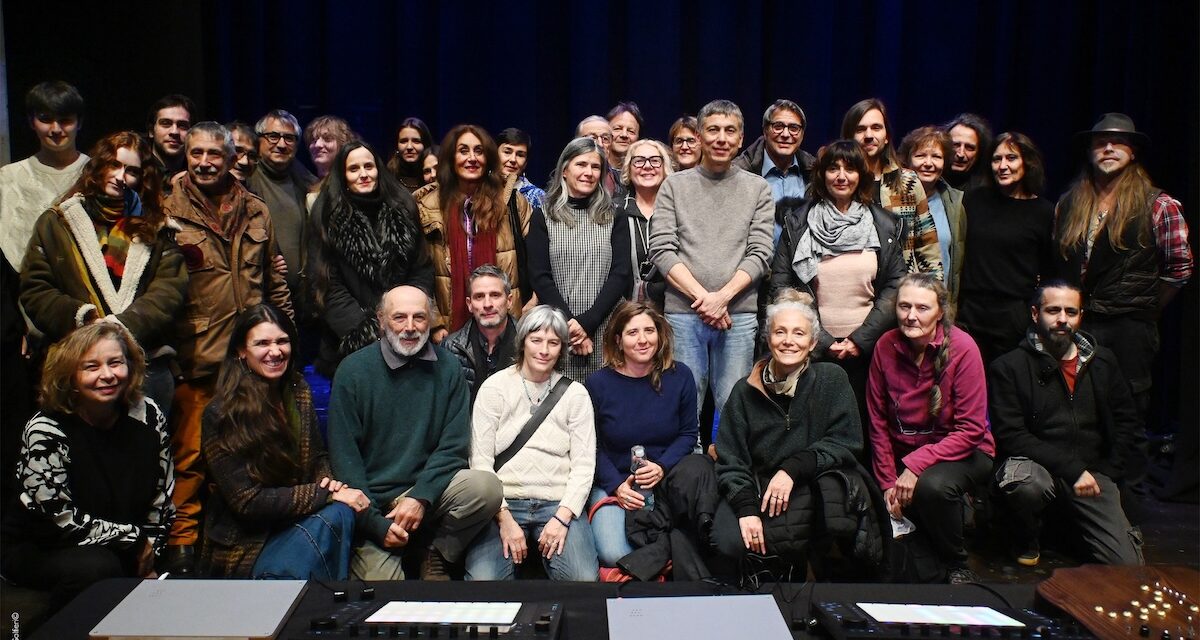
Namkhai Yeshi and Alessandro Di Maio at the Teatro San Leonardo, Bologna
Article by Tatiana Gambetta
The concert by Namkhai Yeshi and Alessandro Di Maio at the Teatro San Leonardo in Bologna is the result of a network of relationships, listening experiences, and affinities that have developed spontaneously, almost inevitably, over time.
My first encounter with Yeshi’s teaching took place in Merigar West, during retreats in recent years. His essential, direct language, deeply rooted in the present, made Dzogchen immediately alive and accessible, not only for those who already participated in the Community, but also for people dear to me, coming from creative and artistic fields, with no previous experience in Buddhism or meditation.
After those retreats, it was natural to continue sharing this experience outside the strictly spiritual context, bringing it to the worlds of contemporary art and research.
This journey led to my meeting Massimo Golfieri, a photographer and long-time friend who has been curating the visual identity of the AngelicA Festival, an international contemporary music festival, for over thirty years. AngelicA was founded in Bologna in 1991 as a space dedicated to the most experimental expressions of contemporary music. It is not just a festival, but a veritable listening laboratory: concerts, meetings, workshops, cinema, and record productions coexist in an idea of music understood as exploration, as experience, going beyond established listening patterns. Since 2011, the Teatro San Leonardo has become its home, transforming itself into a Music Research Center, a lively place frequented by different audiences.
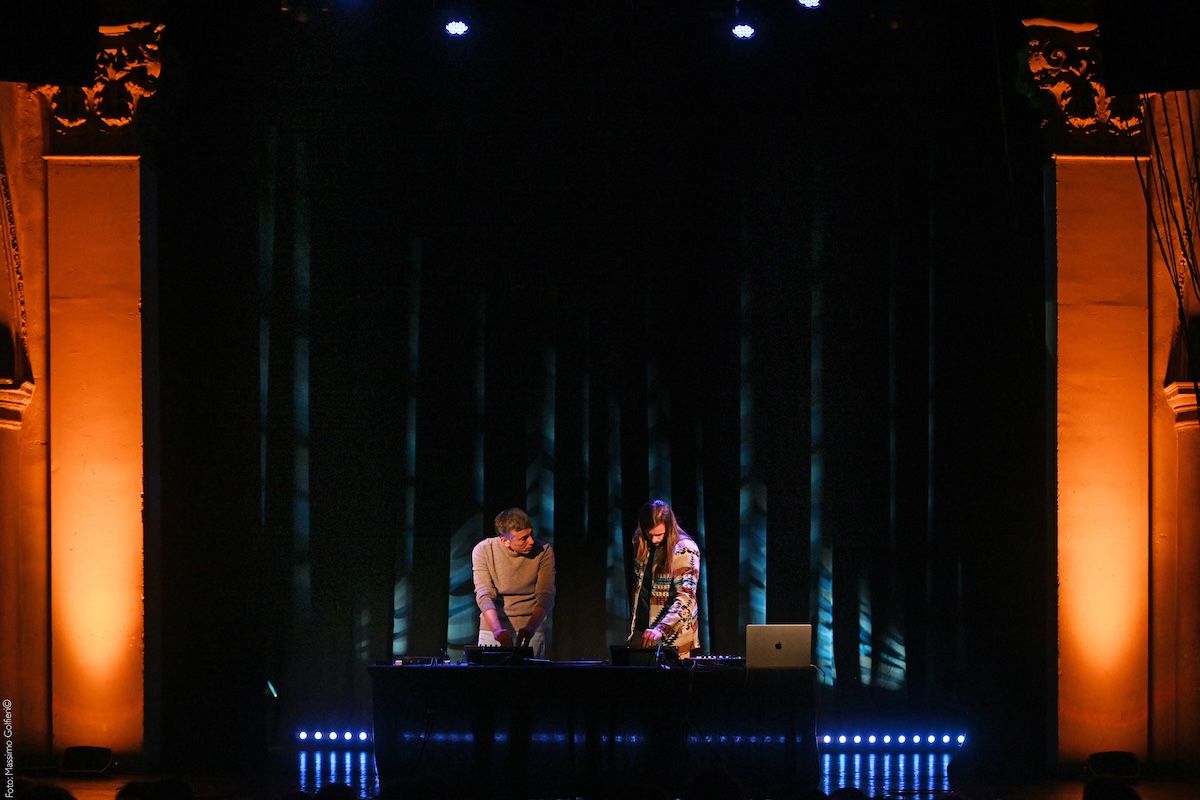
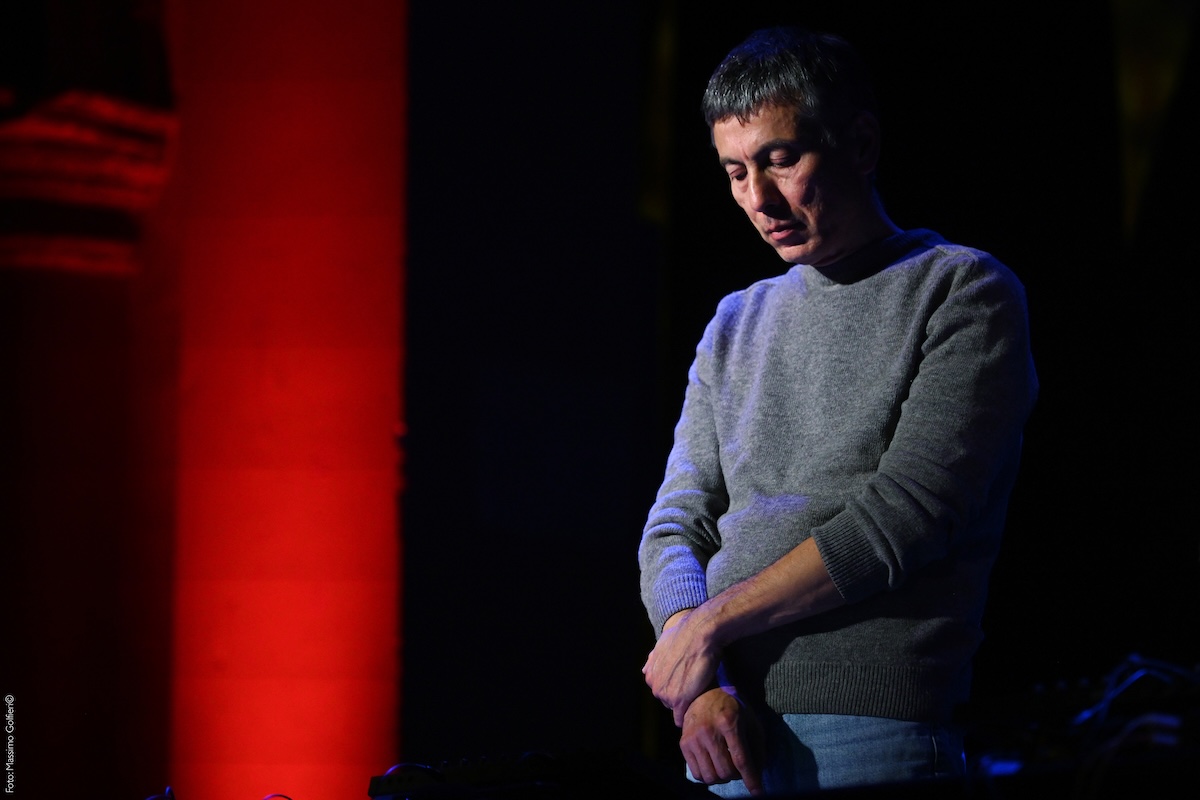
It is precisely in this context, so akin to Yeshi’s research, that the dialogue began to take shape. Through shared listening, informal conversations, and a common focus on the quality of the experience, a deep resonance between Yeshi’s musical work and the spirit of AngelicA clearly emerged. Some compositions shared on SoundCloud deeply impressed Massimo Simonini, the festival’s artistic director, who recognized in Yeshi’s music not only sophisticated formal research, but also the use of sound as a vehicle for knowledge and direct experience. This led to an invitation to present Musica del tempo presente (Music of the Present Time), a concert that featured Yeshi on the computer and Alessandro Di Maio on live electronics, in an intense and calibrated dialogue.
The evening brought together a diverse audience, including many members of the Dzogchen Community, regular theatergoers, and fans of experimental and contemporary music. It was a shared but deeply individual listening experience, as often happens when sound becomes a living experience.
The compositions, EMDS6, Assonaggio, Union of Sun and Moon, and Turing Complete, constructed true inner landscapes. Sounds that evoked primordial images, linked to the elements: water, wind, movement in space. Vibrations capable of physically acting on the body, transforming it from within. Not a guided narrative, but a journey.
By relaxing, allowing oneself to be touched without trying to control the experience, the sound seemed to reach intimate and often unknown places. Places where, despite starting from different perceptions, many recognized something essential and common. A silent, non-conceptual recognition that does not need to be described or compared.
And it is precisely here that Yeshi’s words find their full realization:
“The ultimate goal of my musical research is spiritual in nature: I want the audience, in the moment of listening, which I consider the moment of true artistic interpretation, not only to be transported into an imaginary world, but to develop a living presence and be led to reflect on themselves.”
During the concert, this intention did not remain a theoretical statement, but manifested itself as a concrete experience. It was not a question of “understanding” the music, nor of interpreting it according to aesthetic or cultural categories, but of “being there,” fully present, while the sound acted. Each listening experience was different, as different as the inner conditions of each person, and precisely for this reason authentic.
Yeshi’s acousmatic music, decontextualized and devoid of traditional instrumental references, combined with the spatialization and live intervention of Alessandro Di Maio, made it clear how sound can become a direct means of knowledge. Not something to grasp, but something that passes through us, opening up spaces of awareness.
In this sense, the concert at the Teatro San Leonardo was a clear example of how ancient knowledge can be expressed through contemporary languages, speaking directly to the listener’s experience. A successful encounter, in which music, presence, and community found a natural unity, leaving many with the desire to continue listening, not only with their ears, but with everything we are.
Concert by Namkhai Yeshi in Bologna
Article by Marco Baseggio
On the evening of November 26, in the space of the Teatro San Leonardo in Bologna (a particularly evocative former church), I attended the concert by Namkhai Yeshi, who was accompanied in his performance by Alessandro di Maio.
Before starting the concert, Namkhai Yeshi told the audience that the intent of his musical work is to induce the listener into a contemplative state, and in fact, the experience of that evening was particularly intense for me precisely because of the experiential journey that resulted from listening.
I had come from a rather demanding day, so I put myself in a condition of relaxed and aware listening as much as possible, and in this way, I was able to feel well how the sounds and vibrations reaching my ears and therefore my mind gradually, but decisively, dissolved one by one the tensions of the day. Remaining in the listening of the sounds arriving and at the same time the sensations and emotions manifesting in my personal condition, in a continuum of resonances from the outside to the inside, I entered into a deep connection with my most authentic nature. In those moments, I had the sensation that Yeshi and Alessandro somehow perceived our most intimate reactions and dialogued with us in the audience, in some way: from the outside to the inside and vice versa from the inside to the outside.
The culmination of my experience was when I had the clear perception of being in contact with space—I would dare say pure sky: it was an experience of profound freedom, which occurred more or less toward the three-quarters mark of the concert. This is the first time I have had the opportunity to recount this experience of mine. Then, gradually, guided by the sounds masterfully performed by Yeshi and Alessandro, this experience of mine of total alignment between external and internal sound and of profound openness transformed. Somehow the vision returned to being more “relative,” less all-encompassing, while still retaining a deep sensation of natural and very concrete relaxation.
An experience, at the same time, of practice and listening in the theater, together with a mixed audience of people from the Dzogchen Community and others. Beautiful! I am truly grateful to Yeshi and Alessandro for having been able to be part of this event. I hope to be able to participate in similar events again.
Addendum by Namkhai Yeshi
The concert took place within the context of the ANGELICA Festival, now in its 35th year and widely recognized for its long-standing commitment to musical research. The festival has been a significant platform for electroacoustic music: notably, Karlheinz Stockhausen performed there shortly before his passing, and the festival commissioned two works from him.
https://aaa-angelica.com/aaa/ee-extra-eventi/stockhausen-dissonanze
https://aaa-angelica.com/aaa/festival/edizione-festival-2015/stockhausen-secondo-giorno
All pieces were adapted for a quadraphonic setup (four speakers) with the support of two skilled sound engineers, Lorenzo and Lilli, and were played from my device. Both Alessandro and I worked using Ableton Live with Push 3. The fixed-media pieces—that is, works not performed live but previously mixed and spatialized specifically for quadraphonic diffusion—were output from my Push 3 via four separate audio channels and routed directly to the hall’s mixing desk.
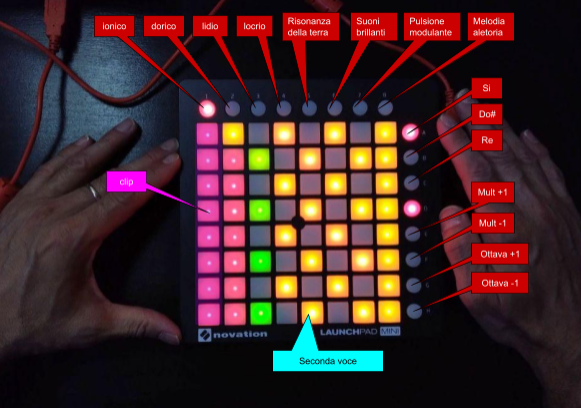
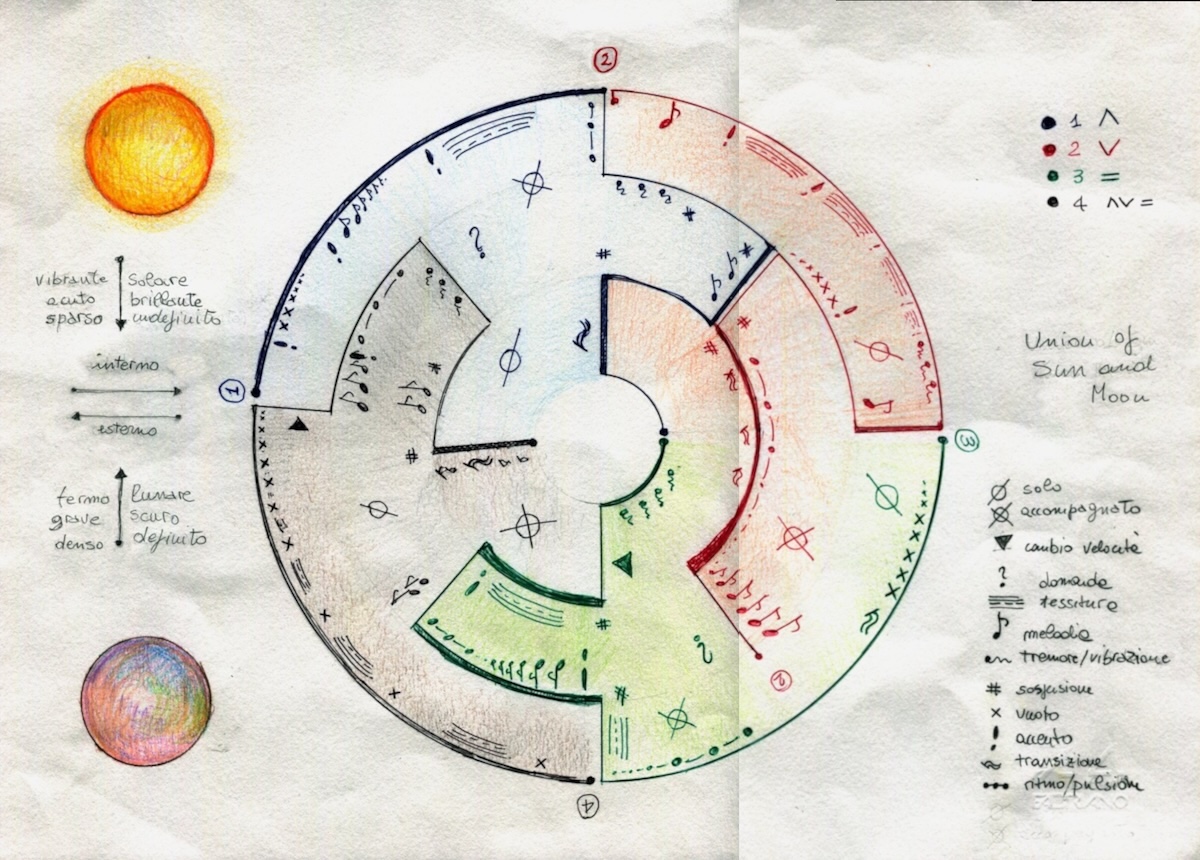
The piece Union of Sun and Moon was performed live together with Alessandro, who was also using a laptop connected to a Push 3. We agreed in advance on a set of formal constraints and created several audio clips designed to function coherently together; however, in accordance with the score, we did not listen to each other’s output during the performance.
When I composed this piece a few years ago, I had not yet determined a concrete method for performing it. In this sense, the process resembles modal jazz improvisation: one commits an entire life experience to a limited set of sounds, trusting that something meaningful will emerge, even if its final form is unknown. The structure we followed is inspired by the image attached (see above image), which is the actual score. It is intended for four musicians of any background or instrument, who alternate roles in a circular manner, similar to a mandala.
Finally, we also incorporated two analog instruments—the Chromaplanes—to test a compositional concept that will form the basis of an upcoming installation for MACO, scheduled to be inaugurated on its anniversary.