With Lopon Karma Phuntsho
A talk from the Shang Shung UK‘s the ‘Light of Kailash’ lecture series, a public platform for rigorous, accessible Tibetan studies. Inspired by Chögyal Namkhai Norbu’s lifetime of research and teaching, it brings scholars and practitioners together to explore Tibet’s languages, histories, arts, medicine, and contemplative traditions.
I want to firstly say, Tashi Delek, Kuzuzangpo, greetings to all. It’s not going to be a very academic presentation tonight. I often jocularly say that I’m a ‘pracademic’, a practical academic trying to take the findings and the knowledge from my academic research and apply them in practice as far as possible. And I’ve been trying to do so in the realm of education, entrepreneurship and cultural documentation. So what I would like to share today would be something that I’ve been doing for a couple of decades now in taking the Buddha’s teachings, the Buddhist wisdom, into our ordinary way of life.
Normally, in our part of the world, as native Buddhists, we are sometimes into this unfortunate situation of outsourcing Buddhist practice to experts, or even having monks to do Buddhist practice for oneself. And sometimes also taking a specific time or a specific amount of one’s income and savings and then dedicate that towards religious work. That is a very habitual practice that happens in Buddhist countries. Sometimes we overlook the fact that Dharma should be part and parcel of our life and that we should bring the Buddha’s wisdom into all aspects of our living.
In most Buddhist societies, people think of the Buddha as a spiritual figure, the founder of a religion. But he was also a kind of a reactionary going against the norms and givens of his time. He was a revolutionary thinker in changing the culture and spiritual thinking. He was a regenerative thinker in reappropriating and reinterpreting the spiritual topics of his time and also an innovator who found new solutions to problems in the world. But above all, he was a pragmatist, somebody who didn’t indulge in theoretical discussions and intellectual exercises, but rather sought practical applications that can bring about a positive impact.
The Four Noble Truths – a problem solving strategy
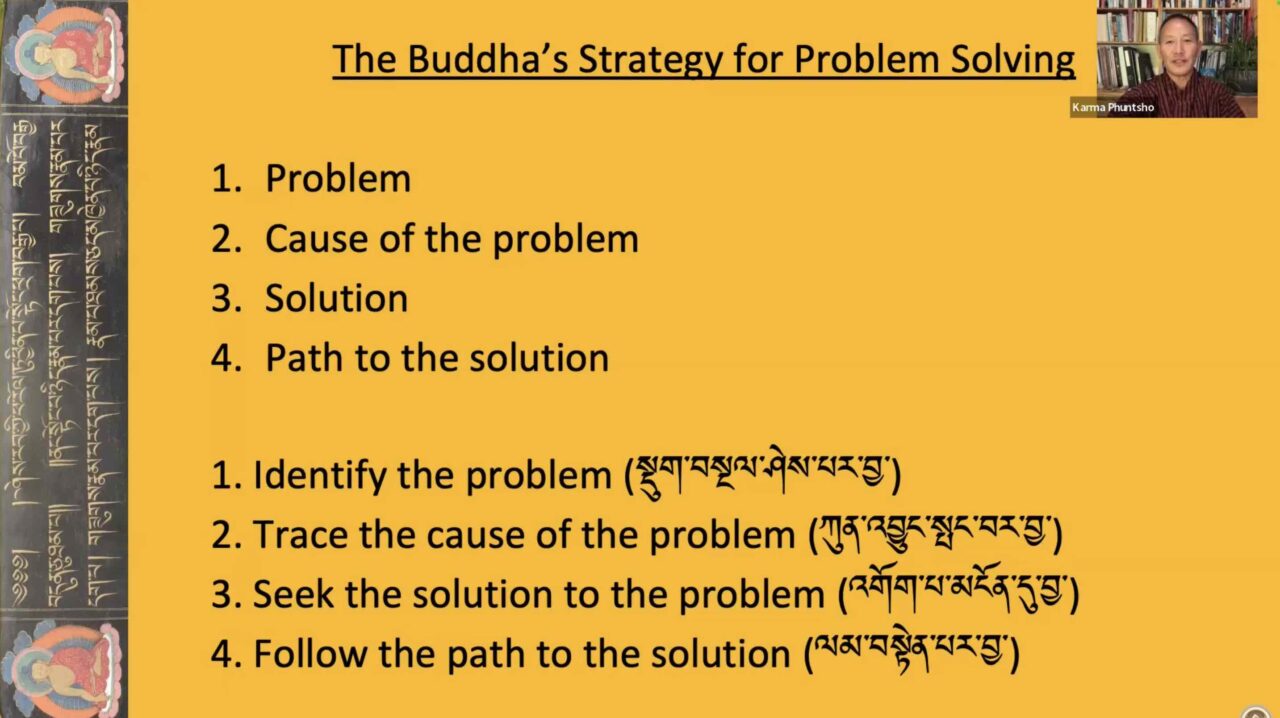
We sometimes forget that the Buddha was a very practical teacher. For instance, when we look at his first sermon in Deer Park, where he declared the Four Noble Truths, that life is full of suffering in birth, in aging, illness, death, and so on. Then there is the origin of suffering, that suffering comes from causes. And then the cessation of suffering, the cessation of craving and of attachment and so forth, and the path leading to the Eightfold Path.
In a monastery, this teaching is delivered in a serious manner as a very fundamental teaching in Buddhism. But if we look at it from a different angle, what the Buddha taught was really about problems and solutions. What the Buddha was saying is that life is full of problems, like sickness, aging, birth and so forth. The first truth is really that there is a problem. And the second truth is the origin of the problem, the causes that bring about problems. The third truth is about solution and the fourth truth the path leading to the solution. So this is how you can see the Buddha’s teachings on the Four Noble Truths as a problem solving strategy. In this respect, I think the Buddha was probably one of the earliest management gurus, if you take his teachings on the Four Noble Truths in a sort of management context.
The Eightfold Path
Then we have the Eightfold Path – right view, right intention, right speech, right action, livelihood, effort, mindfulness, and concentration. Often we look at this as a very spiritual Buddhist topic. But then what we have been doing in the business context in promoting social entrepreneurship is we’ve been taking this Eightfold Path as a way for an entrepreneur to think about the project.
The first important point is to have a right view or vision, which basically is a full understanding of the situation of the ecosystem, the legal, financial, social, cultural, environmental, and whatever aspects that one needs to know. And with such understanding and view, one can then come up with an idea, which is right intention, the wish to do something. And that idea, which initially is a very weak thought, is gradually moulded into a proper intention. And then it gets strengthened as a determination and a commitment. When one has this idea or plan, one has to communicate it as right speech, like pitching a business proposal, either in written or in oral form, to share the intention and the thought with others.
And then such communication is followed by action, actual practice and implementation, sort of ‘walking the talk’. And as one continues an action repeatedly as a source of one’s living, that turns into livelihood. And as one adopts something as a livelihood, it becomes a habitual practice and one experiences fatigue; whatever is done repeatedly gets tiresome and boring and one may feel like giving up through fatigue. Especially in the case of entrepreneurs, it’s a very lonely journey and people often give up through exhaustion. That’s when bringing in effort or enthusiasm can boost morale and put more diligence into the project.
And then as one keeps putting in extra effort to make things work, the problem that arises is that it may turn into drudgery and one ends up doing things mindlessly which is where one has to do things with mindfulness or consciensciousness. And finally, as one pushes through with any effort one puts in, one of the big challenges is distraction which can make one fail. So here finally, the eightfold path is about bringing concentration, bringing focus to the project.
So we take this Eightfold Path as a way for an initial idea of what one wants to do, then pitching and implementing the project, taking it as a source of living, putting in more effort, doing it mindfully, and then focusing on it until one succeeds and reaps the results. So this is how we often talk about the Eightfold Path in the context of entrepreneurship.
Going back to the Four Noble Truths, the Buddha has often presented them using the metaphor of medicine, that suffering like illness is something that one must diagnose and only having diagnosed it can one then trace and avoid the cause and through that attain the solution or, in the case of illness, health. And in order to attain that health one must go through the specific treatment. The path is really like the treatment that one must follow, diligently, step by step, expediently.
The problem of the problem
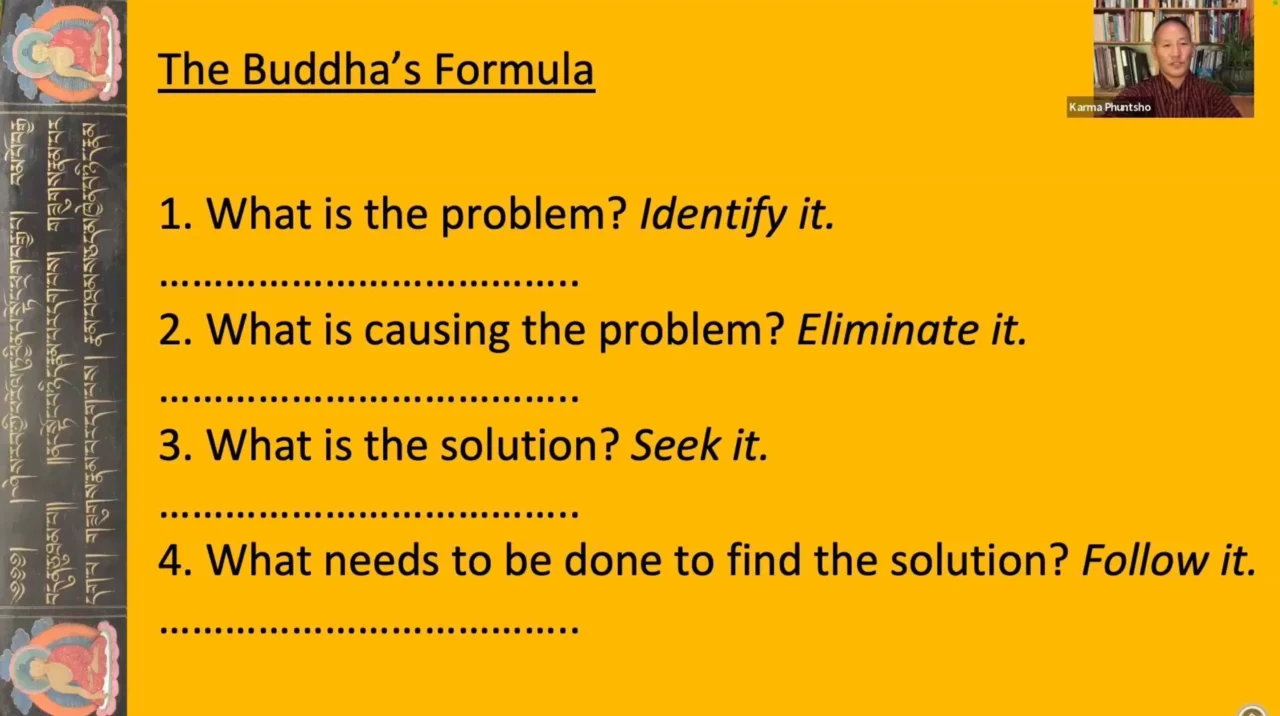
So in terms of solving problems, even in the Buddha’s first sermon we find a way of being very smart in problem solving. But we should remember that the Buddha’s focus was not on solving a specific problem. There is the problem of the problem.
For instance, when we talk about problems, the question of identifying the problem comes up. One man’s solution would be another man’s problem. We know for now, for instance, the US’s solution is Iran’s problem and Iran’s solution is Israel’s problem. Russia’s solution is Ukraine’s problem. In the same way in the business world, a business may have a heavy loan to pay back and therefore hike their prices. But that solution may create a problem for a single mother who is trying to make ends meet and can’t afford the new prices.
One has to go beyond just being smart for oneself to address the problems. And that’s why I think the Buddha, when talking about the path, uses the word “Samyak-drsti” (right view/vision) in Sanskrit. We have to know which problem, and the problem should not be a specific individual problem. It should really be aimed at solving the problem for a greater cause, greater community, or country, or the world, for sentient beings, and that the path leading to such problem-solving should also be a morally correct one.
So we have a new moral ethical addition. In addition to using the Buddha’s Eightfold Path as a very strategic means to seek solutions to a problem, we now need to also bring in the moral ethical compass to have the right vision. And when we talk about the right vision, there are many things that we need to know in order to get a very objective, responsible, useful understanding of the situation. And among them, one of the most critical, the cardinal sort of view or outlook one has to have, that one can learn from the Buddha’s teachings, is the understanding of dependent arising, of interdependence.
Dependent Arising
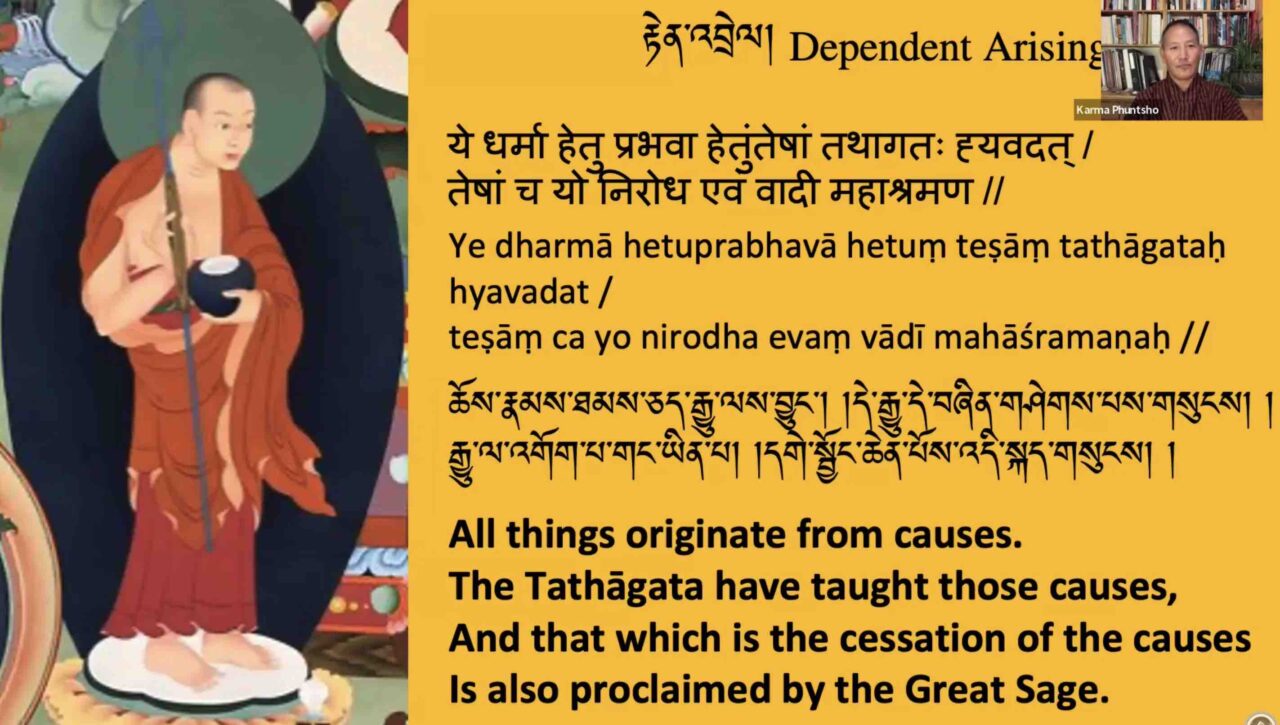
Ye dharma hetuprabhava hetum tesam tathagatah hyavadat / tesam ca yo nirodha evam vadi mahasramanah //
All things originate from causes.
The Tathagata have taught those causes,
And that which is the cessation of the causes
Is also proclaimed by the Great Sage.
In the Buddhist world, this verse is chanted in so many rituals. Most people don’t even know what it means, but it is used to consecrate temples and statues and also to create auspiciousness during ritual. It is one of the most common verses about how things come from cause and conditions. So I think that interdependence is the most important right view one has to have, particularly in today’s world where we are intensely interconnected. We can appreciate the Buddha’s theory of interdependence much more in today’s highly globalized world.
The gist of the Buddha’s theory of interdependence is that things don’t come from nothing or from an eternal cause. And then he also argues that things do not come from a personal cause. The results correspond to the cause: if the cause is a rice seed, it will lead to a rice harvest. If it’s a chilli seed, it will lead to chilli harvest. So results and causes correspond to each other. And then as causes give rise to results, they can expand and multiply.
So these are the main things that one has to keep in mind, I think, to really appreciate how things work, and especially when you’re getting into a project, it’s important to know exactly what causes lead to what results and how they come about and this kind of view becomes critical for understanding.
Mind
Then the second most important view or outlook one needs to have is the Buddha’s focus on the inner state of the mind or the inner spirit – it’s tricky sometimes in translating sem in Tibetan or vijnana, citta, in Sanskrit, which covers the entire world of emotions, concepts and so on. In the Buddha’s teachings such as the Dharmapada, the compendium of the teachings, the first verse makes the claim that mind is the forerunner of all things and all things are mindmade. Mind is the chief.
So this understanding that the inner state of the mind is the primary cause is also so important, especially for an entrepreneur because a lot of people believe that it is the external support that makes one very successful. But most of the successful social entrepreneurial journeys are results of the indomitable will and the courage of the entrepreneur. So we stress a lot the inner state of the mind being the most important, primary asset for any project.
Mind is the root of all phenomena
Then focusing on the mind, in the Himalayan Buddhist world, this phrase is bandied around a lot – “Mind is the root of all phenomena” – putting a lot of focus on the inner state of the mind. People often wonder what the Kangyur and the Tengyur, the vast canon of Buddhist works, talk about. I often say that around 30% of these books deal with the inner state of the mind and are really a deep psychology of understanding the different levels or states of the mind, what provokes attachment, what provokes hatred and so forth. A very thorough study of the ordinary state of the mind.
And then we have 60 to 70% of teaching talking about how to transform, train and improve this ordinary state of mind into a better one: a distracted mind into a focussed one, an aggressive mind into a calm peaceful one, an egoistic selfish mind into a compassionate altruistic one. So the vast amount of Buddhist literature, theories, philosophies, and even art, rituals, chanting, talk about how to transform the mind. Finally, some portions of the teachings talk about what happens when the inner potential of the mind is fully harnessed, when that inner capacity is fully developed. When one becomes the Buddha, what kind of clairvoyance would the Buddha have, what kind of compassion, what kind of composure. And as a result of the inner transformation, what kind of external experience would the Buddha have? So it’s mainly these three things that the Buddhist corpus talks about really focusing on the inner state of the mind.
My favorite author, Shantideva, makes this proclamation:
Those who do not know the secret of the mind,
The Supreme essence of Dharma,
They wander hopelessly in this world,
Though they wish to gain happiness and overcome suffering.
So this is how important understanding the inner state of the mind and its role is to all the great Buddhist masters. And this is what we can learn from them to work on any project, to really know how things come about through interdependence, through many different causes and conditions. And among all those causes and conditions, it is the inner willpower, inner determination that plays the most important role.
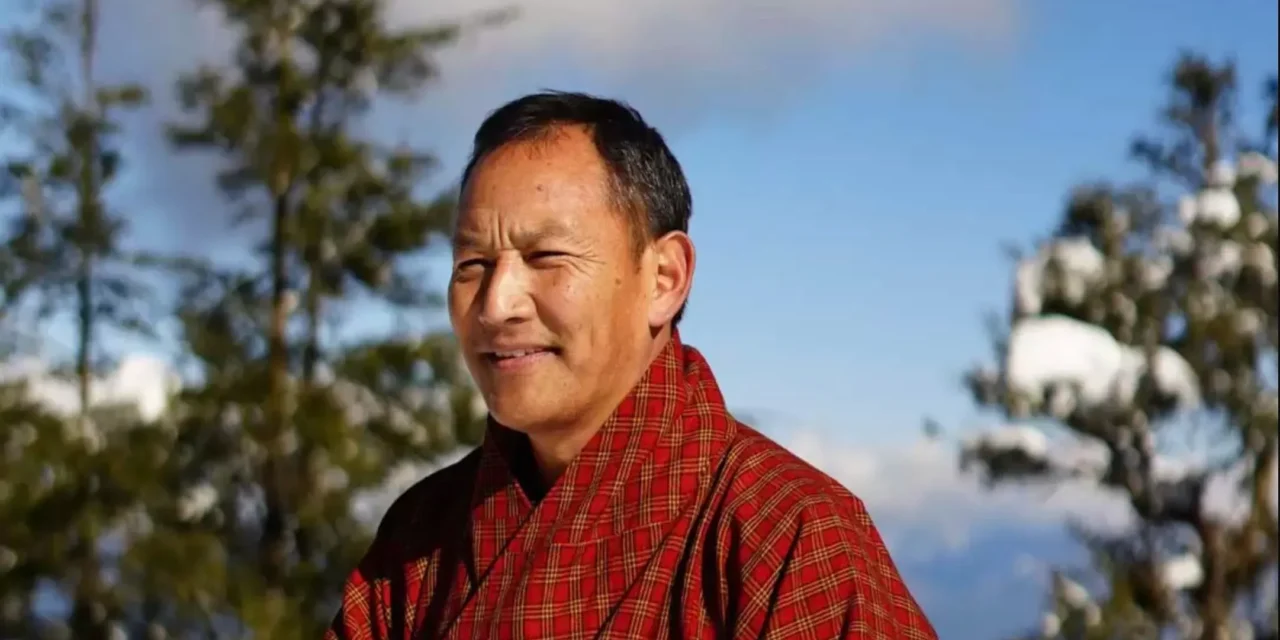
Lopen Karma Phuntsho is one of Bhutan’s most distinguished intellectuals, renowned for bridging the worlds of traditional Buddhist scholarship and modern academic research. After earning the title of Lopen after nine years of advanced monastic studies at the Ngagyur Nyingma Institute in India, he obtained a D.Phil in Oriental Studies from the University of Oxford. He has held research positions at the University of Cambridge and the CNRS in Paris, and is widely known as the author of The History of Bhutan. Phuntsho is a leading social entrepreneur and the founder of the Loden Foundation, supporting education and entrepreneurship.
You can listen to the rest of the conference on the SSUK youtube channel: https://www.youtube.com/watch?v=eohmmKpubwY
This post is also available in:
 Italian