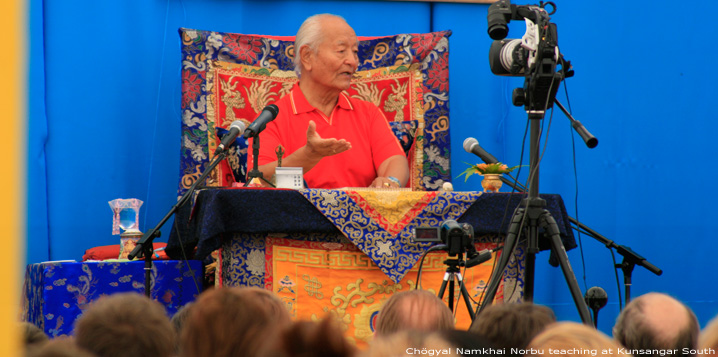
An excerpt transcribed from the Song of the Vajra Retreat, Hong Kong, 2012. May 18, day 4, part 2. Continued from issue 171 of The Mirror
Rinpoche quotes from “The Treasury of the Supreme Vehicle” composed by Longchenpa.
ཤེས་པ་གཅིག་པའི་དཔུང་རྣམས་བྱེད།
This refers to the unique state. All our mental concepts are infinite. In the Dzogchen teaching there is a famous expression, chig she kun drol, which means that when we discover one we discover all. For instance, if we wanted to discover everything that exists in the relative condition, even if we try life after life, we will never succeed. We need to discover our real nature. Our real nature is just like the symbol of the vajra. The vajra has a ball at the center, representing kadag the state of the dharmakaya. In this state there is not only emptiness but also the quality of self-perfection. The non-duality of kadag and lhundrub is the primordial state. When there are secondary causes then there are pure manifestations.
What are secondary causes? If we are in front of a mirror we are the secondary cause. If there is nothing in front of the mirror, nothing manifests. For something to manifest, a secondary cause is indispensable. It is the same in the pure dimension – when a being such as a yama is in front of the dharmakaya, the reflection of the yama will manifest in the mirror. This manifestation is called sambhogakaya and appears because the dharmakaya has that infinite potentiality. The secondary cause is the yama. Now, there is a sambhogakaya manifestation that can transmit that knowledge.
Even though we may have received the transmission, if we fall into dualistic vision, accepting and rejecting, then we produce negative karma and our samsara becomes heavier and heavier. So you see everything is related to the dharmakaya, the real condition. Even though what we see now with our dualistic vision, with our karmic vision of the human condition, is not the dharmakaya condition, its source is the dharmakaya. This is the reason we say chig she kun drol: when we discover one we discover all. Not only do we discover but when we realize and mature that state all its qualities also manifest.
You may have heard about the famous Dzogchen master Jigmed Lingpa. When he was young he became a monk in a small monastery where his uncle was living and studied writing, reading and the monastic pujas in a traditional way as well as a little astrology. That is all he studied and learned.
At a certain point they invited an important teacher to give Dzogchen teaching at the monastery and he gave some instructions on his terma, but Jigmed Lingpa didn’t understand very much about the teaching. The teacher explained that the first thing you should do is Guruyoga, which is very important for increasing your clarity. So Jigmed Lingpa learned that.
When he was a little older he asked his uncle if he could do a personal retreat and spent three years in a retreat place doing only Guruyoga although he didn’t really know how to do it in the Dzogchen way. His Guruyoga was more like the Anuyoga system. In any case he had profound faith and devotion.
After three years he had a vision of Longchenpa who gave him a special Guruyoga in more Dzogchen style and Jigmed Lingpa dedicated himself to it for many years and attained this chig she kun drol, when you discover one you discover all. He continued following many teachers in order to receive the lineage of the transmission in a more traditional way, however, after he had attained chig she kun drol he also had a lot of contact with Longchenpa through visions. He received the Dzogchen Nyingthig Yazhi in a traditional way as well as through visions of Longchenpa. The terma of the Longchen Nyingthig also arose in his mind and he became a very famous teacher.
Although he never really formally studied, he manifested intellectual qualities and wrote commentaries of important tantras and teachings. He also wrote the kinds of books that Tibetan scholars generally do not write because the topics are quite difficult. These books, for example, explain certain qualities of ancient statues as well as the connection between certain kinds of precious stones and the energy of the individual. These books are fantastic. These were all manifestations of his intellectual qualities. So although he never studied these things, with chig she kun drol everything manifested through his maturing of that knowledge. This is the reason why some very good Dzogchen masters and practitioners manifest many things without needing to study. When one is able to mature chig she kun drol, these kinds of qualities manifest.
There is also a great tertön called Jatsön Nyingpo whose terma teachings fill six volumes. In particular one of his teachings called Könchog Chindü is very diffused in the Kagyüpa and Nyingmapa traditions. He belonged to the Kagyüpa school but while he was growing up he applied Dzogchen teaching and when he received his terma teaching, he practiced that and also matured his capacity of chig she kun drol. Then the intellectual aspect of his writing manifested even though in his biography it says that he never had the opportunity to study. This is very important in the Dzogchen teaching.
ཤེས་པ་གཅིག་པའི་དཔུང་རྣམས་བྱེད།
So when we have this kind of capacity we can develop everything and, with practice, we can develop our integration with the Song of the Vajra.
ཡིད་ཅན་རྣམས་ཀྱི་སྐྱོན་རྣམས་སེལ།
All sentient beings have their characteristic karmic vision and produce their karma through their kind of specific vision. We, too, have this condition as humans and with our human vision we consider things to be very concrete and live in our human condition until we die. In general we are conditioned very much by this kind of attachment, but with a practice such as the Song of the Vajra our knowledge becomes concrete.
In a Sutra teaching the Buddha said that everything is unreal, which means that nothing concrete exists. He gave an example saying that everything is just like a dream, that life is a big dream from birth till death. We consider our life to be concrete and very important but Buddha makes us understand that it is just like a dream even though it is not easy to discover that.
People think that their lives are very concrete and even if they may consider life to be like a dream it doesn’t help. For instance, if I am extremely hungry and think, “Ah, this is just a dream” and I go two days without eating, I couldn’t live. Eating is something concrete for us because we have not matured this knowledge. First of all we should learn about this mentally, but when we are dying we will truly discover it is just like a dream.
For many ordinary people when they are dying first there is the experience of the bardo of the dharmata, which they may not notice. Then there is the bardo of existence when our mind starts to function according to the functions of the senses, without being dependent on the organs of the senses. Just like in a dream. The state of the bardo is just like the dream state in which we are judging and thinking, but at that moment most sentient beings do not know that they have died and are in the bardo.
For that reason, in the practice of Shitro, we introduce what is called the bardo ngotröd from the Tibetan Book of the Dead. First of all there are some words and mantras to call the consciousness of the dead person. Once we consider the consciousness to be present we read the bardo ngotröd which explains to the departed that they have already died because they no longer have a physical body, or a shadow. If they want to go outside they can pass through the wall, they don’t need to use the door because they are no longer dependent on their physical body. We explain that now that they have died and have no physical body it is useless for them to be attached to their life and what remains of their condition. Instead they should try to remember the teachings they have received or the contact they had with teachers and so on. There is a series of explanations to make the person understand that they have died.
Most beings don’t recognize that because they have a very strong attachment to their condition and still believe that they are living in their homes and so on. They try to talk to people but nobody replies because they cannot see beings in the bardo. Then they become angry or sad. Many sentient beings do not notice death and sometimes remain for many weeks that way due to their attachment.
Then every seven days after death, there is a process similar to dying again and again. It is not a heavy feeling like when you are dying and leaving your physical body. Now you only have your mental body and that, too, is passing. In the Tibetan tradition we do pujas and purifications for forty-nine days, seven weeks, for the dead. Each week on the day of the death, which is called dun tsig, we do an introduction to the bardo as some people still do not notice that they have died.
This is the condition of the bardo. So when you understand that you have already died and that you are in the state of the bardo, you realize that the human condition is just like a dream that no longer exists. In our lifetime when we are practitioners we know that, and when we are doing practice of integration, we should develop being in the state of contemplation more and more.
In particular when we do the practice of the night we don’t need to do anything complicated. There are many Tantric practices of the night such as dream practice and some very complicated methods, but in the Dzogchen teaching the practice of the night is very simple. We do Guruyoga according to the Atiyoga system, visualizing a white A in a thigle at the center of our body. Then we relax in that clarity and continue in that state of Guruyoga. We can do that practice when we go to sleep; the important thing is we remember to do it.
We may have the idea to do the practice of the night but always forget even though we may have a good intention to do it. In this case it’s important to have a picture of something like a white A in a thigle on the wall in the bedroom because when we see it we will remember Guruyoga and particularly when we are going to bed, we will remember the practice of the night. If we don’t have any problems sleeping we can do Guruyoga with the visualization of the white A in a thigle, and if possible we can also sound A to feel it more alive. If we cannot sound A we exhale deeply and simply do that visualization. After the visualization we relax in that presence and after a little while we continue in that state and fall asleep.
This is night practice in a very simple way. At the beginning it is not easy to know that there is a continuation of our presence. But even though we may not notice it we shouldn’t worry. The important thing is to do this practice and gradually, when we become more familiar with it, our condition in the dream changes.
In general we have many karmic dreams connected with our tensions. When we have tensions something remains in our condition and repeats when we are sleeping deeply. For instance, when we fall asleep, at the beginning we sleep deeply for one or two hours because we have been busy during the day and are tired, but after two or three hours our sleep gradually becomes lighter.
During our deep sleep karmic dreams may manifest connected with our tensions. For example, if we had some bad experience when we were young, we may often have a dream about it that is repeated. Or if something very heavy took place in our past life it may manifest frequently as a karmic dream in this life.
We may dream about a precise place and condition that we have never experienced in this life and this dream repeats two or three times, which means that it is a karmic dream of our past life.
Some people want to know more about their past life, however, the past is the past and people shouldn’t worry about it; the present is far more important. Now we are in our present condition and we should do our best. Sometimes we can understand a little about our past life in our present condition, but we don’t need to research it. About this the Buddha said that to understand what we did in our past life we should observe our actual condition, which is a product of our past life. If in our past life we did something good, we will have something good in this life. If we are born in this life in the human condition, possibly into a good family, our parents are good practitioners, for example, that means we did well in our past life. On the other hand, someone may be born into a very poor family, in a very poor country, with no conditions for enjoyment, so everything is related to our circumstances.
For instance, if someone is born in the Western world, they have some good cause because in most parts of the Western world people have an enjoyable life from birth. My birth in Tibet was not as enjoyable as birth in the Western world, but my parents were practitioners and there was Dharma in the country, which was really fortunate in spite of other conditions that were not perfect. If everything is perfect Tibet would have to be something like America. When I was at college for many years, until I was sixteen years old, we didn’t have watches or even know what a watch was. We had no matches for lighting our lamps. I grew up that way but today I am even using a computer. So this is our condition.
This means that the future depends on our actions in the present, so if we want to have total realization we should give importance to the present. Or if we want to be definitely, continually in infinite samsara we can also do that. Everything is in our hands now and this is very precious. For that reason we need to be present, not distracted. This is an important point.
ལུས་ཅན་རྣམས་ཀྱི་སྒྲིབ་པ་སྦྱོང་།
All sentient beings have their concrete dimension. For example, we are human beings with a human body which is produced by our karma. If we purified all the potentiality of our negative karma we couldn’t have a physical body, but this is what is called jalü, rainbow body. Under some conditions when the physical body disappears people call it jalü, rainbow body, however, the rainbow body can only be the result of a method such as the Dzogchen Upadesha. We have visions which are something like a reflection of our primordial potentiality. When we understand and develop that kind of vision, with certain methods we can succeed in integrating our physical body in that. This realization is the rainbow body.
When we consider the form of the rainbow body there is a very nice thangka of Guru Padmasambhava in which there are rainbow colored lights coming out of the center and filling the whole dimension of Guru Padmasambhava with this rainbow color. A lot of people think that it represents the rainbow body. The thangka was originally painted by a Sakyapa and because a lot of people thought it was very nice it also became diffused in the Nyingmapa tradition even though many Nyingmapa have no idea what the rainbow body really is. The rainbow body is not like that thangka.
If we consider the physical body of Guru Padmasambhava, it is an aggregation of the five elements, then his physical body manifests. But when it enters in its real nature, we can see the form and color of Guru Padmasambhava, everything is just like Guru Padmasambhava, the only difference is that Guru Padmasambhava’s rainbow body has no physical materiality. He manifests like rainbow colors. This is called the rainbow body.
When our physical body disappears, in Dzogchen teaching it is called lü dultren tengwa, which means that the physical body has become atoms. Finally the atoms enter the state of shunyata, as is explained in Madhyamika, so the physical body does not remain. We have a physical body due to our negative karma, which is why we call it a “karmic body.” Of course if we eliminated or purified our karma there would be no body, but this is not the same as the rainbow body. It is very important to distinguish that.
Edited by Liz Granger
Final editing and Wylie by Susan Schwarz
Tibetan script by Prof. Fabian Sanders
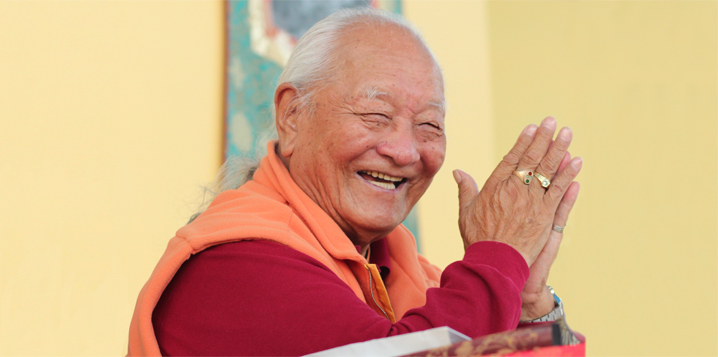
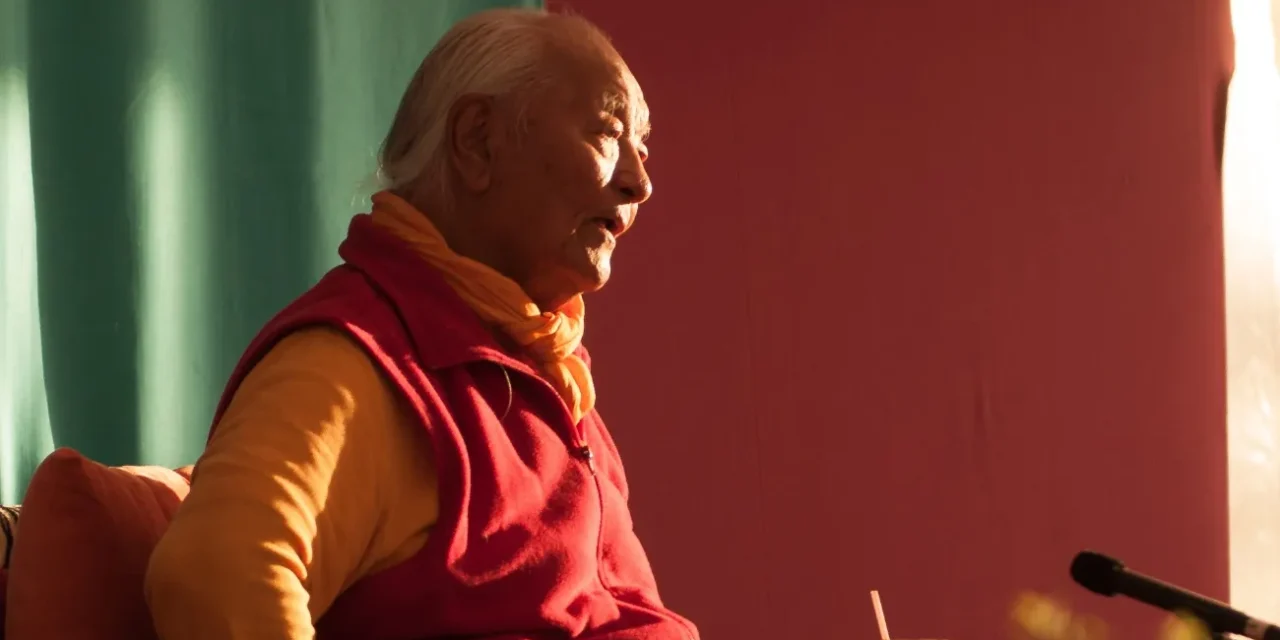
Photo of Rinpoche by Paolo Fassoli
You can also read this article in:
 Italian