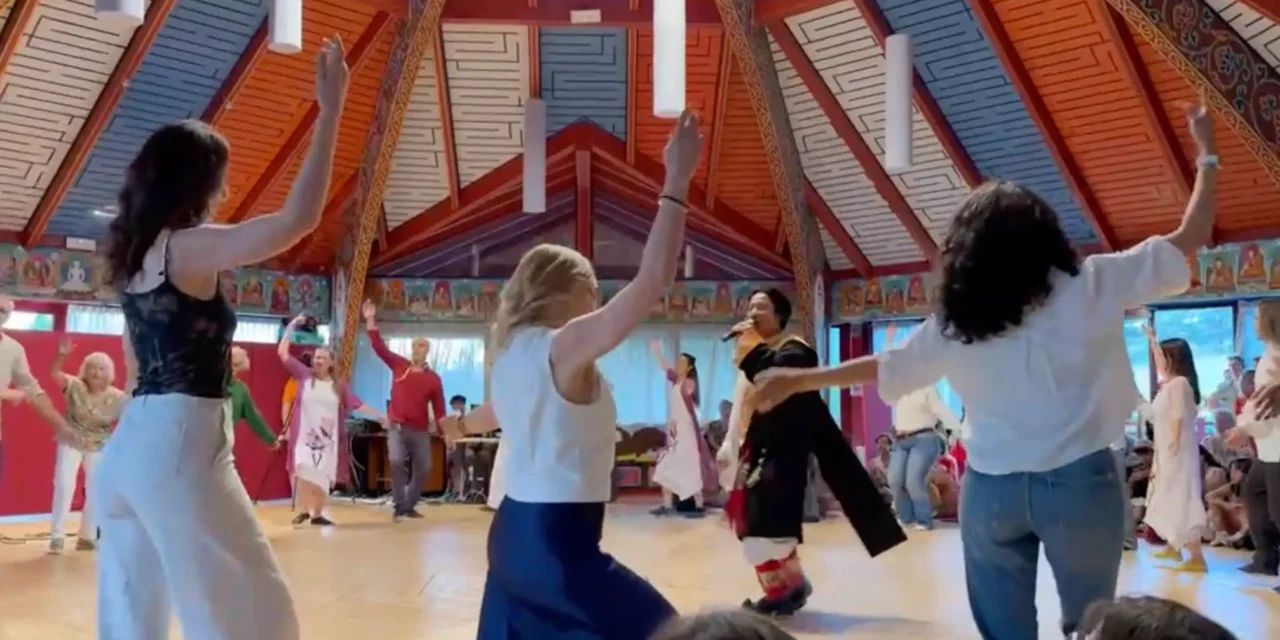
In the early evening of Saturday, July 25, 2026, roughly 250 adults and children gathered for the Merigar Dzogchen Community concert Lobsang Delek Live: Live Concert with Vajra Dance, Khaita Joyful Dance, Tibetan Dance, and Alessandro Di Maio on Live Electronics, at the Temple of the Great Contemplation, or Gönpa, of Merigar West, in Arcidosso, Tuscany, Italy.
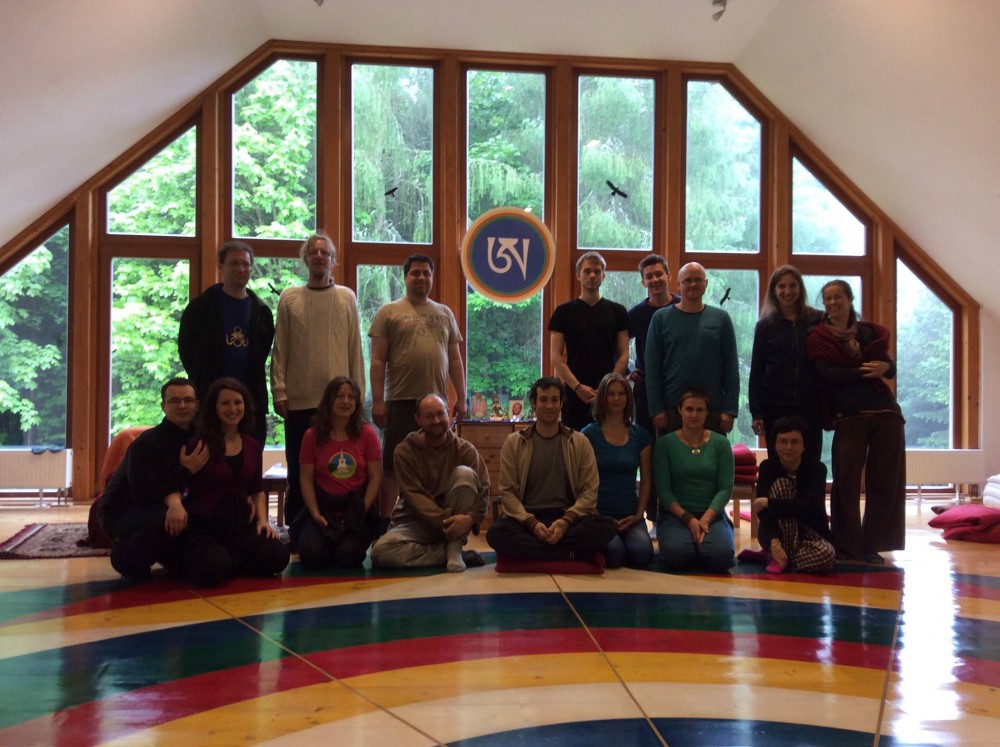
The Gönpa is a hand-painted octagonal temple made of wood, glass, and copper, located on a prominent rise that looks out over Merigar and its green surroundings. It was conceived, designed, and developed by Chögyal Namkhai Norbu, and so a fitting location for a tribute to His work on dance and music.
Professor Cristina Leonardo introduced the evening, noting that, “We will open tonight’s concert with a very special performance: a new version of the Dance of the Six Spaces, composed [and performed] by Alessandro Di Maio on the original basis created by Mikhail Malt, and developed under the supervision of Yeshi Namkhai. It will be released soon and will be available for purchase at the Shang Shung store.”
This accelerating version of the Dance of the Vajra that Benefits Beings (otherwise known as the Dance of the Six Spaces) was also performed at the June 20th Espírito Festival World Spiritual Music in Arcidosso, and it has proven challenging and illuminating for both the dancers who practice and perform it, as well as for observers habituated to the original tempo.
Here the intention is described by Cristina, “This new interpretation introduces an original element: rhythm. Through a gradual acceleration of tempo, the music accompanies the dance on a journey of increasing intensity, offering a fresh perspective on this practice while remaining fully respectful of its meaning and essence. In just a few moments, this new creation will come to life through the performance of dancers from the Dzogchen Community, led by Adriana Dal Borgo, whom we warmly thank for her invaluable dedication and work. We invite you to experience this dance with the same openness and attention with which it was created, allowing yourselves to be carried by the meeting of movement, rhythm, and sound.”
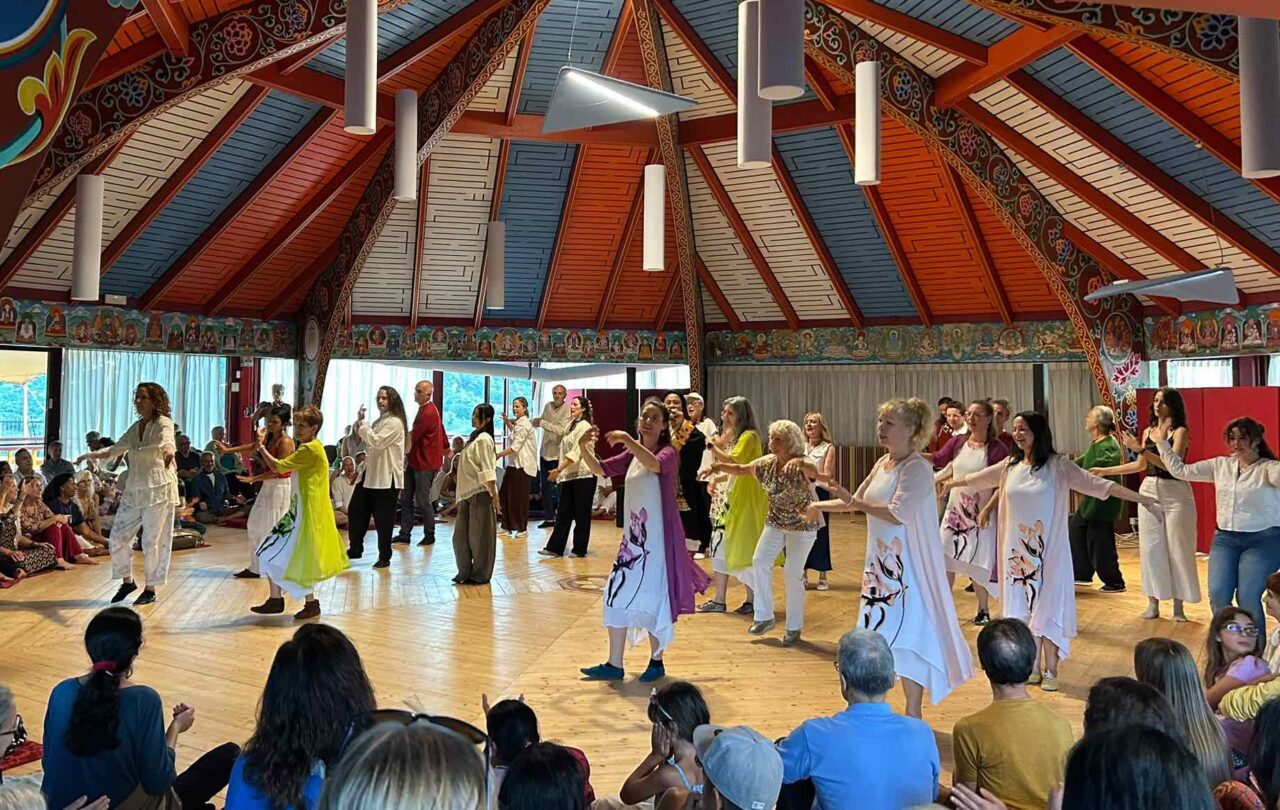
As the twelve dancers finished the dance with an A, and the audience showed its appreciation, several dancers removed the Vajra Dance mandala from the space. Then additional dancers joined them for the Khaita song Bhoe La Dro, sung live by the Tibetan and Himalayan singer, composer, and entrepreneur Lobsang Delek. According to the event page, “Born in Ganzi County, Tibet, Lobsang discovered his passion for music at the age of nine. After fleeing to India as a teenager, he studied at the Tibetan Children’s Village (TCV) in Dharamsala and later at Sarah College for Higher Tibetan Studies. During his college years, he released three acclaimed albums—Cuckoo, Tenzin Dolma Returns (2009), and Bhoe La Dro (2012)—which became beloved among Tibetan and Himalayan communities worldwide.”
Earlier Cristina had introduced Lobsang, saying, “Born in Tibet and now living in France, Lobsang Delek has devoted his life to music, transforming it into a bridge between cultures and a means of preserving a precious musical tradition. His songs speak of love for his homeland, longing, hope, and the beauty of Himalayan culture, touching audiences in more than eighteen countries. Tonight, his concert will be further enriched by the participation of the Khaita dancers, with whom he shares a special connection.”
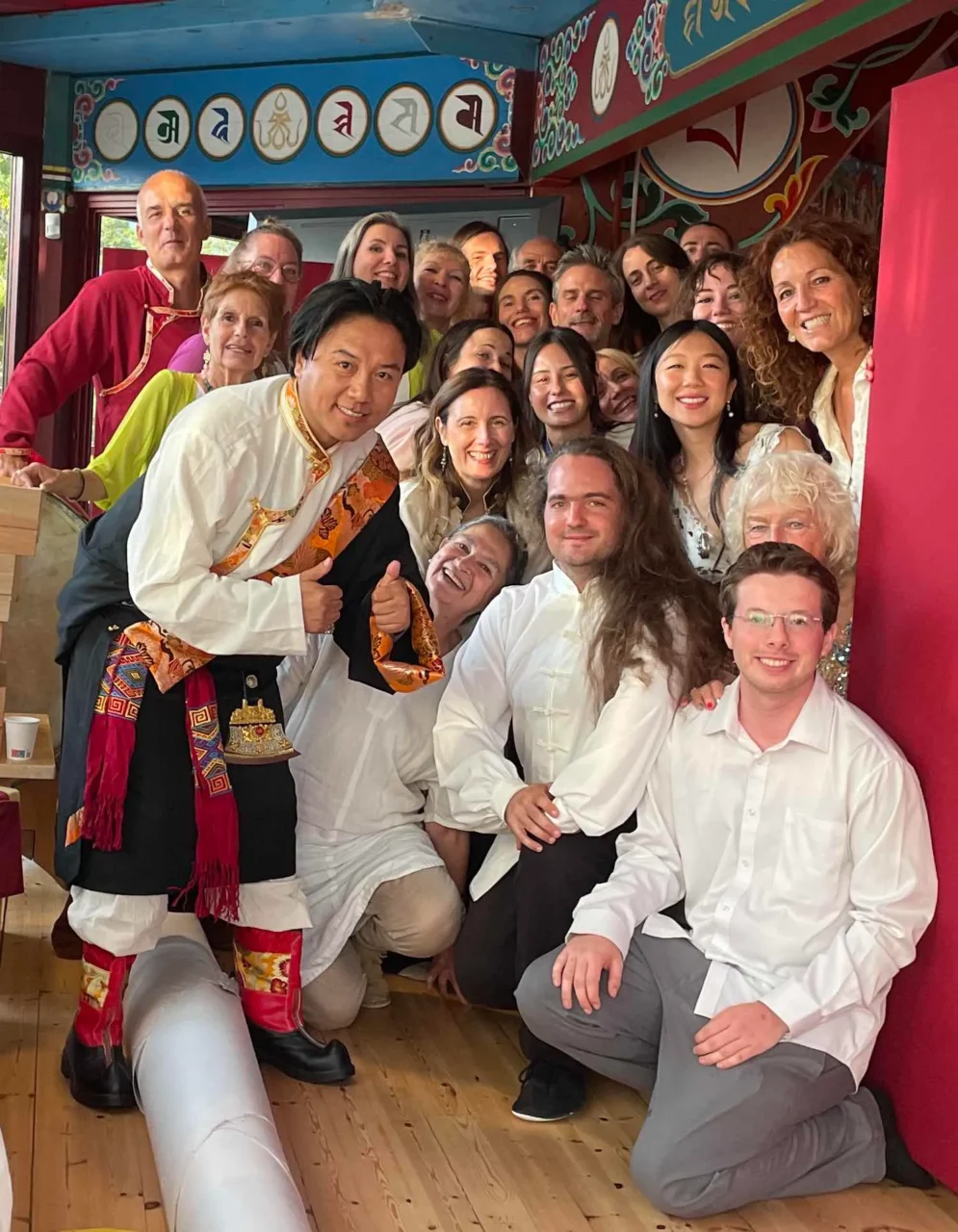
At the end of the live concert, which included many Khaita songs, dances, and moments of interaction between Lobsang, the dancers, and the audience, Lobsang expressed his gratitude, saying: “I’m very happy and fortunate that many of my songs were selected as part of the 108 [songs in Messages of Tibet] selected by the Master Chögyal Namkhai Norbu-La. I’m very, very honored, especially to perform in front of you guys. I’m very, very honored. Thank you so much. Thank you so much to your team.”
Towards the end of the evening composer, sound designer, and performer Alessandro di Maio, whose work has received several international awards, such as Best Soundtrack, Best Sound Design, and Best Newcomer Director, let the audience know that, “The main circumstance and reason why Lobsang is here is because, together with our Master Yeshi Namkhai, we are working on the development of a new music album, on the bardo. It is strictly related to… Chögyal Namkhai Norbu’s book On Birth, Life, and Death.” He went on to explain that, “Yeshi’s advice was that a very nice Tibetan singer was needed for one section of the album, therefore we connected with Lobsang, and we started talking, and we started the process of collaboration. Now he [Lobsang] finally came here. It’s actually his first time in Merigar. So it’s a very auspicious thing that he came here to collaborate with us. You will hear him in a completely different musical context, so it’s going to be interesting…The album will be announced relatively soon. Thank you very much. I hope you enjoy.” Alessandro later noted that this work is based in part on his own work of many years on the bardo, including a film of the same name.
At the end of the evening Alessandro invited everyone out onto the patio next to the Gönpa, where attendees enjoyed Tibetan momos, wine, and the sunset.
A. Caroline Hotaling
Arcidosso, Tuscany, Italy
Featured photo: Lobsang Delek surrounded by Khaita dancers. A frame from a video by John Shane.