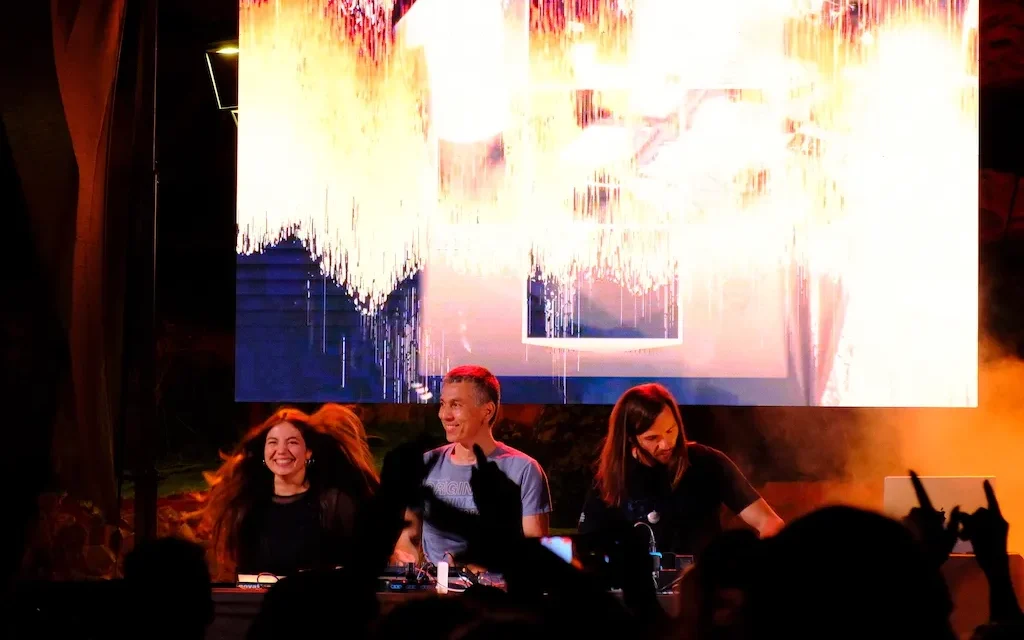
Performance by Yeshi Namkhai, Alessandro Di Maio, and Matilde Namkhai at the Espírito Festival World Spiritual Music in Arcidosso, Tuscany, Italy on June 20, 2026
“Wow evolution started again”
Over two hot and beautiful evenings almost 1000 people gathered in the Piazza della Riconciliazione at the foot of the ancient town of Arcidosso, Tuscany, Italy, for the Espírito Festival World Spiritual Music organized by Dynamic Space of the Elements and the Municipality of Arcidosso. The festival was timed to coincide with the annual retreat at Merigar, Confidence in Liberation with Namkhai Yeshi, and so a great many of the 850 Dzogchen practitioners who had come from all over the world for the annual retreat also attended the festival.
The two-day festival was ambitious and made possible by the support of Shang Shung Publications, Comunità Dzogchen Merigar, International Atiyoga Foundation, Conseil International de la Danse, Pro loco di Arcidosso, Embassy of India in Rome, Coop Unione Amiatina, and Dental Health Clinics.
Over the week preceding the performances, Yeshi Namkhai worked closely with International Vajra Dance and Khaita teacher Adriana Dal Borgo and a group of experienced Vajra and Khaita dancers to craft a new performance.
As the sun was setting on June 20th, the second evening of the festival, the open field below the cliffs was filled with 500–1000 people of all ages talking, laughing, fanning themselves, finding places to sit, taking photos and videos, running after children, visiting the food trucks, and standing on the stone walls surrounding the piazza.
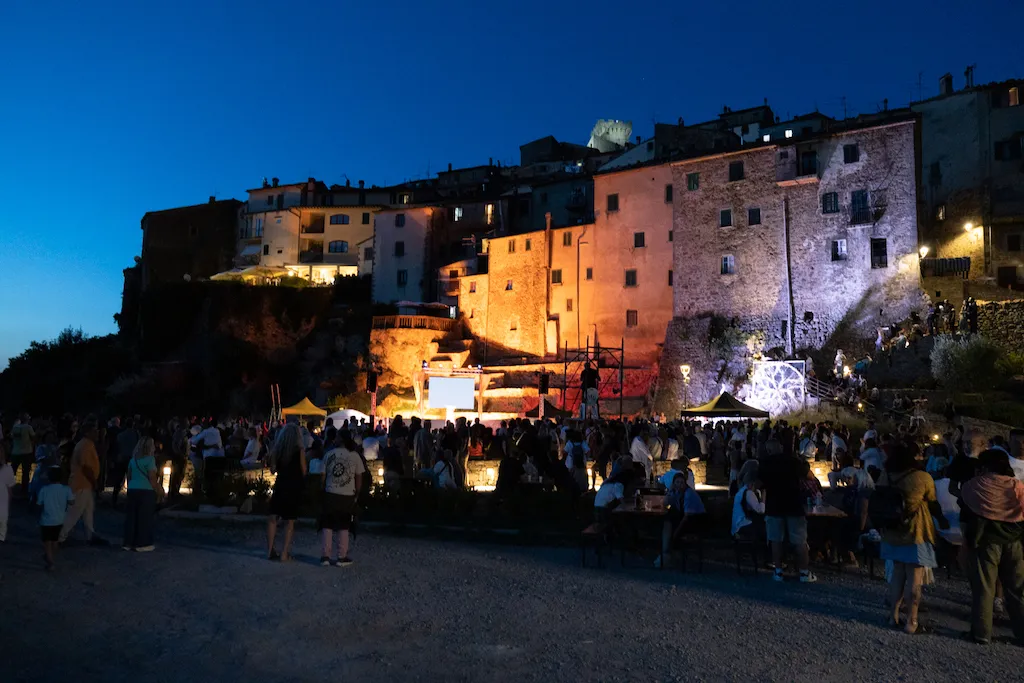
The scene was set by the impressive character of Arcidosso itself. The first documented mention of Arcidosso was in the year 860. The village sits on the side of the Amiata lava dome complex, remnants of a volcano which last erupted 300,000 years ago. The Piazza della Riconciliazione is an open plaza and performance area that lies below the western cliff edge of the medieval walled village of Arcidosso. The rock faces are lit from below, and punctuated by staircases cut into the stone and topped by stone houses, form an impressive backdrop to performances on the piazza. On the other side of the piazza, across from the cliffs and below a wooded hillside, runs the small highway which leads travelers down the western side of the Amiata slope, through the Etruscan homeland known as the Maremma, and out to the Mediterranean Sea at Grosseto.
It was in this environment that—following several other beautiful and evocative performances and during an introduction by Giulia Yangcen Mimaciren and Jaka Giacalone—a Vajra Dance mandala was rolled out onto a wooden dance platform below the stage. Then the dancers, in the silky Khaita costumes characteristic of Dzamling Gar, took their places in the triangles at the border of the mandala.
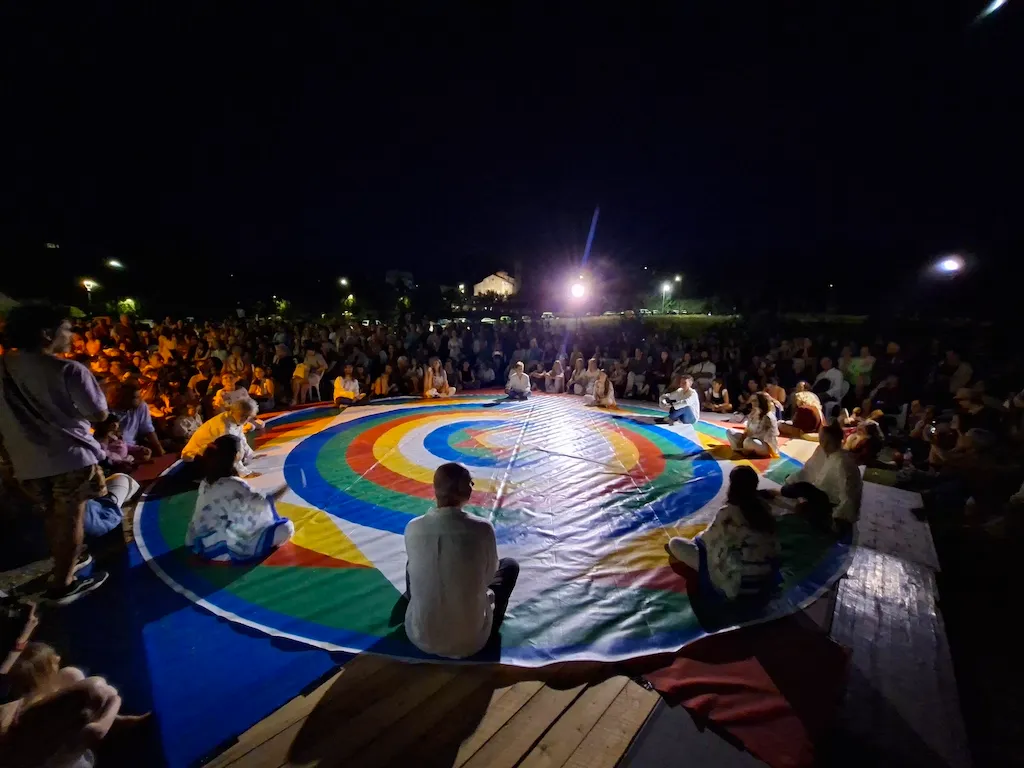
As the dancers arose to move into the position of the A to start the Dance of the Vajra that Benefits Beings (otherwise known as the Dance of the Six Spaces), Yeshi Namkhai, Alessandro Di Maio, and Matilde Namkhai began to play a complete Electronic Dance Music (EDM) rearrangement of the music for the dance from their position on the stage. Suddenly at the beginning of the fourth of six spaces, and much to the surprise of the many Dzogchen students in attendance, a faster beat was added to the music, and the dancers began to dance in accelerated time, moving rapidly around the mandala, even as the melody of the Dance of the Six Spaces remained the same. The beat accelerated again at the start of the seventh cycle of six spaces, and again at the start of the tenth cycle.
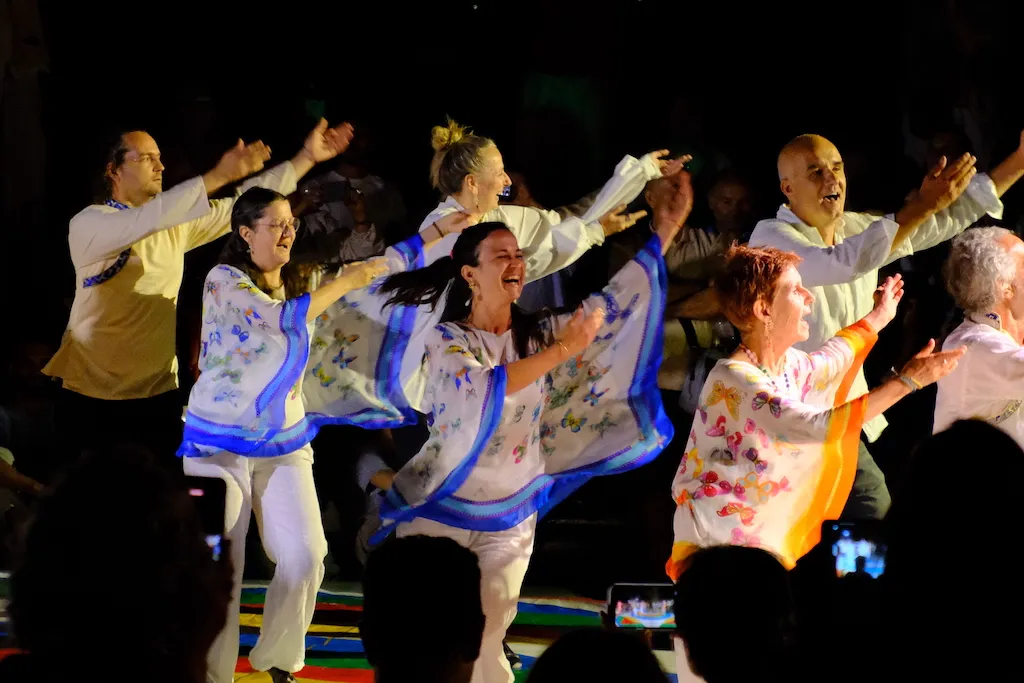
At the end of the Dance of the Vajra that Benefits Beings, Rosa Garcia Policreti and Sebastien Remy joined the practitioners, who remained on the open mandala, and everyone moved gently into a large “V” position to perform the three dynamic Khaita dances, Bod La Dro, Phayul, and Metog Sebla. At the end of the three beautiful Khaita dances the mandala was rolled up and moved backstage over the heads of the many people gathered at the edge of the dance space, and the dancers invited the entire gathered crowd onto the dance platform. The mood became ever more energetic and charged as the area filled and then exploded with the crowd dancing to the Electronic Dance Music (EDM) composition played by Yeshi Namkhai, Alessandro di Maio, and Matilde Namkhai.
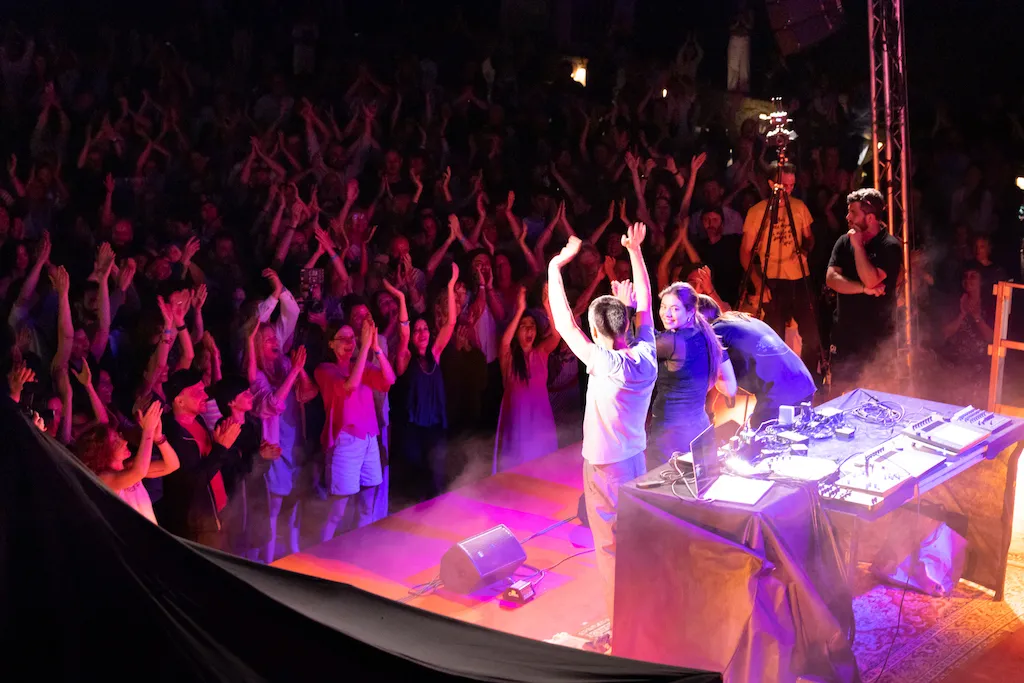
Yeshi Namkhai noted in the beginning of this performance that the music throughout the sequence was not a DJ set, per se, but a composition that was written and would be performed live, note by note. As described on the website for the festival: “The live set designed for the Espírito Festival is a continuous flow that integrates the typical dances of the Dzogchen Community with contemporary electronic sounds. The repertoire unfolds like an uninterrupted evolution: it opens with the active contemplation of the Vajra Dance, moves through the melodies of the Joyful Khaita Dances, and culminates in a live set of Electronic Dance Music (EDM). This approach embodies the concept of ‘Music of the Present Time.’
The electronic rhythms are not a simple playful interlude, but the culmination of the celebration through presence in the present moment: a moment in which the practice of integration, fundamental to Dzogchen teaching, unites with movement and dance, fluidly embracing the expressions of our time, keeping awareness alive and continuous. On stage, the performance will come to life through the performances of the Vajra Dance and Khaita dancers, while the musical component will be performed live by maestro Namkhai Yeshi, Alessandro Di Maio, and Matilde Namkhai. Enriching the sound architecture will be special field recordings from David Attenborough’s BBC archives, selected and processed live to celebrate his 100th anniversary. Through this modern and layered musical language, they will create a direct expression of the integration of presence in the present moment and movement.”
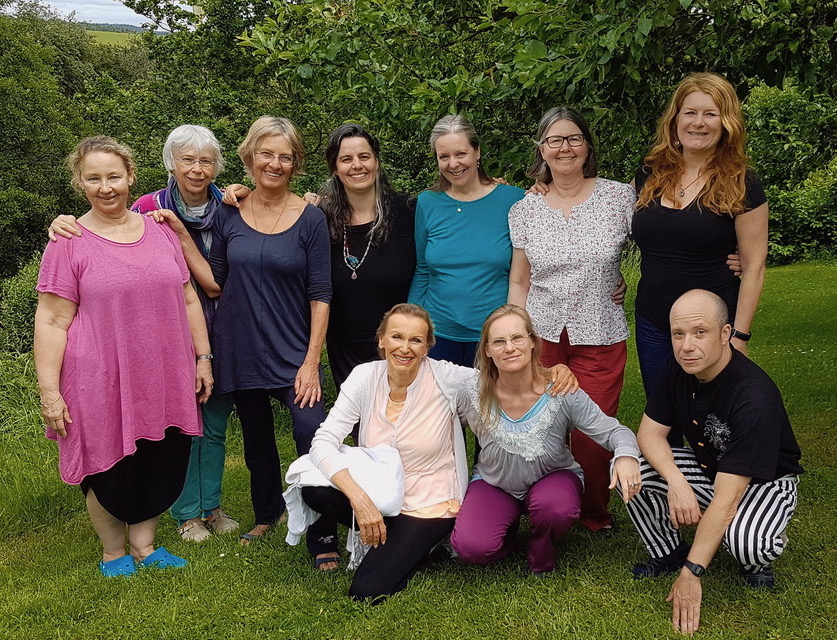
The Vajra and Khaita dancers, some of whom can be seen in the post-performance photo below, included international teacher Adriana Dal Borgo, Nicola Cassano, Clotilde Hubert, Monika Marcik, Piotr Marcik, Rosa Garcia Policreti, Tibor Puškar, Sebastien Remy, Christiane Rhein, Angelica Siedlecki, Maciej Sikora, Gioia Tondo, Tamara Vinokhodova, and Petra Zezulková.
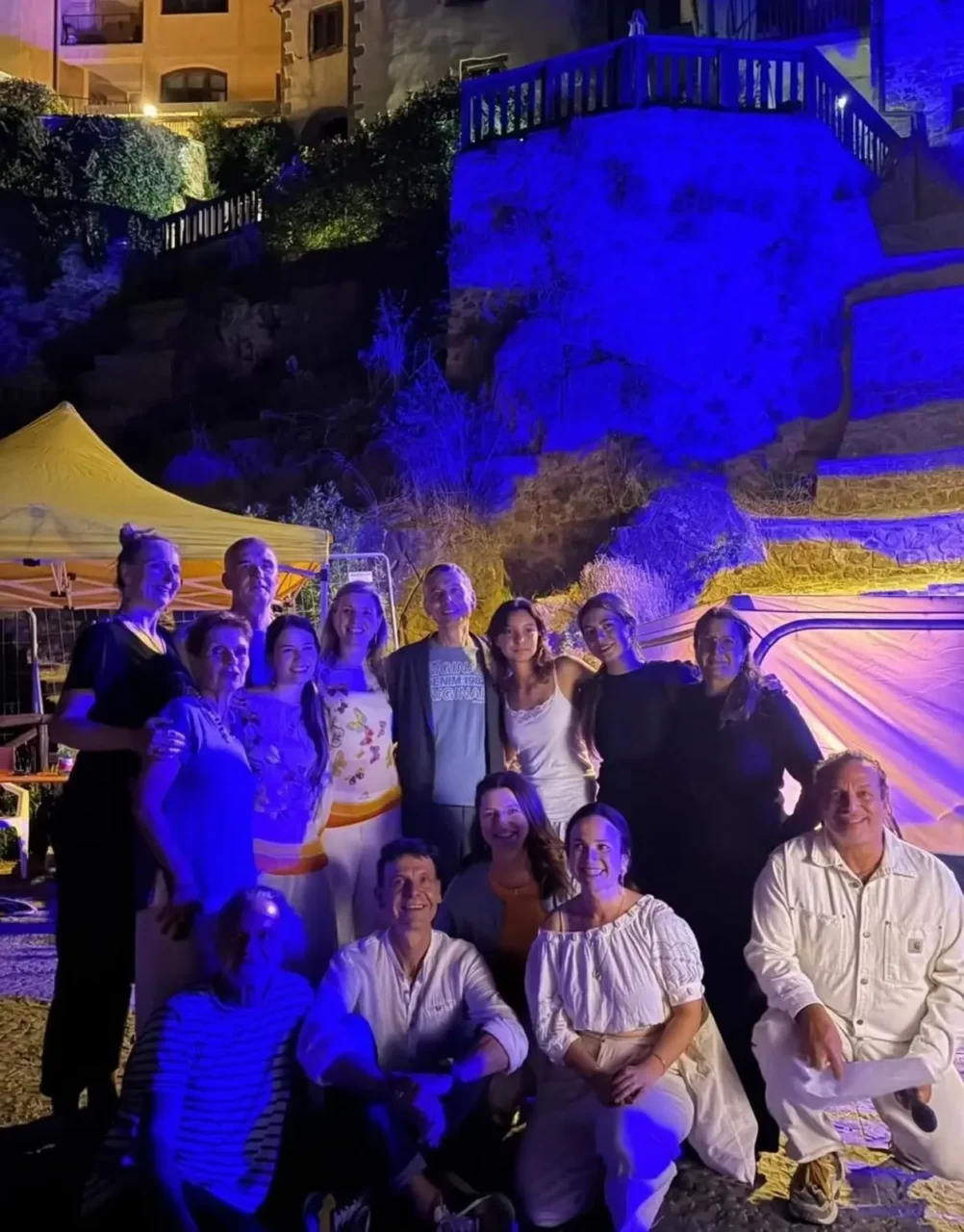
The dancers reported that the accelerated movement broke any hypnotic movement that was going on, brought joy to the process which translated into joy during subsequent dancing, and in general gave the dancers a lot to work with in the week before the performance. They found it difficult at first to increase the speed of the Six Spaces steps, and then each dancer found their own way into achieving the accelerated steps. Likewise, the dancers later noted that each personal style of dance seem to resonate with different people watching the dance. The testimonies below and sidebars describe some of the dancers’ processes.
“Yeshi Namkhai, in this particular collaboration, has opened whole other dimension with [the] musical part, destroying concepts we all have, including the one with Vajra Dance”; Petra Zezulková
“Today with Yeshi Namkhai was something amazing. We did not understand the idea of the acceleration in the Vajra Dance of the Six Spaces. We needed to discover how to make steps with much higher speed with the prediction. We were not able to be perfect with all movements, but with indications from Yeshi Namkhai, we should be on the rhythm and not interfere with other dancers. So the first try was not so good, but after dancing all the set of Khaita and then all the 20 minutes of Yeshi Namkhai, Matilde Namkhai, and Alessandro Di Maio, of various types of dance music, we tried again the Dance of the Six Spaces with open minds, no rules, free, connected with the rhythm, and aware of other people on the mandala. The result was a new free dance of the Six Liberations, on the mandala but with the settings of Yeshi Namkhai’s rhythm, and speeding up of the rhythm. After this experience dancing a set of three Khaita dances was a wonderful, joyful experience. It is hard to put into words because all the experiences went beyond ideas and words;” Monika Marcik
“Wow, evolution started again”; Nicola Cassano
“Then that night, Adriana figured out the key to following the sequences of the Dance of the Six Spaces ‘ to the rhythm of a waltz,’ as Yeshi Namkhai had asked. The next morning she explained it to us, we applied ourselves—and we experienced something completely new. Although we were still uncertain and a bit off-balance, the moment we picked up speed was a veritable explosion of joy, a whirlwind of energy—we began to fly!” Christiane Rhein
“The word that kept coming back to my mind was flexibility. A Dzogchen practitioner should master the ability to adapt to circumstances; for those who practice the Dances, this is perhaps even more essential. Yet it is far from simple or automatic. For me, this experience became a true teacher in this respect. It dismantled certainties and expectations, showing that it is possible to dance while soaring together, with confident steps and in harmony at the same time, as circumstances change (speeding up and slowing down of the rhythm). Thanks to the dedication and joyful collaboration of all the dancers, the short but intense training gradually dissolved doubts, resistance, and uncertainty. In the end, entering the flow of the music as one body, the dance became our offering to the Master”; Adriana Dal Borgo
On behalf of Dynamic Space of the Elements, Davide Boni noted that the Espírito Festival managed to achieve the results they were aiming for: creating an event where various spiritual traditions connect with music, and offering so many people the chance to connect with these traditions and spiritualities. He said organizing it was a wonderful challenge; it was a great experience, though very demanding. They received a fantastic response from so many volunteers, friends, brothers, and sisters who contributed significantly and decisively to the event’s success. They want to continue developing and advancing the Espírito project, finding new opportunities for it to grow, and intend to repeat the event next summer and improve upon it; we hope the circumstances will be right for another successful festival.
Dynamic Space of the Elements expressed their deep gratitude to the city government of Arcidosso, to the Mayor Jacopo Marini—who is passionate about this and contributed greatly to the event—and to all the volunteers and collaborators. Special thanks go to Emanuel Lopez and Giovanni Boni, who were very involved throughout. Finally Dynamic Space of the Elements expressed special gratitude to Maestro Yeshi Namkhai for playing a pivotal role in the event’s conception, creation, and realization, including a beautiful concert.
In addition, there is a possibility that a recording of part or all of the EDM composition will be made available in the future from Shang Shung Publications.
Performers and presenters at Espírito Festival included:
- June 19, 2026:
- Coro Madrigalisti Senesi, European traditional music
- Ivan Ceci, Lakota flute from North America
- Alessandro Cipriani, contemporary audiovisual art
- Bismani Huni Kuin, Amazonia, South America
- Ati Sphere, Dj set and VJ set
- June 20, 2026:
- Dr. Youdon Tsering, Conference on Tibetan Medicine
- Migmar Tsering, Tibetan Geomancy book presentation
- Il Piccolo Coro della Terra, Children’s Choir of the Amiata (region)
- Gianni Ricchizzi & Saraswati House Ensemble, Hindustani, India
- Urna Chahar-Tugchi, Ordos, Mongolia,
- Marcel Caprise, African tradition of Benin
- Yeshi Namkhai, Alessandro Di Maio, & Matilde Namkhai, Mandala Dance and live Electronic Dance Music (EDM), including Vajra and Khaita dancers
- Ati Sphere, Dj set and VJ set
Article by A. Caroline Hotaling, June 26, 2026
Featured photo by Daniyal Ibragimov
Testimony of the dancer Tibor Puškar:

“It was an interesting journey from start to finish. First and foremost I’m grateful for all the masters of the lineage who made it possible for us to engage with these profound practices. Then, I’m indebted to my dear Petra and Clotilde who invited me to dance with you all, and who helped cultivate my crazy mind on the mandala and on the limitless Khaita dancefloor.
It was the first time I danced in such high intensity and with such a determined group, and that brought a lot of different experiences… Luckily, I felt accepted and free from the start, which made the whole journey pleasant and joyful. I enjoyed every moment of it, from the hard rehearsals, interesting conversations, new friends made, all the way to the shocking rehearsal with Yeshi Namkhai, which I’m sure everyone will remember for some time.
When it came to the culmination, the performance, I felt as if the Sun of compassion and freedom was at the center of the mandala, and that we all got to offer it to all beings through these sacred dances. There isn’t much more to say, I’m beyond lucky to have had the opportunity to dance with such amazing people.”
Testimony of the dancer Gioia Tondo:
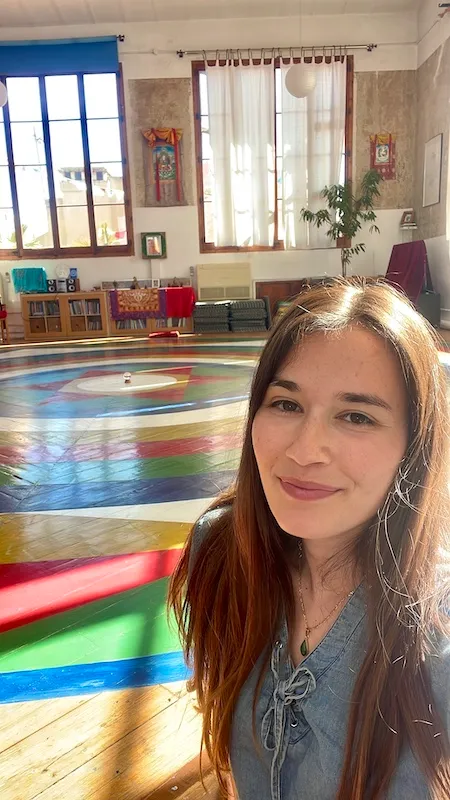
“The first few times I danced the Six Spaces with the new music, I felt a kind of energy building inside me—it wanted to burst out, but it always remained just potential. When we finally rehearsed with Yeshi Namkhai, he stopped us as soon as we started the fourth sequence to tell us we were not dancing in the right rhythm.
From the master’s instructions, I had understood that it wasn’t important to do the right steps at that moment, but to land on the color at the right time and not to bump into anyone. So, I decided to follow the rhythm. Dancing at that rhythm set me free. It broke my mental patterns.
I drew a metaphor from this experience: when we begin the dance in the mandala at the usual pace, it’s as if we’re preparing to be present—like a warm-up. When the rhythm suddenly accelerates, it’s the same feeling I get when I step out of the mandala after a Tun and return to my ordinary life: everything is more chaotic, and it’s easier to bump into one another while trying to reach our destination. But the practice is precisely about integrating presence into different speeds and uncertainty of daily life to avoid causing problems and suffering to ourselves and others.”